
It’s not often that a handful of yellowish fragments lying quietly in the desert end up plunging scientists back into questions about ancient disasters and planetary violence. For decades, Libyan desert glass sat in museum drawers, scattered across remote areas of North Africa, and was sometimes cut into jewelry that once belonged to ancient Egypt’s elite. The latest examination of a microscopic mineral encased within adds another layer of unease to an already shaky picture. The evidence does not point in one direction. Rather, it suggests conditions so extreme that familiar geological processes begin to seem inadequate, even strained.
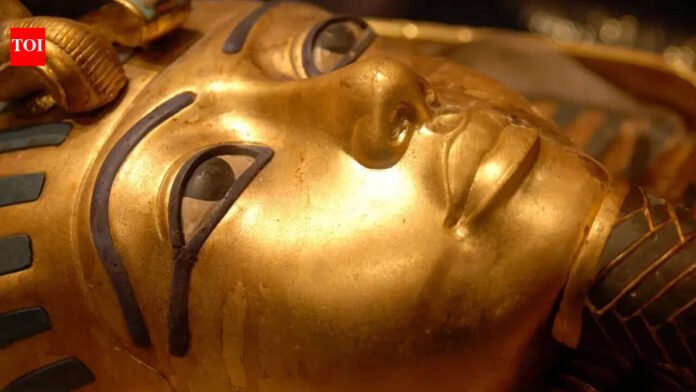
King Tutankhamun: The ancient mystery of Libyan desert glass from a royal tomb
In parts of eastern Libya and western Egypt, the glass appears almost randomly at first glance. Smooth, yellow and unusually clean compared to the surrounding sand, it has long been considered an outlier in the landscape. Ancient craftsmen apparently valued it, turning it into decorative items that later ended up in royal tombs, including items related to Tutankhamun.Modern geology has never been entirely sure how it got there. The material itself looks simple, being essentially silica that has been transformed into natural glass. The difficulty lies in explaining the power required to achieve this on a large scale across vast desert areas without leaving a visible scar on the Earth’s surface.
What’s hidden in the alien-like glass?
According to research published in Meteoritics & Planetary Science, titled “New evidence on the formation conditions of Libyan desert glass (western Egypt): clues from dendritic zircon inclusionsIn one sample, scientists used high-resolution imaging to discover something that would have been easy to miss without closer inspection. Tiny zircon grains that are barely visible even under magnification are retained within the glass.It’s not just its survival that’s remarkable. The internal structure exhibits a branching pattern, almost tree-like, as if the crystals were growing rapidly under conditions that did not allow for stable, orderly development. The texture suggests a brief window in which the material behaves more like a fluid than a solid, then locks into place before anything settles.Chemical differences between the trapped material and the surrounding glass suggest they don’t exactly share the same history during cooling. Although they eventually fuse into the same final structure, the conditions under which they were recorded appear to be slightly different.
extreme heat events and rapid cooling recorded in zircon
Temperature estimates based on the state of the zircon suggest a brief period of intense heating that was hot enough to melt minerals normally thought to be resistant to such changes. The numbers in question are much higher than those typically found in volcanic environments.Even in the most extreme volcanic eruptions on Earth, lava flows tend to be well below that range. Here, condition means something more sudden and unstable. The mineral appears to have completely melted and then crystallized again almost immediately, skipping the stages that would normally leave clearer signs of the transition.It’s not just the temperature that’s striking, but also the speed of change. The structure shows that heating and cooling occur within a narrow window, giving the material little chance to react gradually.
Why Libyan desert glass still lacks confirmed impact site
For decades, one of the sticking points in explaining Libyan desert glass has been the lack of a confirmed impact site. If a large asteroid hit this area, it should leave a crater large enough to be identified. Several candidates have been proposed over the years, but none have withstood scrutiny.This gap keeps the debate alive. Some explanations tend to directly affect events. Others believe that a smaller object entered the atmosphere and explosively broke apart before reaching the ground, releasing enough energy to heat the surface without leaving lasting scars.