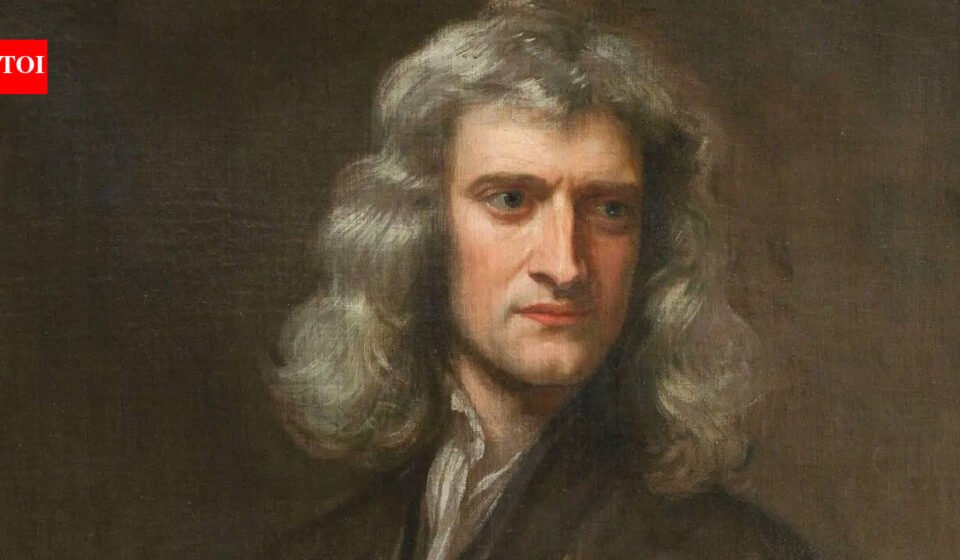
Isaac Newton’s quote of the day: “A man may imagine wrong things, but he can only understand things that are true.” |

Most people know Isaac Newton as the man associated with the story of the falling apple, although historians still debate how much of the story is fact and how much is legend. What is indisputable is that Newton spent much of his life trying to answer a question that still challenges humanity today: How do we know whether something is actually true?This question lies quietly behind one of his little-known quotes: “A man may imagine false things, but he can only understand true things.”This sentence seems simple. It contains neither complex scientific language nor mathematical formulas. However, the more one thinks about it, the more relevant it seems. Newton pointed out a fundamental difference in the way humans think. We can invent almost anything we imagine. Understanding, however, is another matter entirely. Understand the rules. It will eventually come into reality.
Isaac Newton’s Quote of the Day
“A man may imagine false things, but he can only understand true things.”
The mind is a wonderful storyteller
Humans have always been storytellers.Long before satellites photographed the Earth from space, people imagined the world beyond the distant horizon. Before scientists understood lightning, many cultures explained it through mythology and supernatural forces. Before the advent of modern medicine, disease was often blamed on causes that sound strange or even ridiculous today.These ideas don’t come about because people are stupid. They try to make sense of a world that still holds many mysteries.Imagination is very powerful. It helps people dream about the future, create art, invent technology and solve problems. Without imagination, there would be no novels, no great paintings, no scientific breakthroughs.But imagination comes with a trap. It doesn’t care whether an idea is correct.One can imagine a treatment that is ineffective. Investors can imagine business success that never materializes. Politicians can imagine that a policy will succeed despite evidence to the contrary. The ability to imagine something does not make it a reality.This is where Newton drew the line.
Reality has the right to vote
One of the reasons scientific discoveries are important is that they must come into contact with reality.An engineer can sketch a bridge on paper, but ultimately the bridge must bear the weight. Scientists can develop a theory, but experiments must support it. Pilots can be confident that the aircraft’s design is feasible, but the final conclusion is made when the machine leaves the ground.Reality often exposes the weaknesses of assumptions.Newton understood this better than most. He lived at a time when science was changing the way people saw the world. Rather than accepting an explanation simply because it sounded convincing, he looked for evidence. Observation is important. Testing is important. Evidence matters.This approach helped transform human knowledge in a way that still persists centuries later.His quote reflects the same mindset. Ideas are plentiful. The truth is more demanding.
Why does Newton’s quote feel so modern?
Although Newton lived in the seventeenth century, his words are oddly appropriate for the twenty-first century.Every day, people encounter thousands of claims online. Some are accurate. Some are misleading. Others are complete fabrications. Information spreads at an alarming rate, often reaching millions of people before anyone checks whether it is correct.Social media makes imagination run faster than ever before.Rumors can make headlines. Guesses can appear as certainties. An opinion can spread widely despite having little evidence to support it.In this context, Newton’s observations feel less like historical quotes and more like practical advice.It encourages pausing before accepting something as fact. It serves as a reminder that believing a claim and understanding a claim are not necessarily the same thing.
The disturbing side of the truth
There is another reason why this saying remains so enduring.The truth is not always convenient.People naturally prefer information that confirms existing beliefs. Psychologists have spent decades studying this trend. We are often attracted to evidence that supports our views and less interested in evidence that challenges our views.History is full of such examples.Many people once believed that the Earth was at the center of the universe. Others believe certain illnesses have supernatural causes. Time and time again, widely accepted ideas collapse when faced with better evidence.This process can be uncomfortable. No one likes discovering that a long-held belief is wrong.Yet progress depends on this willingness.Growth in knowledge requires people to follow evidence, even if it leads to unintended consequences.
More than just a lesson about science
It is easy to view Newton’s quote as a statement about laboratories and experiments. In fact, it applies to everyday life as well.Consider personal relationships. People often think they know why someone behaves a certain way. They create explanations in their heads, fill in missing details, and draw conclusions based on limited information.Sometimes these conclusions are correct. Sometimes they are not.The same pattern appears in workplaces, businesses, and everyday decisions. People imagine outcomes, motivations, and possibilities. Sometimes these assumptions match reality. Sometimes, they don’t.Understanding requires more than assumptions. It requires evidence, experience, and a willingness to revise opinions as new facts emerge.This principle is as useful at the dinner table as it is in the research lab.
Why Isaac Newton’s Quotes Still Matter
Many quotes stick around because they sound smart. Newton’s words have survived for different reasons. They describe things that people encounter repeatedly throughout their lives.The gap between imagination and understanding never disappears.Let the kids experience it. Scientists have experienced it firsthand. Business leaders have experienced this. Society as a whole has experienced this. Humans are constantly moving between what they think may be true and what is actually provable.The process is rarely tidy. Mistakes will happen. Assumption fails. Expectations collide with reality.Yet this is how knowledge grows.
Final Thoughts on Isaac Newton
Isaac Newton spent his life studying the natural world, but this quote is also about human nature. Thoughts can wander almost anywhere. It can create endless stories, possibilities, and interpretations. This freedom is one of humanity’s greatest strengths.At the same time, true understanding demands more of us. It requires us to test ideas, question assumptions, and focus on evidence even when it challenges our preferences.Centuries have passed since Newton lived, but the challenges he alluded to remain unchanged. People still imagine false things. They always will. The more difficult task is to recognize which ideas survive contact with reality. This is where understanding begins, which is why this quote remains influential long after the person who said it is dead.