

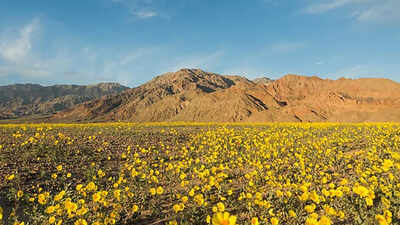
Southern California has had an unusually wet winter this year. Storm after storm came in, flooding cities and even the driest desert valleys. Now, moisture begins to show its effects in a quieter, more colorful way. Wildflowers bloom in desert landscapes that often look harsh and lifeless. Visitors to Death Valley National Park have discovered patches of yellow, purple and orange scattered across the sand.Still, experts remain cautious. The flower looks promising and even impressive in places, but many say it hasn’t yet reached the stunning size of a true “super flower.” Time, temperature and wind patterns all play a role. Rain alone doesn’t tell the whole story. Currently, Southern California seems to be enjoying above-average blooms and it feels special, even if it stops right there in its desert history.
Death Valley presents ‘super boom’ prospects in 2026
Even Death Valley, known for being one of the hottest and driest places on Earth, receives about twice as much rainfall as is typical for the season. This sounds like the perfect super bloom fuel. Experts say the separation between storms is more important than raw totals. Seeds need early moisture, steady rainfall throughout the winter, and mild warmth in the spring to survive. Sudden heat waves or strong winds can dry out fragile plants before they can spread throughout the landscape.The term “super bloom” gets thrown around a lot. Erica Newman, an ecologist at James Madison University, said these events typically occur about once every decade and depend on a complex set of factors. Rainfall is only one piece of the larger puzzle, but soil, temperature and germination clues are also important. She reportedly noted that strong winds alone can damage young plants and prevent the blooms from spreading across the vast landscape associated with the classic superflower. Climate change adds another layer of uncertainty, subtly altering the seasonal patterns that plants have relied on for centuries.
Death Valley’s location makes it the “hottest place on Earth”
Death Valley is a large tectonic basin located primarily in Inyo County in southeastern California. It is widely considered to be the lowest, hottest and driest region in North America. The valley stretches about 140 miles (225 kilometers) from north to south and is between 5 and 15 miles (8 and 24 kilometers) wide. Mountains frame the landscape, with the Panamint Range extending to the west and the Amargosa Range’s Black Mountain, Funeral Mountain, and Grapevine Mountain forming its eastern boundary. The valley is located near the transition zone between the Great Basin and the Mojave Desert.The desert doesn’t usually reveal its color that easily. Most years, scattered blooms appear and then fade quickly. This season feels different. The latest from park officials, including the National Park Service, says blooms have begun in lower elevations and may continue into mid-to-late March. Roads such as Badwater Road and Highway 190 reportedly provide some of the best early displays. This unpredictability is part of the charm. If conditions permit, flowering at higher elevations may occur later, into April or even June. This staggered timing often leaves visitors lingering, hoping to see the desert’s peak.Rainfall totals this winter appear to be unusually strong. Downtown Los Angeles has received well above average rainfall since October. The percentages in nearby Burbank were even higher than normal.
Desert wonders in 2016 continue to influence bloom expectations
Many observers still compare each bloom to the famous 2016 event in Death Valley. That year, vast swathes of desert transformed into vibrant fields visible for miles. Attendance surged as visitors rushed to witness the rare spectacle.Interestingly, rainfall totals before flowering are not particularly high. The key appears to be well-timed early storms followed by favorable spring conditions. This year’s flowers may be felt more strongly in remote areas. However, the broad, landscape-scale coverage that defines superblooms has not yet been fully achieved. Visitors are already sharing photos of poppies, desert gold flowers and tiny purple flowers blooming in the sand.