
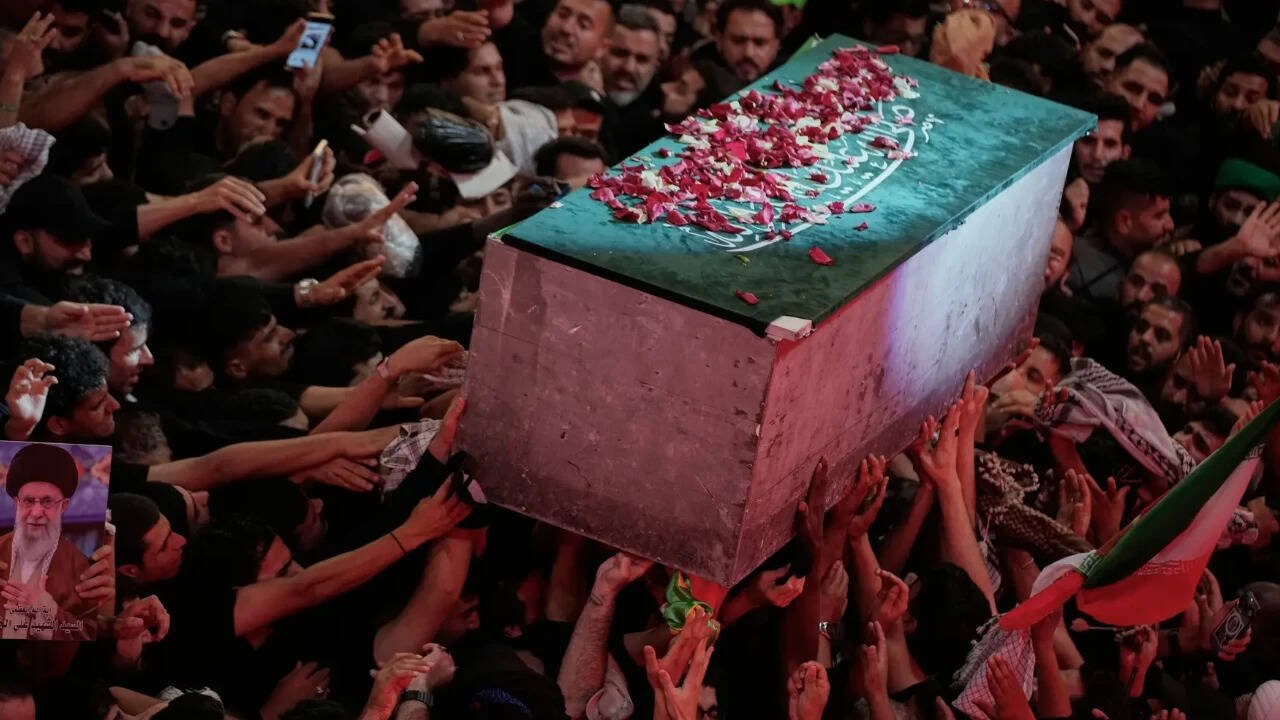
Iran used the funeral of slain supreme leader Ali Khamenei to stage an elaborate display of regional influence, religious symbolism and diplomatic class, and to send a message to allies, rivals and friends through recitations of the Quran.The funeral, which traveled through Tehran, Qom, Najaf and Karbala before finally being held in Mashhad, was as much a political spectacle as a religious ceremony. Iran uses it to tell its public that the country can still unite the country in victory and sorrow; to reassure allies that Tehran has not surrendered; to show major powers that it is not broken; and to remind adversaries that it is keeping score.
Quranic verses as diplomatic signals
As the Saudi delegation came forward to pay their respects to Khamenei’s coffin in Tehran’s Grand Mosalla, the Qur’an that followed was Imran 3:13 – a passage that describes the Battle of Badr, in which a vastly superior Muslim force routed a much larger army “by the will of God.” This is an apparent reference to what many are increasingly calling Iran’s victory over the United States and Israel in their war against the country.Read generously, this verse symbolizes Islam’s first victory and the memory of a shared civilization between Tehran and Riyadh. But given Saudi Arabia’s quiet alliance with the United States during the war and reports of secret Saudi attacks on Iran, the tone of the sentence took on a more pointed tone.For the Axis of Resistance, Hamas, Palestinian Islamic Jihad, Hezbollah, the Houthis, the Iraqi Hashid al-Shaabi and the Taliban, the selected verses share a common theme: martyrdom, unwavering commitment to God and victory.Hamas was greeted with a poem describing a people that “have proven their fidelity to God’s promise.” Hezbollah verses promise “true believers” to “prevail.” The Houthis received verse 29 of Surah Al-Fath, a passage about loyalty and discipline. Hashd al-Shaabi in Iraq heard the well-known saying: Those who “are martyred in the cause of God” do not die, but live.For the second recitation of Russia, China, India, and Egypt, the verses are decidedly calmer and more about justice, assurance, and reward than war. Russian verses speak of “the eternal home of the Hereafter.” China was more conciliatory: “Victory comes only from God.” India received the same “Do not waver or grieve” verses as Hezbollah, although there were no surrounding verses about martyrs.The first readings in Qatar, Türkiye, Pakistan and Egypt were somewhere in between, praised, welcomed but not considered part of the resistance camp. Qatar has also received the same “clear victory” verse as Palestinian Islamic Jihad and the Taliban, but in a diplomatic context its meaning has been significantly softened. The Turkish verse places “those who have fought with their wealth and lives” above “those who remain”.“For the Lebanese state, Iran used chapter 66 of Anisa: “If we ordered them to sacrifice themselves or abandon their homes, no one would obey except a few. It would certainly be better and more secure for them if they did as advised.”Read in context, this verse sounds like a rebuke. Critics accuse the Lebanese government of failing to do enough to resist Israel’s occupation of the country, while attacking Hezbollah for retaliatory attacks on Israeli forces.
Funeral in Iraq: Showcasing regional influence
The decision to hold funerals in Najaf and Karbala, Shiite Islam’s holiest sites, has deep religious symbolism. The coffins of Khamenei and several family members, who were killed in the US-Israeli attack on February 28, were brought to Najaf on Tuesday and transferred to Karbala on Wednesday.Iraqi officials declared a public holiday and organized transportation for mourners. Iranian state media said more than 2 million people attended in Najaf and more than twice that number were reported in Karbala, but the figure could not be independently confirmed.Esmail Qaani, commander of the Quds Force of the Islamic Revolutionary Guard Corps, said that the funeral procession in Iraq will “make the red line of revenge more prominent” and “further strengthen the unity and determination of the Iraqi and Iranian people against the US conspiracy.”The rituals allow Iranian officials to link Khamenei’s legacy to holy sites in Najaf and Karbala, while also seeking to bolster the religious legitimacy of the Islamic Republic and his successor, Mojtaba Khamenei.