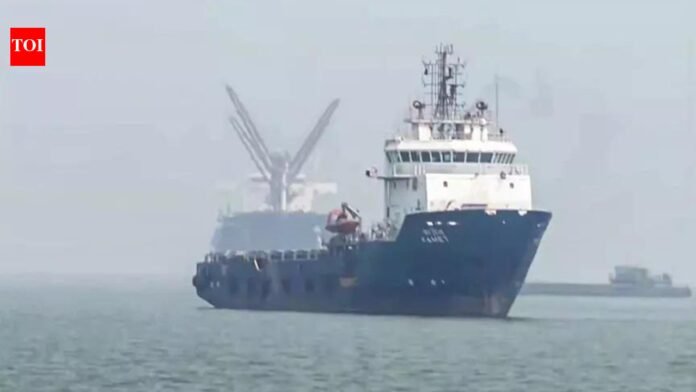
NEW DELHI: One of the first crude oil tankers to cross the Strait of Hormuz has reached Mumbai port since the Iran-US conflict broke out.The Liberian-flagged oil tanker Shenlong Suezmax docked at Mumbai Port at 1 pm on Wednesday and at Jawahar Dweep at 6:06 pm, news agency ANI reported. The tanker loaded crude oil from Saudi Arabia’s Ras Tanura port on March 1 and departed on March 3.The vessel is carrying 1,35,335 tons of crude oil and will be supplied to the refinery in Mahul, east of Mumbai. The crude oil discharge process is expected to take approximately 36 hours.The tanker is owned by Shenlong Shipping Co., Ltd. and managed by Dynacom Tanker Management Ltd of Athens. The ship has a crew of 29, including Indians, Pakistanis and Filipinos, and the captain is Indian.How ships cross the Strait of HormuzMaritime tracking data shows that the ship stopped in the Strait of Hormuz on March 8 and then temporarily broke away from the tracking system. According to ANI, the ship switched off its Automatic Identification System (AIS) transponder while sailing in a high-risk section of the strait.After sailing through a high-risk area, the ship reappeared in the maritime tracking system on March 9. Shipping companies often use this tactic, also known as “darkness,” to avoid the risk of being targeted or tracked.The transponder is a mandatory maritime VHF radio system that automatically broadcasts a ship’s identity, position, speed and course to nearby ships and shore stations to prevent collisions and improve navigation.Earlier, IRGC Navy Commander Alireza Donsiri said ships seeking to pass through the waterway must obtain Tehran’s approval. He said in a post on X that two ships that ignored Iran’s warnings were targeted on Wednesday.“Can these ships safely pass through the Strait of Hormuz? This question should be asked of the crews of the ships “Rome Express” and “Mayuri Nari” who today believed in empty promises, ignored warnings, intended to cross the Strait of Hormuz, and were caught. Any ship intending to pass must obtain permission from Iran,” the Iranian general said.Iranian state media reported that Tehran had tightened restrictions on shipping through the strait, while saying ships that did not serve U.S. or Israeli interests would be allowed to pass safely.The Strait of Hormuz is one of the world’s most important maritime chokepoints, with more than 20 million barrels of crude oil passing through the narrow strait between Iran and Oman every day – accounting for about a fifth of global oil consumption and nearly a quarter of seaborne oil trade.Meanwhile, the Ministry of Ports, Shipping and Waterways said that 28 Indian-flagged vessels are currently operating in the Persian Gulf. Among them, 24 ships carrying 677 Indian crew members are located to the west of the Strait of Hormuz, while 4 ships carrying 101 Indian crew members are located to the east of the Strait.The ministry said the 24-hour control room of the ministry and the Directorate General of Shipping has been operational since February 28 to monitor the evolving situation and coordinate assistance if needed.The authorities are also working with the Indian Embassy, ship management companies and recruitment agencies to ensure the safety of Indian seafarers in the area.
Into Darkness on Shadow Voyage: How India-bound Ships Cross the Strait of Hormuz

WEB DESK TEAMhttps://articles.thelocalreport.in
Our team of more than 15 experienced writers brings diverse perspectives, deep research, and on-the-ground insights to deliver accurate, timely, and engaging stories. From breaking news to in-depth analysis, they are committed to credibility, clarity, and responsible journalism across every category we cover.
Related articles
Recent articles