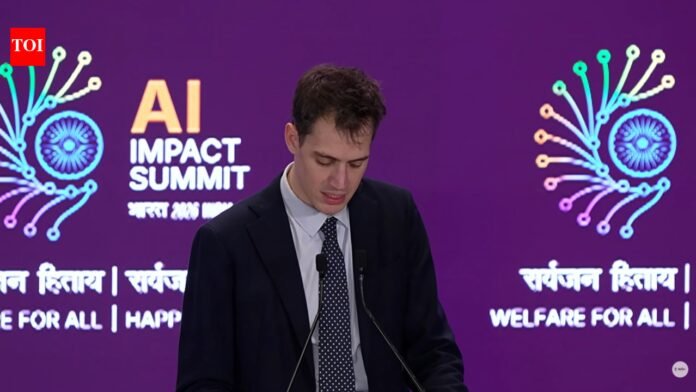
NEW DELHI: For years, Europe watched its best artificial intelligence researchers migrate to the United States. India faces the same challenge – top engineering and computer science talent continues to flow into Silicon Valley. Arthur Mensch, co-founder and CEO of French startup Mistral AI, said reversing this trend is at the heart of the global race for artificial intelligence. “Like Europe, India is also sending talent to the United States,” Mensch told The Times of India in an interview. “The more talent you can retain locally and create value, the better.” Founded in 2023 by Mensch, Guillaume Lample, and Timothee Lacroix, Mistral AI aims to challenge the opaque, closed nature of “big AI” and make cutting-edge models more accessible through an open architecture. In just three years, the company has scaled rapidly, reaching a revenue run rate of $400 million and on track to surpass $1 billion soon. As of last year, it was valued at $14 billion. But for Mensch, the AI race is more than just business. This is structural and geopolitical. With Europe relying heavily on overseas digital infrastructure, especially hyperscalers in the United States, Mistral chose to build its own capabilities. “We don’t position ourselves as a sovereign alternative. We position ourselves as a global competitor in the AI race,” he said. “But tactically, to have fully controlled capacity, you need infrastructure – the servers running the technology.“ About 60% of Mistral’s business comes from Europe and 40% from the rest of the world. Some customers choose its platform precisely because it can be deployed on their own infrastructure, reducing reliance on hyperscale. He believes that sovereign artificial intelligence is both a strategic necessity and a political necessity. As artificial intelligence begins to dominate much of the global economy, governments and defense systems cannot risk external control. For companies, over-reliance can weaken negotiating leverage and continuity. India, which has one of the largest developer pools in the world, had a similar inflection point. “We have brought many European researchers back to Europe. India also has a unique opportunity to do the same. Universities here produce great talent in artificial intelligence and computer science. “The focus should be on making sure they innovate and create value here,” Mensch said. Mistral is currently establishing commercial partnerships in India, and the next step may be to establish a local technology center. While competitors such as OpenAI and Anthropic are exploring the IPO path, Mensch said a listing is “in the works.” Profitability and global scale will be prerequisites. Mensch believes that enterprise AI adoption has largely been met with setbacks because companies view GenAI as a collection of tools rather than a transformation of a platform. Early chatbot deployments focused on improving productivity. “This doesn’t change the bottom line,” he said. Instead, Mistral focuses on high ROI use cases that address major sources of business friction. At the core of its strategy is open source. “If you have access to the model parameters, you can deploy anywhere you want – including on-premises infrastructure,” Mensch said. The open model also allows for customization. “Running a business should not mean over-reliance on a single service provider. I have said it many times – Europe cannot become an American AI colony.”