
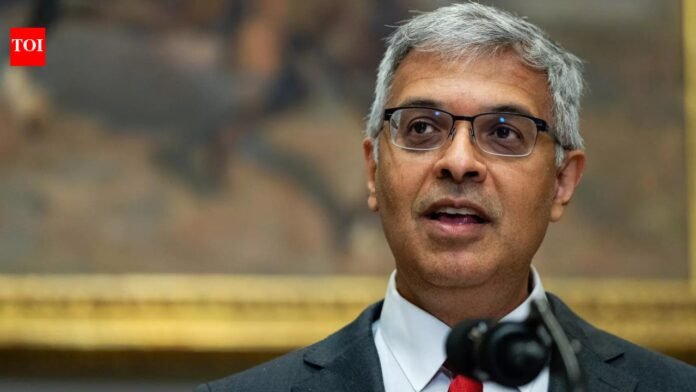
TOI reporter in Washington: In a comprehensive effort to solidify federal health leadership, President Donald Trump Appointed Dr. Jay Bhattacharya, director of the National Institutes of Health (NIH) and an Indian American, to lead the Centers for Disease Control and Prevention (CDC). The move marks the first time an individual has led both the nation’s premier medical research institution and its leading public health agency, marking an unprecedented step in U.S. public health leadership amid continued turmoil in the scientific establishment. The White House sees the decision as a necessary step to synchronize federal health policy, a dual-role strategy that administration officials say is designed to bridge the gap between biomedical research and public health implementation. Bhattacharya succeeds Jim O’Neill, who will lead the National Science Foundation (NSF) after its director, Dr. Sethuraman Panchanathan, resigned amid deep funding cuts. Dr. Jayanta “Jay” Bhattacharya, 57, is a physician and health economist with a decades-long background at Stanford University. Born in Calcutta, he immigrated to the United States as a child, eventually earning four degrees from Stanford University, including an MD and a PhD. He earned a PhD in economics with a focus on health economics and disadvantaged populations before becoming a tenured professor there. His research emphasizes the impact of aging populations, chronic disease, and government programs on well-being.Bhattacharya came into the political spotlight in 2020 when, as a co-author of the Great Barrington Declaration, he opposed widespread COVID-19 lockdowns and advocated for “focused protection” of the elderly while allowing the young and healthy to live their lives normally. His opposition to vaccine mandates and censorship from officials like Dr. Anthony Fauci pushed him into the MAGA orbit. He has since framed his views as opposing “politicized science,” in line with Trump’s agenda to reform institutions and restore trust in public health.This stance put him in direct opposition to the public health establishment of the day, leading former NIH Director Francis Collins to call him a “fringe epidemiologist.” The career blow solidified his standing within the MAGA movement, which viewed him as a courageous dissident against “medical overreach.” Now positioned as the nation’s No. 1 health official, Bhattacharya faces a daunting task. Although he expressed support for standard childhood vaccinations during a Senate hearing, he took over the CDC, whose vaccine schedule has been aggressively scrutinized and multiple tasks reversed under Surgeon General Robert F. Kennedy. Supporters, however, hailed it as a step toward decentralizing power, increasing funding for innovation, and addressing chronic conditions like obesity and autism in the United States through Trump’s “Make America Healthy Again” initiative, within a broader global focus on infectious diseases.Critics, however, worry it will advance Kennedy’s vaccine-skeptic agenda, exacerbating outbreaks of preventable diseases amid funding cuts, staff layoffs and policy rollbacks at both agencies. They also point to the logistical challenges he will face in managing the $50 billion budget of the NIH in Bethesda, outside Washington, D.C., on the one hand and more than 10,000 employees at the Atlanta-based Centers for Disease Control and Prevention (CDC), which has a $10 billion budget on the other. Bhattacharya’s tenure at the NIH has already seen budget freezes and an exodus of experts, raising concerns that divided leadership is hampering efforts to address new threats. But for ordinary Americans, the shift in leadership could signal a reduction in federal mandates and a continued emphasis on “medical freedom” and personal choice.