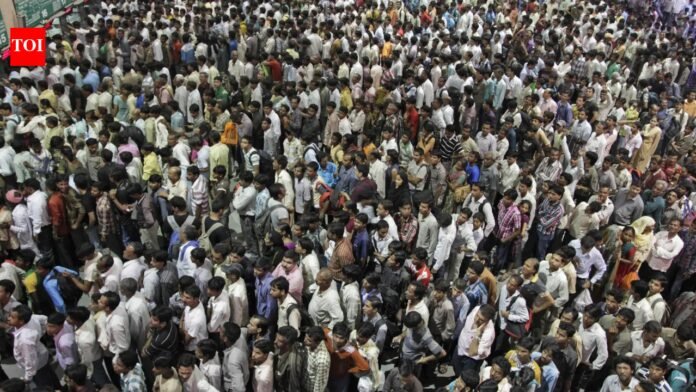
NEW DELHI: Counting every person in a country of over 1.4 billion people is not an easy task. India is currently gearing up for one of the world’s largest census exercises – the 2027 Census.The national census was originally scheduled to be conducted in 2021, in line with the ten-year census cycle that India has conducted since 1881. However, the Covid-19 pandemic and subsequent elections repeatedly delayed this work.
Despite the delay, the upcoming census is expected to be one of the most comprehensive ever. The government has announced that the census will include a caste census and for the first time the entire process will be conducted in a paperless digital format.According to the government, around 3 million field staff will be deployed for data collection, monitoring and supervision and Rs 11,718.24 million has been allocated for the exercise.why this is importantThe census holds up a national mirror, reflecting changes in demographic identities, occupations, living conditions and family structures. The data also help the judiciary, policymakers and researchers track trends in immigration, urbanization, employment and fertility.Sectors from education to rural development rely on census data to identify where schools, primary health centers and infrastructure projects are needed. Population figures also influence central allocations to states and districts and the distribution of subsidies and ration supplies.The census will take on additional political significance as it will form the basis for the delimitation of Lok Sabha boundaries, a process that has been frozen since 2002. The Women’s Reservation Bill, which reserves one-third of the seats in the Lok Sabha and state assemblies for women, is also likely to come into effect after the census and subsequent delimitation exercise.How will the 2027 Census be conducted?According to the government, the exercise will be carried out in two phases – house registration and housing census, followed by census.First stage: The housing inventory exercise will collect data on 33 parameters, including building materials, drinking water, sanitation, household assets and cooking fuel sources. This information will help build a detailed profile of housing conditions and amenities across India. The New Delhi Municipal Council (NDMC) will start listing houses from April 15.Second stage: The second phase will focus on personal demographic data including name, age, gender, date of birth, relationship to head of household, marital status, education, occupation, religion, caste or tribe, disability status and immigration history.Enumerators will record details about everyone, including homeless people, ensuring the database captures demographic and socioeconomic information.The data will then be centralized and released in stages – first provisional population totals, then detailed tables broken down by multiple indicators. The process includes quality checks, revalidation and auditing to ensure accuracy.What’s different this timeThe 2027 Census will be India’s first fully digital census, using mobile apps, online self-census and near-real-time monitoring systems.This secure web-based portal will enable eligible family members to complete their data in 16 languages. Once submitted, a unique self-census ID will be generated, which enumerators can later verify during a field visit.“The current effort is to provide the upcoming census data in the shortest possible time across the country. There will also be efforts to disseminate census results through more customized visualization tools. The data is shared with everyone till the lowest administrative unit i.e. village/district level,” the government said.The Ministry of Home Affairs said that adopting a digital platform will reduce paperwork, increase efficiency and increase transparency in the census process.The event launched four digital tools designed to modernize census operations:\
House Listing Block Creator (HLBC) Web App: A web mapping platform that enables officials to create blocks of home listings using satellite imagery for standardized geographic coverage.HLO mobile app : A secure offline application that allows enumerators to collect and upload house listing data directly from the field using registered mobile devices.self enumeration portal : A web-based platform that allows households to voluntarily submit census information online prior to physical verification.- Census Management and Monitoring System (CMMS) Portal: A centralized dashboard for real-time planning, management and monitoring of census activities across district, state and national levels.
caste censusIt is also the first project since 1931 to collect caste data for all communities. Caste censuses were a regular feature of censuses during the British rule from 1881 to 1931. However, with the first post-independence census in India in 1951, the government chose to discontinue the practice, except for Scheduled Castes (SC) and Scheduled Tribes (ST).However, with the first census of independent India in 1951, the government chose to discontinue this practice, except for Scheduled Castes (SC) and Scheduled Tribes (ST).“Questions for the second phase, including caste, will be notified before the second phase of census operations begins,” the home ministry said in a statement.“Several representations have been received from various organizations in different states, including Tamil Nadu, regarding the caste census. Questions for the second phase, including those on caste, will be finalized and notified as per the laid down procedures,” it added.The decision marks a major shift after more than 70 years of hesitation.delimitationThe 2027 census has also reignited the debate over the demarcation of parliamentary constituencies. The government is likely to start the delimitation process once the final census data is released. Parliament needs to pass a delimitation bill to establish a delimitation commission.The committee will finalize the population-to-constituency formula in consultation with stakeholders, including state governments.However, increasing the number of seats in the Lok Sabha requires a constitutional amendment, which must be passed by a two-thirds majority in Parliament.According to Article 81 of the Constitution, the total number of seats in the Lok Sabha shall not exceed 550.The issue remains politically contentious, with some southern states arguing that delineation based purely on population could reduce their representation in parliament.Southern states have had better population control over the past few decades than many northern states, raising concerns about potential North-South political imbalances.The DMK government in Tamil Nadu had previously passed a resolution opposing census-based delimitation.What experts sayNabhnipa Bhattacharjee, professor of sociology at Delhi University’s Sri Venkateswara College, told The Times of India that delaying the census could affect policy planning.“This is a big delay. Even if the entire exercise ends in 2027, the data may not arrive at ministries until late 2027 or early 2028, so there is limited time to design targeted welfare policies,” she said.Bhattacharjee added that delimitation, digital infrastructure, caste enumeration and conduct of census jammu and kashmir Ladakh after the abrogation of Article 370 will be one of the key issues to watch.“The key question is how the government handles the demarcation issue after the census, particularly as it has sparked a north-south debate. Introducing numerical enumeration is another challenge given that a large proportion of the population still lacks digital literacy. ” she said.She also noted that despite the government’s announcement, details on how caste data will be collected, classified and used remain unclear. “Another issue of concern is the government’s decision to include a caste question in the census. Despite the announcement, details on how the data will be collected, classified and used remain unclear,” she added.