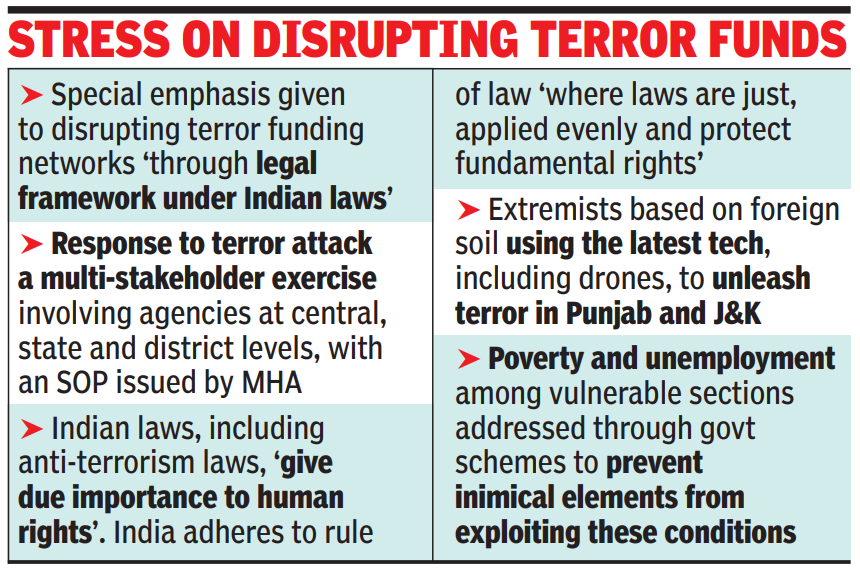
NEW DELHI: The government on Monday unveiled the country’s first-ever counter-terrorism policy, taking its “proactive and intelligence-led” approach to a doctrinal level, focusing on the emerging challenges of terrorists using modern communication equipment and criminal networks, besides the ongoing threat of terror deployment by “hostile neighbours”.‘Prahal’, short for India’s comprehensive counter-terrorism policy and strategy, aims to criminalize all acts of terrorism and starve terrorists, their sponsors and backers of funds, weapons, safe havens and cyber resources.The policy is based on seven key pillars, represented by each letter of the acronym. It focuses on “prevention” of terrorist attacks; prompt and proportionate “response”; “aggregation” of internal capabilities to adopt a whole-of-government approach; “human rights” and rule-of-law-based processes to mitigate threats; “weakening” of the conditions in which terrorism thrives, including radicalization; “coordination” of international counter-terrorism efforts; and “recovery” through a whole-of-society approach.
.
The policy notes that India has been at the forefront of the fight against terrorism and refers to “neighboring countries” that use terrorism as a state tool, highlighting threats from jihadist groups and global terror groups such as the Islamic State and al-Qaeda.
Prahal aims for a graduated police response to radicalization
In describing the way forward, the policy hints at the scope for further cooperation between agencies in intelligence collection and investigations. While seeking revisions to the legal framework on counter-terrorism “from time to time”, it highlighted the ongoing need to build the capacity of national-level counter-terrorism mechanisms and the harmonization of their structures, resources, training and investigative methods.The policy stated that violent extremists based in foreign territories are using the latest technology, including drones, to carry out terror attacks in Punjab and J&K, and pointed out the use of organized criminal networks for logistics and recruitment to carry out terror attacks in India.
Prahal calls for global cooperation to fight terrorism
Additionally, the policy draws attention to the use of social media and messaging applications for terrorist communications and propaganda, acknowledging how encryption, the dark web, and cryptographic technologies allow terrorist groups to operate anonymously.As foreign terrorist groups rely on the infrastructure, logistics and terrain knowledge of local groups to carry out transnational terrorist attacks, Prahal stressed the need for international cooperation and collaboration, including through technology investments and partnerships with private businesses, to combat the misuse of information and communications technology (ICT) by terrorists.The counter-terrorism strategy aims to prevent attacks in a “proactive and intelligence-led” manner through coordination between central and state agencies. Likewise, it calls on law enforcement agencies (LEAs) to proactively disrupt terrorist groups’ cyber activities and to sustainably disrupt ground staff networks.For timely counter-terrorism response, the strategy requires all stakeholders at the central, state and district levels to have a unified counter-terrorism structure and standard procedures. As for “convergence” capabilities, law enforcement and security agencies must modernize with the latest tools, technologies and weapons. Prahal also sought to safeguard human rights through legal processes that would allow for multiple levels of redress and appeals against terrorism charges.The policy aims to grade police responses to radicalization and take legal action based on the level of radicalization. At the same time, the socioeconomic conditions of vulnerable youth and groups must be addressed through education and constructive engagement, in addition to deradicalization programs.The need to coordinate and shape international counter-terrorism efforts through treaties and procedures such as extradition and deportation in accordance with United Nations norms was also outlined.