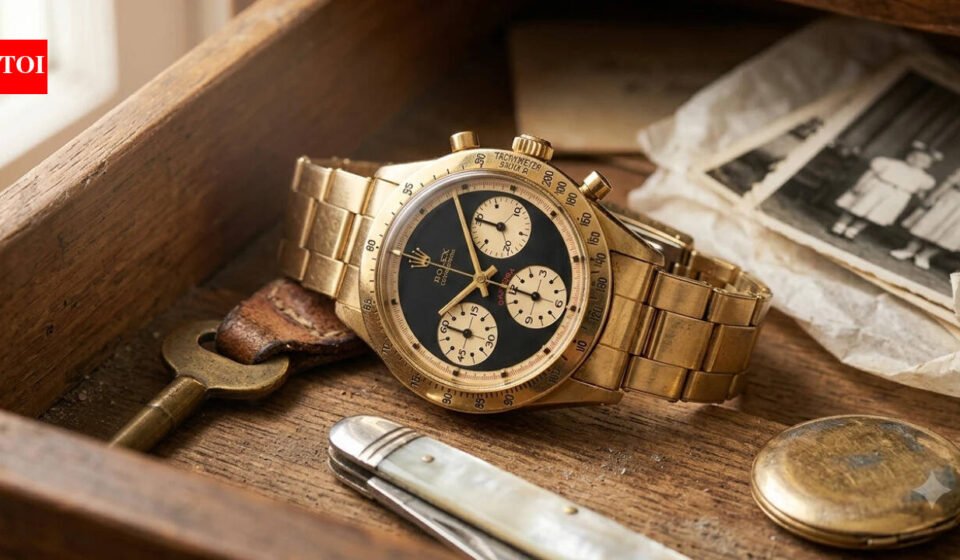
In 1967, Rolex made a rare yellow-gold Daytona with a Paul Newman dial; after more than 45 years in a family drawer, two sisters inherited it and it sold for CHF 1.143 million in Geneva

A rare Rolex Daytona made in 1967 and kept in a family drawer for more than 45 years sold for CHF 1.143 million at auction in Geneva. The 18k yellow-gold watch, a Reference 6239 with a black and champagne “Paul Newman” dial, belonged to the family of its original owner. It was later inherited by two sisters before being offered at auction.According to Phillips Auction, the watch was listed by Sotheby’s with an estimate of CHF 300,000 to CHF 600,000. Its final price was much higher than the auction house’s estimate. The sale drew attention to the rarity of yellow-gold versions of the early Rolex Daytona, particularly those fitted with the Paul Newman-style dial.The Reference 6239 has an important place in the history of the Daytona. Rolex launched the model in 1963, and it was discontinued only a few years later. Sotheby’s estimates that around 14,000 examples of the Reference 6239 were produced, with only about 300 made in yellow gold.That already makes the yellow-gold version a small part of the total production. The watch sold in Geneva is rarer still because of its Paul Newman dial. Sotheby’s research suggests that only about 10 gold Reference 6239 watches with Paul Newman dials have resurfaced on the market.
Rare yellow-gold Daytona
The watch has an 18k yellow-gold case measuring 37 mm in diameter. It has a black dial with champagne-coloured registers and is powered by Rolex calibre 722-1, a manually wound movement with 17 jewels. The case, dial and movement are all signed.Its case number is 1’757’928. The watch has a gold-plated Rolex buckle and a screw-down case back. It does not come with its original box, papers or other accessories.Sotheby’s said the watch came directly from the family of the original owner. It had been left forgotten in a drawer for more than 45 years. That history was an important part of the watch’s provenance when it was presented for sale. The watch was also described as being in exceptional condition.

Its final price was much higher than the auction house’s estimate.
Why the Reference 6239 is important
The Reference 6239 was the first Daytona model produced by Rolex, according to Sotheby’s. The model was launched in 1963 and was created for the world of endurance racing. Its design combined a mechanical chronograph with a tachymeter scale, features associated with its racing purpose.The few yellow-gold examples have details that set them apart from the more common steel watches. Sotheby’s described the gold versions as having refined dial details, champagne tones, gilt markers and distinctive graphics.The Paul Newman dial is another feature that makes these watches particularly sought after by collectors. The term refers to a specific dial layout used on some vintage Daytona models. The yellow-gold watch sold by Sotheby’s has a black dial with champagne registers.Another yellow-gold Reference 6239, known as “The Golden Pagoda”, was also highlighted by Phillips in its coverage of a 2025 Geneva auction. Phillips described that watch as having a champagne “Paul Newman” dial and said it was one of the rarest versions of the Daytona.
Only about 300 yellow-gold examples
Phillips said that around 14,000 Reference 6239 Daytonas were produced between 1963 and 1969, while only about 300 were made in yellow gold. This means the gold version was a very small part of the total production.The yellow-gold watches also differed from the steel versions in their appearance. Phillips described the champagne Paul Newman dial as having a warm finish, with three recessed registers and gold graphics.The auction house also noted that gold was not the usual choice for a Daytona at the time. The Cosmograph was designed as a functional chronograph, while Rolex’s gold watches were more commonly associated with dressier models.Over time, however, rare examples of the Daytona became important pieces for collectors. Condition, originality and provenance can be particularly significant when vintage watches are offered at auction.