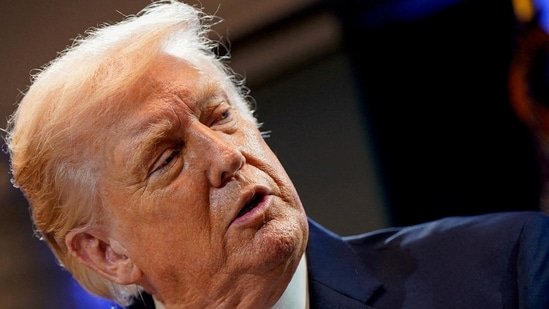
President Donald Trump lashed out at the U.S. Supreme Court on Friday after it struck down his administration’s reciprocal tariffs, saying the ruling meant he “cannot charge even $1” to other countries. Within hours of the setback, he announced new “global tariffs” of 10% on all U.S. trading partners.

Trump spoke to reporters after the ruling, framing the court’s decision around what he said were fundamental contradictions.
“However, just to give you an idea of how ridiculous that argument is, the court said I’m not even allowed to charge a dollar. I can’t charge a dollar… You can’t charge a dollar to any country under IEEPA. Not a dollar,” he said.
The Supreme Court earlier invalidated reciprocal tariffs imposed in April under the International Emergency Economic Powers Act (IEEPA), dealing a blow to one of Trump’s key trade measures.
“I can do whatever I want but don’t charge $1”
Trump argued that the decision limited his ability to impose minimal tariffs while allowing for tougher action.
“But I’m allowed to cut off any and all trade or business with the same country. In other words, I can destroy trade. I can destroy this country. I’m even allowed to impose breaking embargoes on foreign countries. I can embargo. I can do whatever I want, but I can’t charge a dollar,” Trump said.
“I assume, [the court’s order is] to protect other countries. This must be done to protect other countries. Certainly not the United States of America, which they should be interested in protecting,” he said.
After court setback, vows to have alternatives
Despite the ruling, Trump made clear he would pursue other options to keep the tariffs in place. He insists that early tariffs generated huge revenue. “We’ve made hundreds of billions of dollars in revenue. We’re going to continue to do that,” he added.
“But now other alternatives will be used to replace the alternatives that the court wrongly rejected. We have alternatives, great alternatives, that will probably bring in more money. We will receive more money and we will be stronger for it,” he said.
India deal remains unchanged
Earlier in the day, Trump said the Supreme Court’s ruling would not change the terms of the U.S. trade deal with India.
“Nothing has changed. They will pay tariffs and we will not pay tariffs. The agreement with India is that they pay tariffs. This is the opposite of what has happened in the past,” he said.
White House officials clarified that for countries that have signed trade agreements with the United States, such as India, the tariff level will be temporarily reduced to 10% before the new tax rate is determined.
Signed the 10% global tariff order
Within hours of the court order, Trump announced a new trade initiative.
“I am deeply honored to have just signed a global 10% tariff on all countries in the Oval Office that goes into effect almost immediately. Thank you for your attention!” he posted on Truth Social.
The new tariffs were authorized under Section 122 of the Trade Act of 1974, which allows the president to impose tariffs of up to 15% for up to 150 days to address “large and serious” balance of payments problems.
Authorities do not require a formal investigation. However, any extension beyond 150 days will require congressional approval. After that deadline, the tariffs can only go forward if lawmakers sign off.
However, legal experts say the newly announced tariffs may also face court review. However, since the obligations under Section 122 are limited to 150 days (unless extended by Congress), any legal challenge is likely to last longer than the measure itself.