
Societies that cling to the past and dream of the future are often caught between two mental states. India, which had just emerged from the clutches of colonialism, also experienced this duality of social order. Against this overall backdrop of ambiguity, the country’s attitudes toward women’s playback voices are also complicated. After all, sound is the secret catalog of social history. The sounds we like at a given moment can reveal something about ourselves.Before and after independence, several singers such as Zohrabai Ambalewali, Rajkumari, Amirbai Karnataki, Shamshad Begum, Geeta Dutt, etc. competed for a place and dominance in Hindi film music. But within a few years, Lata Mangeshkar’s voice, which embodied purity and propriety, became the gold standard for heroines and assumed a decisive dominance.
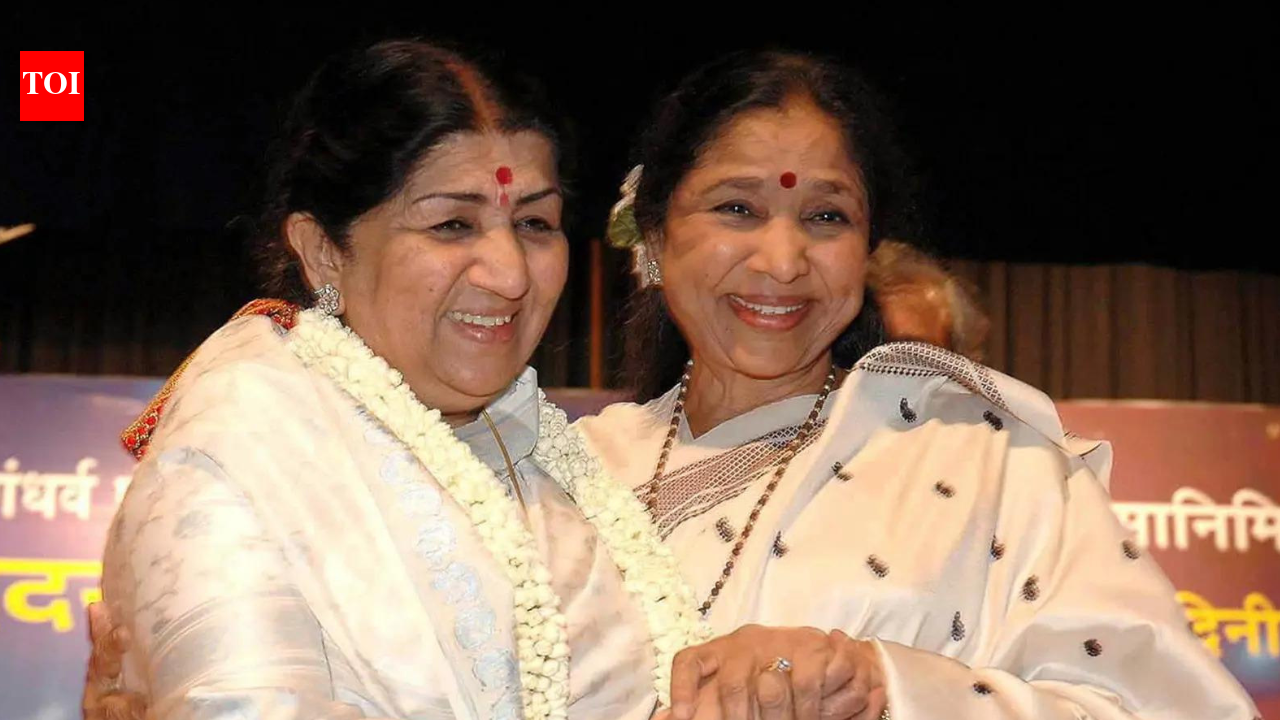
Asha Four years younger, Bhosle began her career in the shadow of her sister Lata. Passionate about finding her own voice, the Sangli-born singer listened to performances by numerous foreign artists: samba singer Carmen Miranda, the joyous Catalina Valente and even a breathless Elvis Presley, while trying to incorporate their style into her performances. “Slowly,” Asha revealed in a 1993 interview with composer Salil Chowdhury on DD Bangla, “I developed a different style from my sister.“Over time, the two voices became antonyms to each other. If Lata is the voice of the times, then Asha is the hidden desire of the times. Lata’s voice embodies sincerity, kindness, consent – qualities that were preferred and respected at the time, while Asha’s voice embodies longing, renunciation, dissent – qualities that were frowned upon at the time. The sound of the Lata conveys the innocence of the morning song and the sanctity of the temple. Asha comes with a cabaret hiss and a French kiss. Lata’s voice is an example of the times, Asha is a prophecy of future freedom.“Lata Didi and I are like Mahatma Gandhi and Nehru. Gandhi was great; Nehru was good,” Asha told Outlook magazine in April 2006.The sisters are fundamentally different, not just in their voices but in their choices and personalities. Asha once said that she thinks with her “head” and I think with my “heart.” Perhaps, circumstances played a role. Lata started singing for films at the age of 13, following the untimely death of her father, singer-actor Deenanath Mangeshkar. She never married. Asha eloped, but Lata didn’t take it seriously. The younger sister has three children from a difficult first marriage. Interestingly, Asha’s early hits were children’s songs aimed at pre-teen boys, such as “De di hamey aazadi bina khadag bina dhal” (film: Jagriti, 1954) and Chandamama Door ke (film: Vachan, 1955).In the 1950s and 1960s, Asha was not the first choice singer for most A-list music directors, except OP Nayyar, with whom she was close. She rarely plays a supporting role to the main heroine. Nayyar as well as composer Ravi nourished her sound. She once praised BR Chopra for giving her the opportunity to sing in a major film, Dilip Kumar’s Naya Daur (Music: OP Nayyar, 1957).By the mid-1960s, Asha had developed her own unique identity. Her range expanded. Her voice has a richer tone and more detailed texture. Three songs embody this. “Aagey bhi jaane na tu” (Waqt, composed by Ravi, 1965) emphasizes maximizing the tune’s growing sense of well-being by aligning each note with the emotional intent of the lyrics.In Teesri Manzil (1966), young composer RD Burman rewrote the grammar of Hindi film music and captured the new musical zeitgeist. Singing for the film felt like a challenge for Asha, especially the breathless “Aaja aaja” where her voice needed to twirl, quiver and tremble as if caught in a mating game. In Teesri Kasam, which was released in the same year and was set in the heartland of Bihar, her rendition of Pan khaye saiyan hamaaro perfectly added a folkloric authenticity to the film.These three songs belong to three different musical worlds, but Asha seems to be an honorary native of each of them.Music director RD Burman, whom she married in 1980, was a driving force. “…Pancham (RD Burman) really brought out the full potential of my voice and challenged me to greater heights,” she told journalist Kavita Chhibber in a lengthy interview in 2003. She added, “When he proposed Aaja aaja to me, I was stunned… but Didi said you are a Mangeshkar, you can do it.” This quote reveals how Lata was also a mentor, although there are some reports suggesting a difference and even a feature film, Saaz, which seems to be partially drawn from their lives, hinting at the rivalry.Generally speaking, RD prefers Lata because his works are more classical. But smoky nightclubs and seedy hippie hangouts were Asha’s domain. These scenes gave birth to some of the most intense and unique beats of the ’70s. “Mera naam hai Shabnam” (film: Kati Patang, 1970), “Piya tu ab to aaja” (film: Caravan, 1971), “Dum maaro dum” (film: Hare Rama Hare Krishna, 1972) and many more.In 1981, “Umrao Jaan” (Music: Khayyam) was to Asha what films like “Anarkali” and “Pakeezah” were to Lata. Her voice becomes an extension of the melancholy life of a prostitute. “Through her voice, you can touch the soul of Umrao Jaan,” Khayyam told this reporter in 2008. The song “Dil cheez kya hai” won her a national award. The same goes for “Mera kuchh saamaan” by Ijaazat (1987).More than Lata, Asha is eager to embrace and adapt to changing musical trends. Her voice was unusual, and a more conservative India tried to keep it in the background. But as the country changed and developed, she found her wings. To her credit, Asha never stopped flying.That’s why she remains timeless and relevant even in her 90s. In the 1980s, when disco hit celluloid and ghazal music hit private albums, she sang “Disco Station” for Bappi Lahiri (film: Hathkadi, 1982) and surpassed Pakistani singer Ghulam Ali in Meraj-e-Ghazal (1983).When Indi-Pop took center stage in the 1990s, she penned one of its most memorable songs, “Jaanam Samjha Karo. (1997),” and songwriting with personalities as diverse as Boy George and Brett Lee was part of her relentless journey to not only change with the times, but stay ahead of the curve. Even in 2026, at the age of 92, she teamed up with the British virtual band Gorillaz to star in “Shadows of Light”!Long before either sister entered the autumn of their careers, Asha had become the go-to voice for a new generation of singers. She is their beacon and north star.Whether we prefer Asha or Lata is more about us than the songs they sing. We see ourselves reflected in their voices. For a true music lover, it’s never Lata or Asha; It’s always a bit of both.