
one B-2 Spirit stealth bomber A ship-killing missile that played a key role in sinking the decommissioned USS Juneau during a major live-fire exercise marked the first public acknowledgment of the use of stealth aircraft’s ship-killing missiles in a maritime strike scenario.

The shipwreck occurred on June 27 during Valiant Shield 2026, a large-scale military exercise held by the United States and its allies in the Philippine Sea that included air, surface, submarineand special operations forces.
A B-2 Spirit operated by the U.S. Air Force fired an AGM-158C long-range anti-ship missile (LRASM) at the USS Juneau during an exercise in the northern Mariana Islands, Air and Space Force magazine reported.
This marks the first time the B-2 has been publicly confirmed to use LRASM, a stealthy long-range cruise missile designed to attack enemy ships at ranges greater than 200 nautical miles.
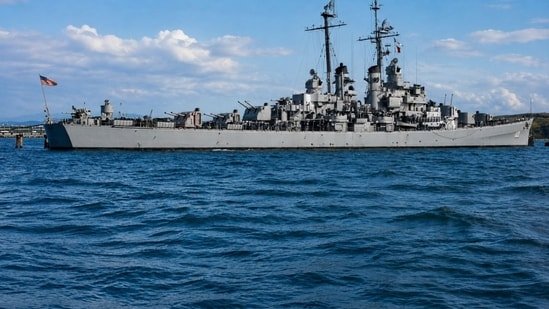
USS Juneau multi-domain strike target
The sinking of the USS Juneau was not the result of a single weapon, but the result of a coordinated multi-platform attack by the United States and allied forces.
According to Mission & Purpose, a USS Juneau aircraft carrier was first attacked by a mixture of air and naval weapons and then shot down by a torpedo fired from a submarine.
A P-8A Poseidon fired an AGM-84D Harpoon anti-ship missile, while a B-2 fired an LRASM. Additional attacks were reported from the U.S. Navy, Air Force, Army and Special Operations Forces.
The final blow came from a Japan Maritime Self-Defense Force submarine, which fired a torpedo that ultimately sank the ship.
Involving F-35, Super Hornet and aircraft carrier support
The exercise also included ship-based and tactical fighter support. According to the U.S. Indo-Pacific Command, aircraft from the USS George Washington participated in the sinking exercise, including F-35C Lightning II jets and F/A-18 Super Hornet fighter jets.
The USS Juneau sank more than 200 nautical miles off Guam and the Mariana Islands.
Pacific Air Forces described the B-2’s participation as a significant advancement in maritime strike capabilities. “The B-2’s impressive performance underscores the U.S. military’s commitment to adaptability and flexibility in the face of emerging security challenges,” said Gen. Kevin B. Schneider, Pacific Air Forces commander.
He added that prioritizing counter-maritime strikes would help maintain a “decisive advantage over adversaries” and support a “free and open Pacific.”
Also read: Seoul says North Korea launched 10 ballistic missiles during US-South Korea military drills
Why the USS Juneau was used as a target
The USS Juneau is a retired Austin-class amphibious transport dock ship that was commissioned in 1969 and decommissioned in 2008 after nearly forty years of service.
According to the U.S. Indo-Pacific Command, hazardous materials such as oil residue were removed from the ship before it sank to reduce its impact on the environment.
Live-fire sinking exercises like this, called SINKEX, are created by U.S. military Test real-world weapons performance under combat-like conditions and improve coordination between the services and allied forces.