
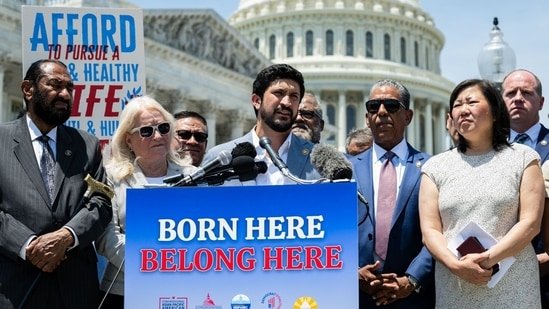
The U.S. Supreme Court on Tuesday upheld birthright citizenship in a landmark ruling, dealing a setback to President Donald Trump, who signed an executive order at the start of his second term revamping a policy he called a “disgrace.”

The verdict upheld the Fourteenth Amendment, Scotus points out that citizenship is promised to “every free-born man in this land.”
“Citizenship, then and now, is the right to have rights—to participate freely in our political community. The framers of the Fourteenth Amendment extended that promise to “every free man in the land.” We make good on that promise today,” Chief Justice John Roberts wrote in the majority ruling.
After the Civil War, birthright citizenship was established in 1868 to ensure rights for all people.
Over the next few years, court orders solidified the concept of birthright U.S. citizenship. Let’s take a look at the origins of this clause.
ALSO READ | U.S. Supreme Court upholds birthright citizenship, Trump plans to revoke it
What is birthright citizenship?
Birthright citizenship in the United States is based on the principle of “jus soli,” or “right to the land.” This means that anyone born in the United States is considered a U.S. citizen under the Fourteenth Amendment.
In addition to jus soli , the United States also grants citizenship based on the nationality or citizenship of one or both parents: jus sanguinis (right of descent) and naturalization, in which the government grants citizenship to immigrants (or aliens).
where did it come from
In 1857, the Supreme Court ruled in Dred Scott v. Sanford that descendants of Africans, whether slave or free, were not citizens.
Dred Scott v. Sanford came on the eve of the American Civil War and the abolition of slavery.
Scott was an enslaved African American who was taken by his “masters” from the slave-allowing state of Missouri to Illinois and Wisconsin, where slavery was outlawed.
After his “master” brought Scott back to Missouri, he sued for his freedom, claiming that since he had been brought into “free territory” he was no longer a slave.
As the hearing progressed, the Supreme Court ruled 7-2 against Scott, saying that people of African descent “are not included, nor intended to be included, within the term ‘citizens’ of the Constitution, and therefore cannot claim any of the rights and privileges provided and guaranteed by that instrument to citizens of the United States.”
In 1868, the 14th Amendment to the U.S. Constitution was ratified, expanding civil rights. Strengthening the position of those who escaped slavery.
The Citizenship Clause of the Fourteenth Amendment reads: “All persons born or naturalized in the United States, and subject to the jurisdiction thereof, are citizens of the United States, and of the state in which they reside. No state shall make or enforce any law abridging the privileges or immunities of citizens of the United States; no state shall deprive any person of life, liberty, or property, without due process of law; nor deny to any person within its jurisdiction the equal protection of the laws.”
Huang Jinde case
In 1898, the Supreme Court issued another landmark decision on citizenship, recognizing the rights of children born to immigrants in the United States.
Born in San Francisco to Chinese parents, Wong Wong was denied re-entry to the United States due to the Chinese Exclusion Act of 1882, which prohibited all Chinese immigration and denied Chinese residents in the United States the opportunity to become U.S. citizens.
Huang filed a court case challenging the government’s decision to revoke his citizenship. The Supreme Court ruled in his favor, determining that the Fourteenth Amendment also applied to children born in the United States to immigrants (aliens), undocumented immigrants, and visitors.
The Supreme Court further noted that the words “subject to its jurisdiction” in the provision strictly refer to children of diplomats and children born to “foreign enemies in hostile occupation”.
Which countries offer birthright citizenship?
As of 2026, some 33 countries offer unrestricted birthright citizenship to people born within their borders.
According to the World Factbook published by the Central Intelligence Agency (CIA), the countries with unconditional birthright citizenship are:
Antigua and Barbuda, Argentina, Barbados, Belize, Bolivia, Brazil, Canada, Chile, Costa Rica, Cuba, Dominica, Ecuador, El Salvador, Gambia, Grenada, Guatemala, Guyana, Hondo Las Vegas, Jamaica, Lesotho, Mexico, Nicaragua, Panama, Paraguay, Peru, Saint Kitts and Nevis, Saint Lucia, Saint Vincent and the Grenadines, Trinidad and Tobago, Tuvalu, United States, Uruguay and Venezuela.
Countries such as Greece, Iran, France and Morocco grant citizenship to any child born to parents in those countries, according to the Pew Research Center.
Meanwhile, in Australia, Germany and the UK, citizenship is available to any child born to a legal resident of those countries. In Israel, Haiti and Liberia, where the law is more restrictive, birthright citizenship is available to those who meet specified criteria.
In India, birthright citizenship is governed by the Citizenship Act, 1995, which states that the right to acquire Indian citizenship is determined by the date of birth and the citizenship status of the parents.