
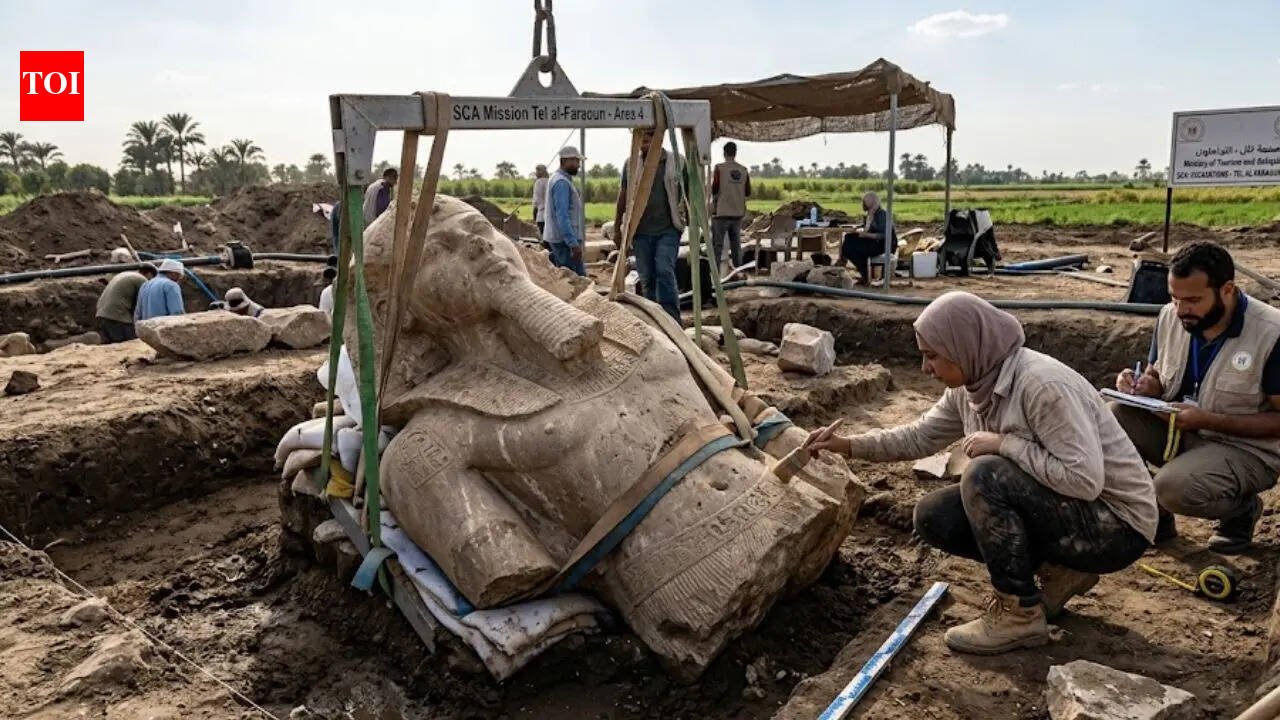
Archaeologists have unearthed an important fragment of a colossal statue in Egypt’s Nile Delta, believed to depict the legendary pharaoh Ramses II. A delegation from the Supreme Council of Antiquities discovered the statue in Tel Faraun, located in the province of Shaqia. According to Ahram Online, the remaining part of the statue is about 2.20 meters high and weighs 5 to 6 tons, but is missing the lower part. The remainder is also consistent with other features and styles from the end of Ramses the Great’s reign. Furthermore, this discovery directly challenges previous views of the extent or scope of royal rule, suggesting that the Nile Delta played a key role as an administrative and worship center during the New Kingdom.
Fragment of statue of Ramses II Found in Egypt
Recent discoveries at Tel al-Faraoun (formerly Imet) have shed new light on the importance of northern Egypt during the 19th Dynasty. Experts from the Supreme Council of Antiquities said the statue was not originally built for this specific site. Instead, it was likely brought from the ancient royal capital of Piramesses and reused in the local temple complex. This reuse of royal monuments demonstrates the political and symbolic significance these statues retained long after their original construction. As such, they continue to symbolize the Pharaoh’s presence throughout the country.
Why researchers see triads in delta discoveries
Due to the fragment’s stylistic features, including its proportions and carving technique, many leading researchers believe the statue was originally part of a larger sculptural group historically classified as a “triad,” according to findings published online by Al-Ahram newspaper. Generally speaking, the triad represents a king with two gods next to him (on either side). This was a common artistic theme in ancient Egypt, used to show the king’s divine protection and as an example of his right to rule. Further research is needed to fully support this theory; however, since there are similar sculptures representing the Triads in the Shaqiya province, scholars believe this also provides additional evidence supporting that the fragment belongs to an overall larger, multi-figure monument. The artifact has now been transferred to a storage facility in Saint-El-Hajar for scientific documentation and special restoration processes.
The important role of the delta in the administration of the New Kingdom
The discovery at Tel al-Faraoun is part of a national program to investigate a neglected historical area of Egypt’s Nile Delta region, which is often considered a difficult area for archaeologists to work in because of the large amounts of water present and the development of modern agriculture. Not only does this provide new information about Ramses II, but it also shows how the northern administrative center established direct, meaningful links with the major political centers of the New Kingdom. By identifying and protecting these monuments, the Egyptian Ministry of Tourism and Antiquities is continuing to redefine our understanding of how Egyptian kings demonstrated and maintained power throughout ancient Egypt.