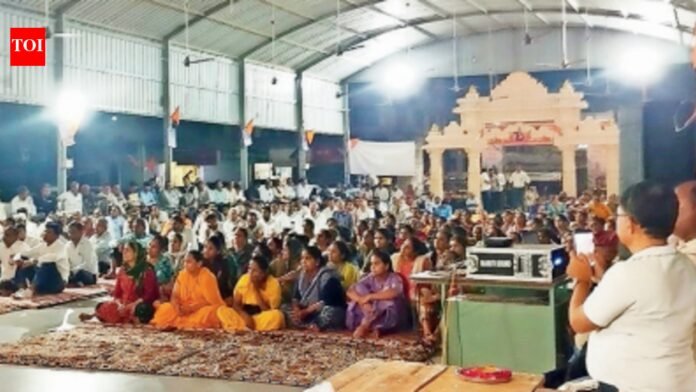
The Gujarat government’s proposal that couples must notify their parents before marrying has not yet become law, but in parts of the state, “orders” to this effect are already in force, and some villages and communities have formulated detailed “regulations” aimed at governing how their members marry.The amendments proposed in the state assembly on Friday reflect local demands and actions, scattered village resolutions fortified into community-level “constitutions” – resolutions and declarations that threaten couples who marry for love to be boycotted, ostracized and excluded from public life.From the gram sabhas of Kheda district to the caste organizations of Patidar and Thaks, the consensus driving such declarations is that marriage without parental consent threatens tradition, disrupts social order and harms women.“Breaking ban, facing boycott”The gram sabha of Nand village in Mahudha taluka recently passed a resolution imposing a total social boycott against couples who get married despite family objections. The couples were banned from community facilities, religious gatherings and social events. The resolution also limits wedding and funeral expenses, bans DJs and “objectionable songs” and imposes fines for violations.
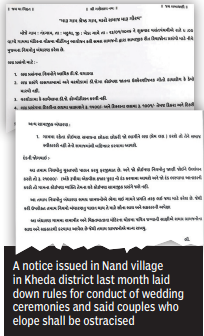
Notice
Village chief Bharat Solanki said rising cases of matrimonial disputes led to the decision. “We are a village of 5,000 people, mostly Thaks and Darbars. There used to be Sargotra (intra-tribal) marriages, which were not allowed. When a couple eloped, it put the parents in an awkward position. With such incidents increasing, we decided to declare a ban on such marriages. Violate the ban and you will face boycott.“Solanki insisted that the rules spared no one. All communities in the village – including minority OBC and SC families – must comply. “These rules apply to everyone. We are not targeting any particular group. Violators will have to pay a fine of Rs 21,000 and will be banned from attending village gatherings,” he said.Similar “rules” are cropping up elsewhere, foreshadowing wider social unrest. Village elders believe the eloping couple – whose union is known locally as “bhgedu lagan” – destroys social harmony and brings shame to their families.Banaskantha MP Geni Thakor, who is spearheading the Thakor community’s movement against such unions, said “the decision was taken because (they) keep seeing fraudulent marriages”.“Girls marrying outside their community weakens its social fabric. In some cases, women are cheated by men, abused and in some cases even forced to commit suicide. Our goal is to protect our daughters,” Thakor said. He also cited demographic factors, saying “the sex ratio is collapsing in Patidhar”. Following the proposed amendment, Thakor said, “She was the first to raise the issue of ‘bhagedu lagan’ when the ‘Love Jihad’ Bill (Gujarat Freedom of Religion (Amendment) Bill, 2021) was tabled in Parliament”. She insists that “99% of love marriages fail and cause pain to the girl.” Asked about the basis for her claim, she said: “I’ve seen this happen in rural areas; that may not be the case in big cities.”“Parents should say” Among the Patidas, opposition to such self-selected marriages has been brewing for years. Sardar Patel Group (SPG) chief Lalji Patel said the campaign was built around the anguish of parents. “During the COVID-19 pandemic, parents came to us and begged us to save their daughters who were trapped in fake marriages,” said Patel. “That’s why we are initiating these measures.” He said that although he acknowledged that the constitution allows adults to choose to marry, the SPG has been demanding that the legal age of marriage for women be raised from 18 to 21. “But society is important. Parents are everything. They should have a say.” A pamphlet circulated by the Patidar Sena in Mehsana goes beyond parental consent and calls for sweeping changes, including requiring parental signatures on marriage registrations for those aged 30 or below. It also wants palace marriages to be limited to the bride’s local jurisdiction, with 40 being the minimum age for witnesses and couples who choose to marry after 30 depositing Rs 10 lakh in their parents’ accounts and giving up any claim to family property.“These demands stem from the pain that parents have gone through,” said Satish Patel, leader of the Mehsana Patidar Sena. Asked about the proposed rules, he said they were “not completely satisfied” as they also wanted “only blood relatives of the girl to sign the marriage registration to ensure that parents and relatives take full responsibility for every such union”. Community leaders who support the demands insist they are not opposed to people choosing who they want to marry, but rather secrecy and deception. “If a couple wants to get married and the parents agree, we will not object,” said Lalji Patel. “But parents have to be involved. They are the ones who will always protect their daughters.” He also said that the latest proposal did not meet their requirements. “The government is saying it is just ‘notifying’ parents, as if notification is enough. We are demanding mandatory parental consent.”“There is no crime in love marriage” Legal experts warn that such measures infringe on the core of constitutional freedoms, but those who violate such orders say they must face serious difficulties in their daily lives.A Dalit man from northern Gujarat, who married a woman from the Darbar community (who are higher up in the social hierarchy) in 2015, said they had to move at least 50 times and stay off social media to avoid being tracked. Both had graduate degrees but could not find steady employment.“We cannot work in one place. Although we all have PG degrees, we are still dependent on daily wages,” the man said. “We work for an NGO, but my wife’s family or relatives approached me during fieldwork.”Kaushik Parmar, a lawyer from Mehsana who serves inter-caste couples, slammed the proposed changes in marriage registration rules, saying “love marriage is not an enemy of society; it is the right of free citizens”. “Every attempt to curb it weakens the constitution and strengthens the caste hierarchy. If we truly want a progressive, equal and just society, we must view love marriage as a tool for social change, not a crime.” These rules amount to murder of democracy,” he said.