
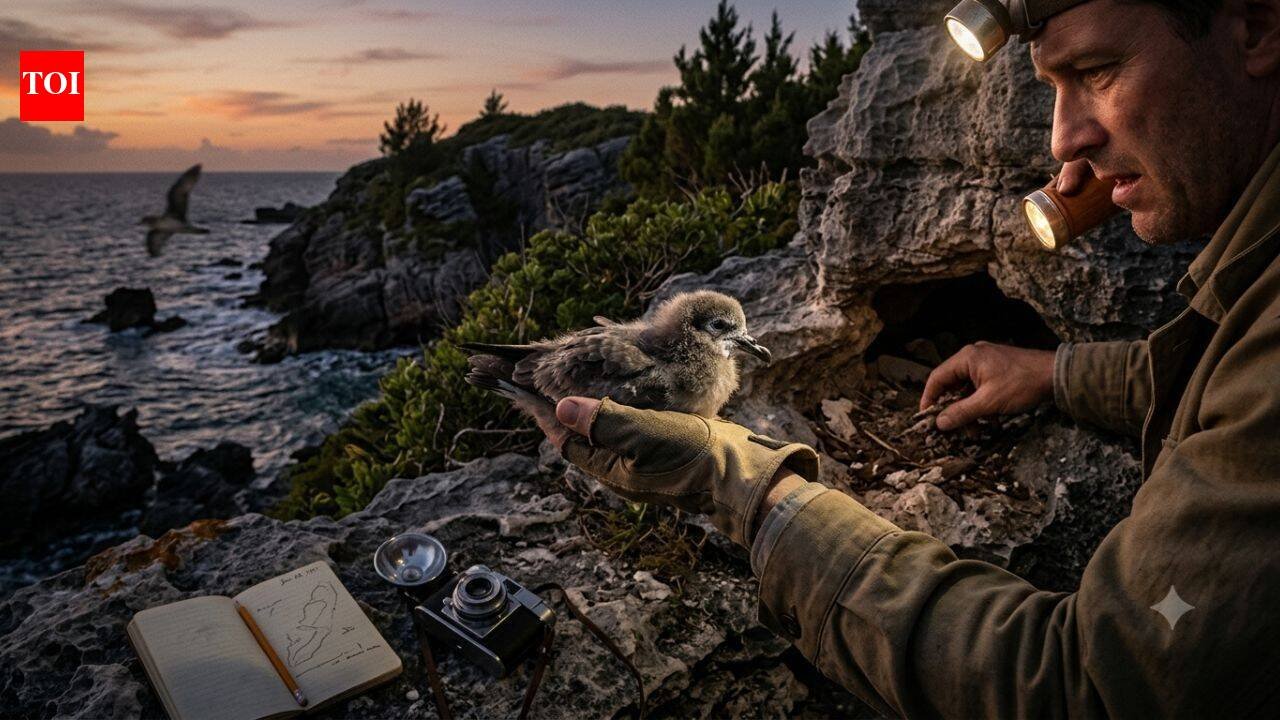
For centuries, the Bermuda petrel existed only as a memory. Sailors and islanders alike know that this bird once populated the skies around Bermuda, but by modern times it was thought to have been lost forever. Then, in the mid-20th century, some unexpected discoveries changed its story. A small colony has been discovered on a remote rocky island, suggesting the species is not completely lost. What followed was one of the world’s longest and most unusual bird restoration efforts, initiated by David Wingate, a young naturalist who devoted much of his life to giving the round-tailed parrot a chance of survival.
How a 1951 discovery saved the Bermuda petrels from extinction
The Bermuda petrel (known locally as a “cahow”) disappeared after European settlers arrived in Bermuda. This seabird once nested in Bermuda, but its ground-nesting habit makes it extremely vulnerable. Humans hunted the birds, and animals brought to the islands, including rats, pigs, cats and dogs, attacked eggs and chicks.As reported in an international bird conservation research report published by Cambridge University Press, titled “Establishing a new, secure habitat for the endangered Bermuda petrel Pterodroma cahow by relocating fledging chicks” reveals that by the 1600s, the round-tailed sandpiper was believed to have disappeared. For more than 300 years, it survived mainly through ancient records and stories. Its name is still associated with Bermuda’s past rather than its living wildlife.Things changed at the beginning of the 20th century, when several dead cows were found. The findings suggest the species may survive in unseen places. In 1951, a team of biologists reportedly began searching for evidence of live birds on the remote islands of Bermuda. One of those invited to join the expedition was 15-year-old David Wingate, a student known for his knowledge of local birds.The search was successful. Surviving populations of cowbirds have been found breeding on isolated rocky islets. For Wingate, the discovery became the beginning of a lifelong effort to prevent the bird from disappearing again.
The conservation challenges behind saving slow-breeding Bermuda petrels
When Wingate began working with Bermuda petrels, wildlife conservation was still a developing field. There are few established methods for recovering species in such small numbers. Much of what he did was derived from observation, experimentation and years of practical work.According to the American non-profit environmental organization (Audubon), Wingate returned to Bermuda after studying at Cornell University and began to pay attention to the survival of round-tail cattle. The challenge is imminent. The birds nest in small cavities on exposed islands, where storms can cause damage and competition for nesting space is fierce.Round-tailed Sandpipers reproduce slowly. They lay only one egg per year and don’t start reproducing until they are a few years old. Losing even a small number of fledglings can have a significant impact on the future of a population.Wingate works closely with the birds during their nesting season. The round-tailed sandpiper is a nocturnal seabird that leaves its nest after dark and begins its first flight over the ocean. Some of the young birds had difficulties in these early attempts. In one case, Wingate rescued a chick that had fallen off a cliff and created a safer artificial nesting device so it could try again.Small interventions like this become part of a wider recovery strategy.
Protect the nest from unexpected enemies
The decline of the ring-tailed sandpiper is not caused by a single threat. Introduced species have transformed Bermuda’s islands. Rats are one of the most destructive predators, attacking bird eggs and baby birds. Other native and introduced birds compete for the same limited nesting space.White-tailed tropicbirds are particularly problematic because they use similar burrows. Clam eggs or chicks may be destroyed when they occupy a suitable nesting site.Finding a solution took years of trial and error. Conservation staff eventually installed a simple barrier around the cave entrance, allowing ring-tailed sandpipers in while keeping competing birds out. Artificial nesting cavities are also constructed to increase the number of safe places available for breeding pairs.These changes gradually improved the birds’ chances. The recovery, although slow, is starting to move in the right direction.
How Restoring Infinite Island Can Help Secure the Future of Bermuda Petrels
One of Wingate’s most ambitious projects involves restoring Nonstop Island, a small patch of land that could provide a safer home for returning round-tailed cattle.Human activities and invasive plants have severely altered this. Wingate moved to the island with his family and began restoring its natural environment. The work includes removing unwanted plant species, planting thousands of native trees, creating suitable habitat and bringing back other lost wildlife. Our goal is not just to protect existing birds, but to recreate an ecosystem that allows the ring-tailed sandpiper to expand.After years of recovery, the Infinite became part of the species’ recovery plan. Round-tailed Sandpipers were moved there from their vulnerable nesting sites, and the birds successfully established breeding colonies. By 2012, dozens of chicks were reportedly born there during the nesting season.The transformation of Nonsuch shows that saving a species sometimes requires rebuilding the landscape around it, rather than just protecting the animal itself.
Slow recovery, facing new challenges
By the early 2000s, Bermuda petrel populations had increased from a small colony discovered in 1951. From just a few dozen breeding pairs in the 1960s, the population grew steadily over the following decades.Monitoring records between 2000 and 2008 show that approximately 29 to 40 young birds successfully leave the nest each year. By 2008, the number of breeding pairs had reached approximately 85, according to research published by the University of Cambridge.The recovery remains fragile. The birds remain dependent on small islands exposed to storms and rising sea levels. Damage from severe weather, coupled with coastal erosion caused by climate change, has become one of the major concerns for the future of the species. Isolated nesting sites help protect ring-tailed sandpipers from human disturbance, but also make them vulnerable to environmental changes.
The legacy of the ring-tailed wren’s return
The story of the Bermuda petrel is closely linked to that of David Wingate, whose decades of work transformed this bird once thought extinct into a species with ever-increasing numbers. His efforts combine field observation, habitat restoration and a willingness to test unfamiliar methods when few conservation models exist.While still rare, the round-tailed sandpiper is no longer a bird that only exists in history books. Its survival is a reminder of how close some species come to extinction, and how long it takes to recover once a population is pushed to the edge.