For centuries, scientists couldn’t explain why flamingos weren’t born pink, until a breakthrough in the 1960s revealed the answer |

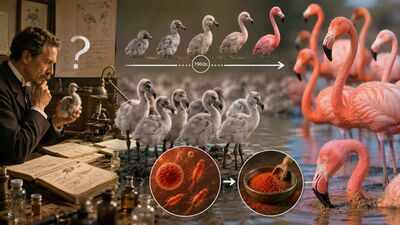
Flamingos have been known for centuries for their bright pink plumage, but the reason behind the striking color remains unclear. Early naturalists could describe what they saw, but they could not explain why young flamingos emerged from their nests in pastel hues, then gradually brightened as they matured. The answer didn’t begin to take shape until the mid-twentieth century, when advances in chemistry and bird physiology allowed scientists to track pigments in animals. By the 1960s, a long-standing problem had been largely solved. Flamingos are not born pink, nor do their feathers naturally develop this color. Their appearance depends on what they eat and their unusual ability to convert the pigments they get from their food.
Research from the 1940s to 1960s explains why flamingos are pink
A turning point came in a series of studies led by biochemist Dennis L. Fox and his colleagues from the 1940s to the 1960s. Rather than dismissing flamingo feathers as a curiosity, they examined the pigments themselves, identifying the compounds responsible for the flamingos’ unique color.According to an article published by ResearchGate titled “Flamingo Colors and Their Meanings,Fox’s study was one of the first to explain how flamingos acquire their color, and remains the basis for much of today’s knowledge on the subject.These experiments revealed something unexpected. Flamingo doesn’t make its pink pigment from scratch. Like most animals, they rely on carotenoids, natural pigments produced by plants, algae and certain microorganisms. Birds absorb these compounds through their diet and then convert some of them into different carotenoids, which eventually accumulate in their feathers, skin and beaks.The findings explain why captive flamingos sometimes become noticeably pale when their diet is changed. Without a steady dietary supply of carotenoids, their bodies gradually deplete existing pigment stores.
Why flamingos turn pink after eating carotenoid-rich foods
The idea that flamingos’ color is determined by their diet is now widely accepted, but only after controlled feeding experiments directly demonstrated this relationship.According to the Smithsonian’s National Zoo, flamingos get their pink color from carotenoid pigments found in microscopic algae and animals such as brine shrimp that feed on these algae. When flamingos eat this food, the pigment is metabolized and gradually deposited into their feathers, producing hues ranging from pale pink to deep coral depending on the diet.Long-term scientific evidence is consistent with this explanation. Amat and Redden point out that carotenoids are typically not produced by the animals themselves, meaning flamingos must obtain them through food and then store them or chemically modify them into other pigments.Baby birds provide another clue. Newly hatched chicks begin life with whitish-gray down, and then develop darker juvenile feathers that contain melanin rather than carotenoids. The familiar pink color appears when immature birds begin to feed independently and gradually accumulate dietary pigments over several years.
Why do different species of flamingos have different shades of pink?
Scientists realized that different flamingo species do not all rely on the same carotenoids, suggesting that habitat and available food influence which pigments dominate.Flamingos have an efficient metabolic system that converts dietary carotenoids into compounds such as canthaxanthin and astaxanthin. These pigments are relatively resistant to sunlight bleaching, an advantage for birds that spend most of their time in exposed wetlands. The authors also believe that species living at higher altitudes tend to have higher amounts of certain carotenoids than species living in lower wetlands, possibly because stronger UV exposure favors more stable pigments.This work shifts the discussion from a simple question of color to a broader study of ecology, evolution, and physiology. A flamingo’s color is no longer seen as a decorative feature, but as a visible result of a combination of diet, metabolism and environment.
Why flamingos’ pink color is important for survival, reproduction and evolution
Scientists continue to build on discoveries made in the mid-twentieth century. Once the chemical origins of flamingos’ colors were determined, researchers began asking why these bright feathers were important.According to the study, adult feathers are linked to reproduction, helping birds advertise the qualities of their parents when choosing a mate. Flamingos can enhance their appearance by spreading the carotenoid-rich secretions of their tail glands onto their feathers, effectively refreshing their color between moults.Later work built directly on discoveries made between the 1940s and 1960s. The central mystery has been solved: flamingos don’t hatch pink, nor do they independently create their famous color. Their appearance begins with pigments obtained from their food, specifically biologically processed, and displayed in their feathers, revealing more than simple color.