
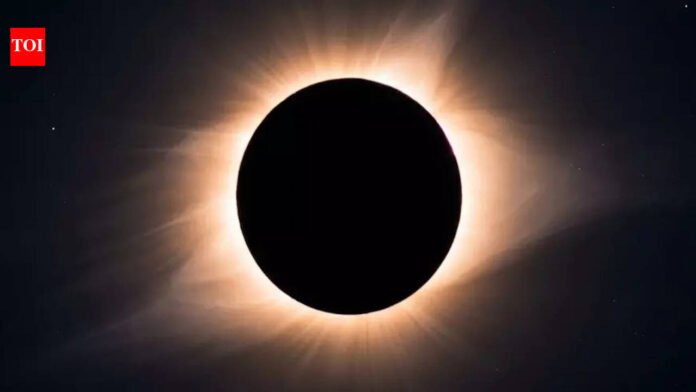
Tomorrow, Tuesday, February 17, the world will witness the first eclipse The 2026 lunar eclipse, known as an “annular eclipse,” occurs when the moon is too far from Earth to completely cover the sun, leaving a visible ring of bright fire around its edge. However, for those of us in the UAE, there’s a problem: the “circular path” is extremely narrow and remote, almost completely cutting across Antarctica. Because the alignment occurs when the Sun is below the local horizon, the eclipse will not be visible at all from UAE skies. While we won’t see the skies darkening over the Burj Khalifa, the event is still an important global scientific milestone. Tomorrow, Tuesday, February 17, the world will witness the first solar eclipse of 2026.
What is a “Ring of Fire” solar eclipse?
The term “ring of fire” refers to the bright circle of sunlight that remains visible during an annular solar eclipse. A solar eclipse occurs when the moon moves between the Earth and the sun, temporarily blocking sunlight. However, during an annular solar eclipse, the Moon is slightly farther from Earth in its orbit. Due to the increased distance, the Moon appears smaller in the sky and cannot completely cover the Sun’s surface. Instead of plunging the sky into darkness like a total solar eclipse, the moon’s dark silhouette is surrounded by a thin, bright ring of sunlight. This glowing halo creates a dramatic “ring of fire” effect that captivates skywatchers. Unlike a total solar eclipse, an annular solar eclipse never produces complete darkness because part of the sun is always visible. This dramatic ring effect will last for approximately two minutes and twenty seconds at peak viewing locations during the event on February 17, 2026.
How to watch from UAE?
Just because you can’t see it from your balcony doesn’t mean you have to miss the show. With the eclipse taking place in one of the most inhospitable places on Earth, several space agencies and research stations in Antarctica are preparing to share the spectacle.
- The partial stage begins at 1:56 pm UAE time, with the “Ring of Fire” peaking at 4:12 pm UAE time.
- Find live stream
NASA or virtual telescope project. These broadcasts will provide high-definition views from the frozen continent, allowing you to appreciate the celestial arrangement without having to endure a 14-hour flight or sub-zero temperatures.
The next solar eclipse is coming in August
If February feels like a missed opportunity, there’s good news. A total solar eclipse will occur on August 12, 2026, and will be visible in parts of Europe, including Spain and Iceland. While it’s still not visible from the United Arab Emirates, it’s geographically closer and may attract eclipse chasers from the region planning a trip.Additionally, there will be other astronomical highlights in 2026, including a lunar eclipse and meteor shower visible from UAE skies.