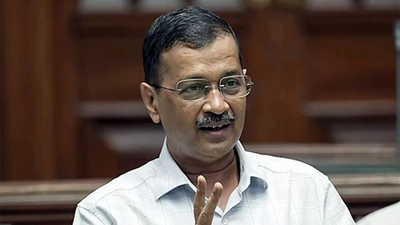

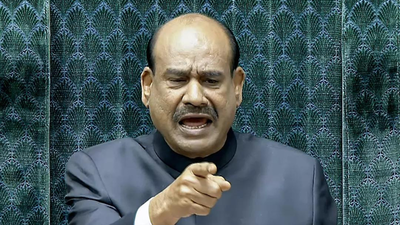
New Delhi: Confrontation with BJP-led National Democratic Alliance government escalates congress House Speaker Om Birla on Tuesday moved a notice of no confidence, alleging blatant partisan behavior on several occasions during the ongoing budget session, including refusing to give speech time to opposition leader Rahul Gandhi and suspending lawmakers.The Congress moved a no-confidence motion signed by 118 opposition MPs on the grounds that opposition leader Rahul Gandhi was not allowed to address the House as he failed to take action against the opposition. bjp MP Nishikant Dubey, made unsubstantiated accusations against congresswomen and suspended eight opposition MPs.
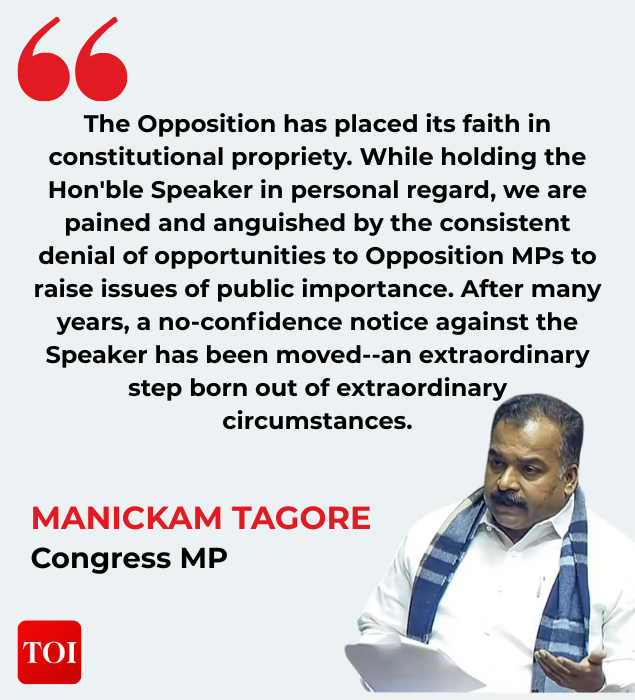
“Under Article 94(c) of the Constitution of India, a resolution notification has been issued to remove Om Birla from the post of Speaker of the Lok Sabha for his blatant partisanship in conducting the affairs of the Lok Sabha. On several occasions, opposition leaders were not allowed to speak, which is their fundamental democratic right in Parliament,” the motion tabled in Parliament said.Congress MP Manikam Tagore said in a social media post on X that the opposition took this step under “extraordinary circumstances”.“The opposition believes in the legitimacy of the Constitution. While we respect the Speaker personally, we are pained and anguished that Opposition members are consistently denied the opportunity to raise issues of public importance,” Tagore said.He added: “Years later, a notice of no confidence has been lodged against the Speaker – an extraordinary step born out of extraordinary circumstances.”The motion has the support of 118 parliamentarians, including the Samajwadi Party and DMK. However, TMC, another partner of the Indian Group, has not yet expressed its position.why nowDuring the budget session, Parliament witnessed a major showdown between the opposition and ruling parties. The incident began when Speaker Om Birla stopped Congress leader Rahul Gandhi from quoting an article citing the unpublished memoirs of former Army Chief General MM Naravane. While discussing the motion to thank the President for his speech, the House fell into chaos when Rahul refused to move forward and repeatedly tried to quote excerpts from his memoirs about the 2020 conflict with China in the Galwan Valley.In addition, Bella suspended eight members of Congress for repeatedly disrupting the House of Representatives.On February 4, Birla also advised Prime Minister Narendra Modi not to come to the House of Representatives to deliver his much-anticipated speech after he claimed to have received information that some Congress MPs may rush to the Prime Minister’s seat in the House of Representatives to “act in an unprecedented incident”.
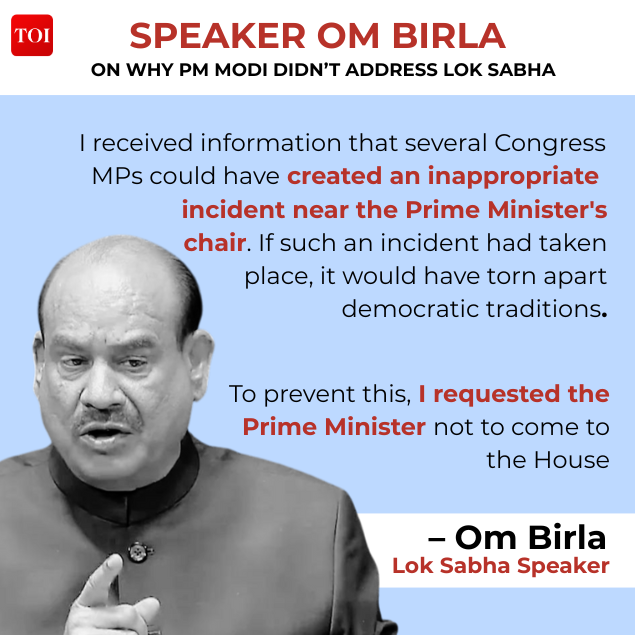
However, Rahul Gandhi refuted Birla’s claims and insisted Prime Minister Modi He avoided appearing on the House floor because of the issues he raised.“This issue started a few days ago when Naravane’s book came out. The government did not want me to discuss the issue, thus leaving the House deadlocked,” Rahul said.“The facts are very clear, the Prime Minister was afraid to come to the House, not because of the MPs, but because of what I said. He remains afraid because he cannot face the truth,” he added.Claims and CounterclaimsEarlier on Monday, a group of women MPs from Congress also sent a strongly worded letter to Om Birla, accusing him of making “false and defamatory allegations” against them.“We write this letter with deep pain and a strong sense of constitutional responsibility. It is extremely unfortunate that you, as Speaker of the Lok Sabha, have been forced by the ruling party to make false, baseless and defamatory accusations against female members of parliament who belong to the opposition,” the letter read.
Refuting this view, a letter from a BJP woman MP to Birla alleged that the MP had crossed parliamentary boundaries.A BJP lawmaker wrote to Speaker Birla, claiming that opposition women lawmakers “surrounded the prime minister’s seat” and invaded the speaker’s chamber on February 4.They urged the Speaker to take the “strongest possible action” against MPs involved in the incident.Parliamentary Affairs Minister Kiren Rijiju also shared a video of the standards showdown that took place in the Lok Sabha on February 4 Rijiju lashed out at the grand old party for “encouraging” its women MPs to block the alley where the Prime Minister could have walked into the House, saying the PPP MPs had shown maturity and restraint which could have led to complete chaos in the House.In the video, two or three ministers, including Ashwini Vaishnaw, Giriraj Singh and other MPs, begged and persuaded the female MPs to return to their seats and not engage in such unparliamentary behavior, but the latter remained merciless and stood firm with banners and posters.What is Section 94(C)Article 94(C) of the Constitution provides for the procedure for moving a motion of no confidence against the Speaker of the Lok Sabha.The Constitution stipulates: “A member who serves as the Speaker or Deputy Speaker of the People’s House may be removed from office by a resolution passed by a majority of all members of the People’s House.”
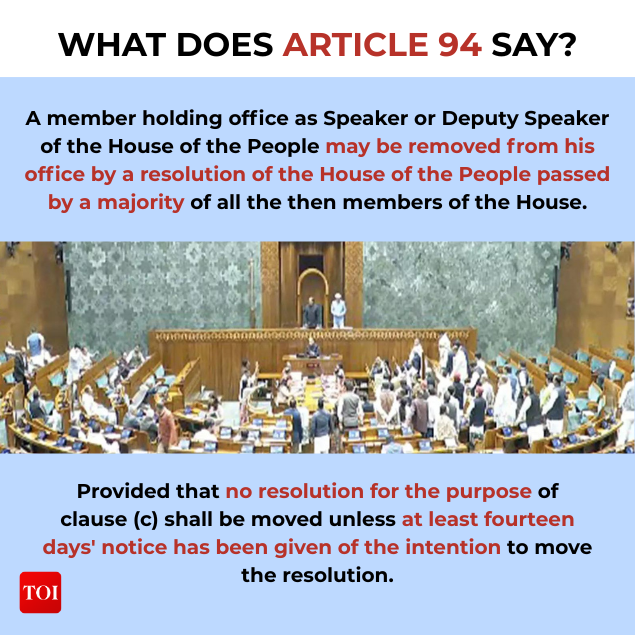
It further states: “No resolution for the purposes of subsection (c) shall be moved unless at least fourteen days’ notice of intention to move the resolution is given.”how it worksAccording to the rules of procedure and conduct of the Lok Sabha, any member of the House of Representatives can demand the removal of the Speaker. Under Chapter 18 of the Rule Book, members must submit written notice along with the full text of the resolution to the Secretary of the House of Representatives.Once the notice is received, the motion seeking approval of the motion resolution will be entered into the list of businesses in the name of the member who submitted the notice. The date for consideration of the motion is fixed by the President (usually the Deputy Speaker), as the Speaker cannot preside over the House while a motion to remove the Speaker is being considered.The Chair then places the motion before the House and asks whether it should be approved for consideration. After the motion is tabled in the House of Representatives, at least 50 members must stand to support it. If this threshold is not reached, the motion fails and the member who proposed the motion is notified accordingly.If the motion is accepted, a vote will take place. Voting may be conducted by oral vote, split vote or other prescribed methods.Will the motion be accepted?Even after obtaining the signatures of 118 opposition MPs, whether the motion can be passed will still depend on the Deputy Speaker of the House of Representatives.For a resolution to be adopted, certain conditions set out in the rules must be met. The resolution should be specific about the allegations and state them clearly and unequivocally.It must also be expressed clearly and precisely, leaving no room for vague or loosely worded claims. Furthermore, resolutions must not contain arguments, inferences, satirical expressions, accusations or defamatory statements to ensure that they are truthful, restrained and strictly limited to the allegations stated.Does the opposition have numbers?The motion appears to be more symbolic and a political gesture since removing the Speaker of the Lok Sabha requires a valid majority – that is, a majority of the existing seats in the House, excluding vacant seats. Even if the motion is tabled, it appears to be an uphill battle for the opposition as it lacks the necessary seats in the 543-member House of Representatives. In the 18th Lok Sabha, the BJP-led NDA has a majority with 293 seats. In comparison, the Indian group has 238 seats, falling short of the required number. However, if the motion is discussed in the House of Representatives, the opposition parties will have the opportunity to make accusations against Speaker Bella.Has this happened before?Although rare, such motions have historically been used to question the moral authority of the chair rather than to overthrow the chair.This is not the first time the opposition has decided to file a motion of no confidence against the Speaker of Parliament. In early 2024, the opposition filed a similar motion against Jagdeep Dhankhar, then Chairman of the House of Federation and Vice-President.However, Vice-President Harivansh dismissed the motion, calling it inappropriate, seriously flawed and rushed, damaging the reputation of Vice-President Jagdeep Dhankar.On December 10, at least 60 opposition members signed a notice calling for the dismissal of Vice President Dhankar.Since independence, history also records at least three instances of no-confidence motions being tabled to remove the Speaker. The first was in 1954 against the first Lok Sabha Speaker GV Mavalankar, when MP Vigneshwar Misra claimed that the Speaker was unfair.In 1966, opposition MPs moved a motion against Speaker Sardar Hukum Singh, led by Madhu Limaye and chaired by Deputy Speaker SV Krishnamoorthy Rao.The third motion was moved on April 15, 1987, by CPM MP Somnath Chatterjee to remove Speaker Balram Jakhar, with Deputy Speaker Thambi Durai presiding. The motion was rejected by the House of Representatives.