
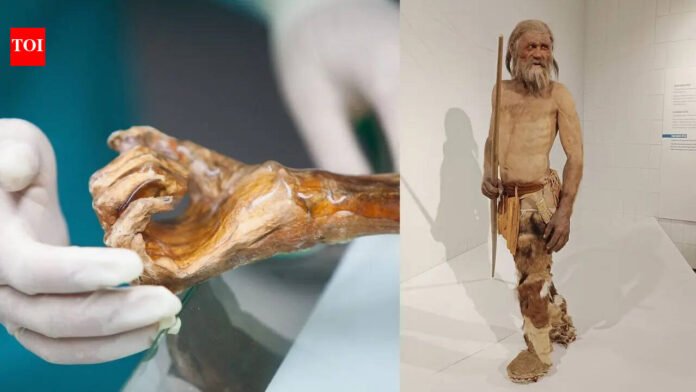
In a cold storage facility in northern Italy, Ötzi the Iceman lies behind controlled glass and steel, maintaining a steady chill that mimics the glacier that once sealed him away. He has been there since 1991, when hikers stumbled upon what appeared to be a recently buried body in the melting ice of the Ötztal Alps. This assumption did not last long. What follows is a slow acquaintance with a man who died five thousand years ago and whose preservation has a strange integrity that still feels a little out of place in a modern laboratory room. Skin, tattoos, scraps of clothing and even traces of his last meal were mapped and re-examined. Now attention shifts again, this time to something less obvious: the microscopic beings still associated with him, and whether any of them are more than just wandering around.
5300 years old Europe’s oldest mummy Revealing the echoes of microbes inside
There is always a sense of time suspended in Ötzi’s remains. The cold slowed the decay to almost a halt, but it did not freeze the body to absolute stillness. According to a study published in Springer Nature titled “At the boundary between preservation and alteration, microorganisms take center stage”The Iceman’s Microbiome: Revealing Thousands of Years of Microbial Diversity and Continuity‘.The current interest is unusual not only because of the presence of bacterial or fungal traces, but also because some of these traces may be more than mere remains. Their form seems to blur the line between ancient remnants and ongoing biological activity, even though such conditions would have been expected to have shut everything down long ago. To get closer to the real life on or inside the mummies, the researchers collected samples from fluids on the mummies’ surfaces and within preserved tissues. Old soil from the original discovery site is also brought back into the picture, along with data from early examinations of stomach and intestinal material.The difficulty lies in disentangling what was part of Ötzi’s original microbial community and what arrived later, either during recovery from the ice or during decades of handling in museums. DNA and RNA sequencing provide a way to classify mixtures, although even this produces blurred edges rather than clear lines. Something emerged that clearly pointed to ancient origins, with fragments of microbial communities appearing to be part of his body during life. Other signals appear much more recent, formed by cold conditions and modern exposure.
Microbial traces between dormancy, survival and glacial transport
One of the more interesting findings is that yeast seems to be well adapted to extreme cold. These organisms are similar to strains found in polar regions, including Antarctica, and appear to have adapted to conditions that bring most biological processes to a virtual halt.Their presence raises the potential possibility that they did not begin with the man himself, but arrived through the glacial environment that eventually surrounded him. In this sense, the ice not only protected Ötzi; It may introduce its own microbial passengers into it. Beyond that, there are some microbial signatures that appear to have changed little, suggesting continuity stretching further back. Whether this continuity represents survival from dormancy or intermittent resuscitation is not easy to determine. Rather than solving the problem, data leaves it unresolved.
Chemical preservation and the unexpected resilience of microbial life
There is another layer that complicates the situation. After their discovery, certain parts of the body were treated with chemical agents designed to limit biological growth and stabilize their preservation. One such compound, phenol, is toxic to many organisms. However, some identified yeasts appear to be able to break down phenol itself. This raises the troubling idea that conservation efforts aimed at preventing activity may inadvertently favor a small subset of resilient microbes that are able to tolerate or even take advantage of such treatments. It’s a narrow technical detail, but it changes the appearance of the body inside the refrigerated chamber. Although not closed, chemistry and biology still overlap in unexpected ways.
When ancient preservation shows signs of slow biological turnover
Samples collected several years apart showed subtle differences. Some cold-adapted species appear to have increased slightly over time, suggesting that whatever exists is not completely static. If growth does occur, it will be measured differently than normal biological cycles and will be extremely slow. This idea is incompatible with the assumption that bodies from 5,000 years ago should be biologically completely inactive. Yet these patterns hint at something less fixed. This isn’t life in the usual sense of a thriving ecosystem, but it’s not complete silence either.Oates continues to sit in that uneasy space between artifact and environment. The ice that once halted decay now serves as a controlled habitat, and the microbes associated with it reflect both ancient biology and recent invasions. Now, Iceman remains what he has always been: a preserved human being, yes, but also something less simple, carrying traces of biological activity and refusing to fully conform to the idea of a completed past.