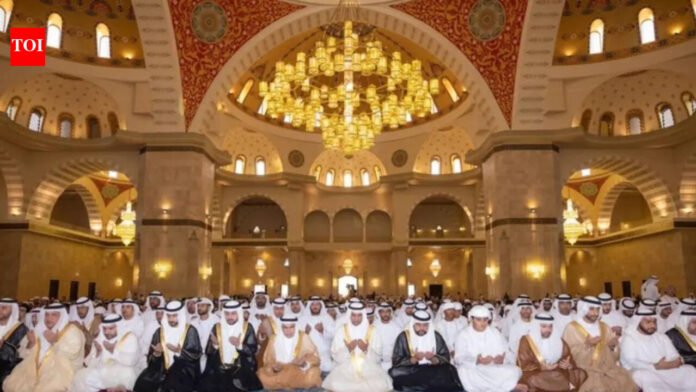
As the UAE prepares for Eid al-Fitr 2026, authorities have made significant changes to one of the most visible and spiritually unifying rituals of the Islamic calendar. eid al-fitr This year, prayers will be held only in mosques, with outdoor prayer venues suspended across the country.The announcement, made by the General Authority for Islamic Affairs, Endowments and Zakat, comes amid heightened regional sensitivity and reflects a broader shift in the way public religious gatherings are managed across the Gulf.
UAE holiday changes: No more open-air prayers during Eid al-Fitr 2026
Eid prayers in the UAE have traditionally been marked by mass gatherings in open-air musharas (prayer venues) where thousands of people gather in the early morning to mark the end of Ramadan, but by 2026 this familiar sight will disappear. Authorities have confirmed:
- All Eid prayers can only be performed in mosques
- Outdoor prayer areas and Eid venues will not be used
- This decision applies to all
emirate
The move is aimed at ensuring public safety and the smooth organization of large gatherings, especially in times of regional instability. At first glance, this change may seem logistical, but it has profound cultural and social implications. Eid prayers are not only a religious duty; They are also a community experience. The empty grounds, which often allow families to pray together, are packed with crowds that mosques cannot accommodate and create the festive communal atmosphere that characterizes Eid mornings. By moving prayers indoors, authorities are effectively reinventing how Eid will be experienced this year. Officials, however, assured residents that mosques across the country are fully prepared to handle the turnout, with coordination between departments in the different emirates to ensure smooth execution.
Eid al-Fitr 2026 timing still follows UAE traditions
Despite the change in location, the timing of Eid prayers remains the same. Eid prayers in the UAE are usually held shortly after sunrise, usually between 5:45 and 6:30 a.m. (depending on location), and are followed immediately by sermons and greetings. Authorities urged worshipers to arrive early, follow mosque guidelines and avoid last-minute crowding.This becomes especially important as the space is limited to the interior of the mosque, unlike an open venue that can be expanded to accommodate larger numbers of people.
Eid al-Fitr 2026 in UAE, Kuwait , Qatar : Crescent observation coefficient
The exact date of Eid al-Fitr 2026 still depends on the appearance of the new moon of Shawal. Officials confirmed that the moon viewing committee will meet on Ramadan 29. If the new moon is spotted, Eid al-Fitr will fall on Thursday, March 19. If not, Ramadan will complete 30 days and Eid al-Fitr will be on Friday, March 20. Astronomical forecasts currently suggest the latter is more likely, adding another layer of complexity, especially since Eid al-Fitr may coincide with Friday (Jummah) prayers, a topic that has become widespread across the region.
UAE, Kuwait, Qatar on alert amid war between Iran and US-Israel
This decision does not stand alone. span middle EastEid al-Fitr 2026 takes place against the backdrop of Iran’s war with the United States and Israel, continued geopolitical tensions, heightened security alerts and heightened surveillance of public gatherings. Recent reports indicate that the region is celebrating Ramadan and preparing for Eid al-Fitr “under the shadow of war,” with governments taking precautions to maintain stability.
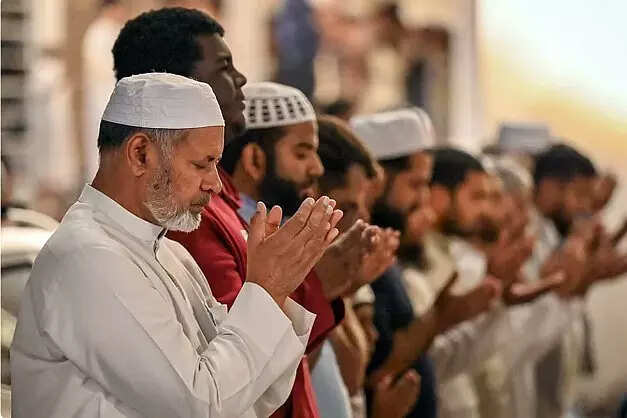
Eid Al Fitr 2026 changes: UAE bans outdoor prayers this year, only in mosques
In this case, limiting large outdoor gatherings is no longer a restriction but a risk management. The UAE is not alone in rethinking the logistics of Eid prayers. Neighboring countries are also taking similar measures. For example:
- Kuwait has announced that Eid al-Fitr 2026 prayers will be held only in mosques, without the use of courtyards or open spaces.
- The Qatari Ministry of Waqf and Islamic Affairs also announced that the 1447 Eid prayers scheduled for 5:53 a.m. will be held in closed mosques across Qatar to ensure the safety of worshipers.
This suggests a regional pattern in which authorities prioritize controlled environments, easier crowd management and enhanced security. The UAE has long positioned itself as a country that balances religious observance with structured governance. This latest directive reflects this approach. Worship is fully facilitated but within a regulated framework.Public safety and religious freedom go hand in hand. Coordination among the emirates ensures consistency. This is not the first time such measures have been implemented. Past events, including national calls to prayer and unified Friday prayer times, have demonstrated how religious practices can be adapted without changing their core essence.
Kuwait: Fixed-time prayers in mosques only during Eid al-Fitr 2026
A similar directive has been implemented in Kuwait, where the Ministry of Religious Affairs and Islamic Affairs announced that Eid prayers will only be held in mosques for Friday prayers, effectively excluding open-air prayer venues in 2026. It marks a significant shift from traditional large-scale outdoor gatherings and marks a nationwide shift toward controlled indoor worship environments. Authorities have also streamlined locations, limiting prayers to designated mosques, ensuring better organization and easier crowd management during the early morning rush hour.In addition to a structured approach, Kuwait has even fixed the precise prayer time at around 6:08 a.m., reinforcing a closely coordinated nationwide program. The move reflects broader caution in the region, with authorities prioritizing safety, security and logistical efficiency amid heightened tensions. With more than 1,000 mosques preparing for Ramadan and Eid al-Fitr gatherings in 2026, the country is relying on existing infrastructure to accommodate worshipers while avoiding the unpredictability of large outdoor gatherings.
Qatar: Only mosques allowed, not open for Eid prayers 2026
Qatar also issued clear instructions that Eid prayers this year can only be held in approved mosques, and no open venues or temporary prayer areas will be provided. The Ministry of Endowments and Islamic Affairs has standardized venues, limiting prayers to mosques that regularly host Friday gatherings, a move aimed at ensuring uniformity and tighter regulation across the country.Authorities further emphasized strict compliance with guidelines inside mosques, including organized entry, shorter sermon times and regulated flow of gatherings. This reflects a broader trend in the Gulf region, in which governments are consciously turning to indoor, controlled religious gatherings in response to changing regional dynamics. For worshipers in Qatar, this means a more structured but still spiritually intact Eid experience, centered entirely on the mosque space rather than the vast outdoors.
What believers in UAE, Kuwait, Qatar should remember before Eid prayers 2026
As prayers shift to mosques only, authorities have highlighted several key points:
- Arrive early to secure space
- Follow official instructions and crowd management protocols
- Avoid large gatherings outside mosques
- Stay up to date only with official announcements
The goal is to ensure Eid is spiritually satisfying without compromising safety. While the context may change, the essence of Eid remains the same. After a month of fasting, charity and devotion (Zakat al Fitr) as well as family time, community and prayer, it remains a day of thanksgiving. The decision by the UAE, Kuwait and Qatar to hold Eid prayers only in mosques clearly reflects the trend of the times. It prioritizes security in an unstable regional climate, ensures better organization of large gatherings and is in line with broader Gulf region trends.