


If anyone hears about Donald Trump — there’s so much in it that banning the word “Trump” would bankrupt the WENA channel — you’d think he was an anomaly in the system, the sum of all the imbalanced equations, antithetical to the American way of life. In recent years, his behavior—expansionist tendencies, belligerence, using government agencies to target his opponents, justifying his own actions, and denying basic freedoms—has been viewed as something as un-American as socialism.But Trump is not an outlier from past U.S. presidents but a Jungian synthesis of them all: expansionist, warmonger and freedom-crusher.
Trump became a more evolved version because he refused to participate in the diplomatic extravaganza that pretended that America’s actions were for some great good rather than self-aggrandizement. To borrow a line from Morpheus’s epic speech in Zion in The Matrix Reloaded, Trump is not here because of the road in front of him, but because of the road behind him in American history. The only difference from his previous Prime Minister is that he manifests these ancient imperial instincts as pure, unembarrassed instinct – an unbridled force the likes of which has never been seen in scrolls or in real life since time immemorial. Tyler Durden.
expansionist
When Trump expresses annexation of Greenland or jokingly calls Canada the 51st state, commentators clutch their pearls and forget the history of the United States expanding from 830,000 square miles (the original 13 states) to nearly 3.8 million square miles, an approximate 360% increase in area.

In 1803, Thomas Jefferson purchased Louisiana from Napoleonic France, doubling the territory. Andrew Jackson expanded this with the Indian Removal Act, expelling five tribes because Americans wanted to obtain the gold found on Indian lands, which displaced 100,000 Native Americans and resulted in the deaths of 15,000 Native Americans. The journey was so horrific that it became known as the “Trail of Tears,” and scholars have justified this by claiming that they were the “Vanishing Indians” anyway.By the 1840s, Americans coined the term “Manifest Destiny,” which sounds like an Instagram influencer’s caption for a 2026 sunset selfie but is actually the 19th-century belief that America is divinely destined to expand its dominance by spreading democracy, capitalism, republicanism, and the American way of life across the North American continent from the Atlantic to the Pacific.
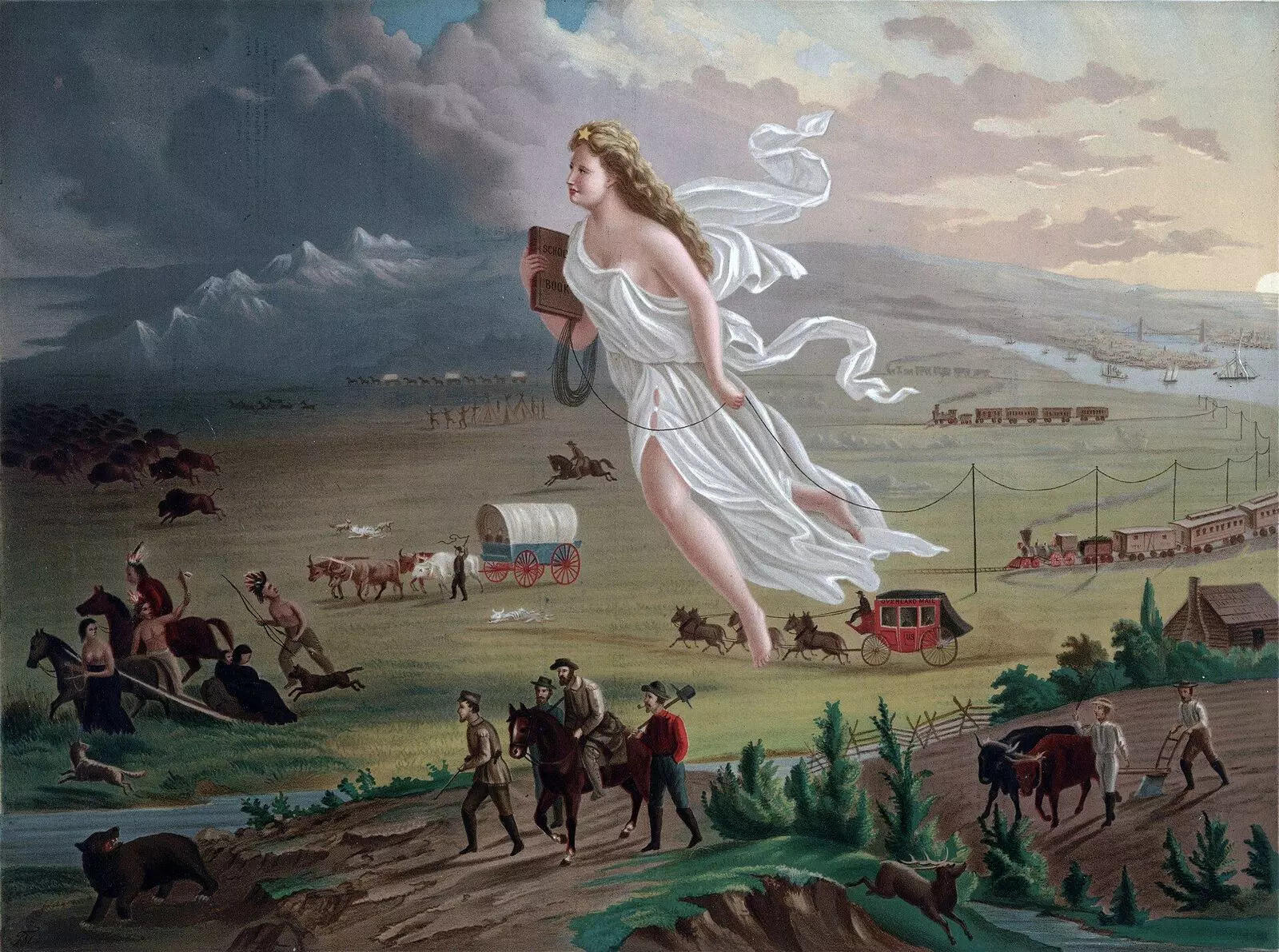
John Gast’s American Progress (1872) is an allegorical representation of the new Western modernization.
It was used to justify the 1846 Mexican-American War under James K Polk, which culminated in the Treaty of Guadalupe Hidalgo, in which Mexico lost half its territory and the United States gained California, Nevada, Utah, Arizona, New Mexico, and parts of Colorado and Wyoming. The California Gold Rush displaced more native tribes.With the outbreak of the Spanish-American War, Manifest Destiny soon moved beyond the continent, occupying Puerto Rico, Guam, and the Philippines, and with the support of American businessmen and the U.S. Marines, Queen Lili’uokalani of Hawaii was overthrown, ultimately leading to the annexation of Hawaii in 1898. Theodore Roosevelt perfected expansion not through settlers but through strategy, supporting the Panamanian rebellion against Colombia so that the United States could build and control the Panama Canal.
The republic began as thirteen colonies just off the Atlantic coast, and by the early twentieth century it had transformed itself into a continental empire spanning the entire North American continent—turning thirteen states into fifty, and turning an insecure republic into a dominant force in the modern world. So when Trump expresses a sudden desire to annex Greenland, he is simply flexing 250 years of American muscle memory. Since 2016, Trump’s theme has been MAGA (Make America Great Again), and that’s how America becomes “great.”
warmonger
The world has become accustomed to American exceptionalism, but even among these exceptionalist features, gun violence remains the most bizarre hill on which all debate dies. Maybe it has something to do with the Second Amendment. In the popular imagination, America is a country that was born with a boom in guns, which means that no American politician will admit that the world would be a safer place if insane people did not have access to weapons that could help commit murder.
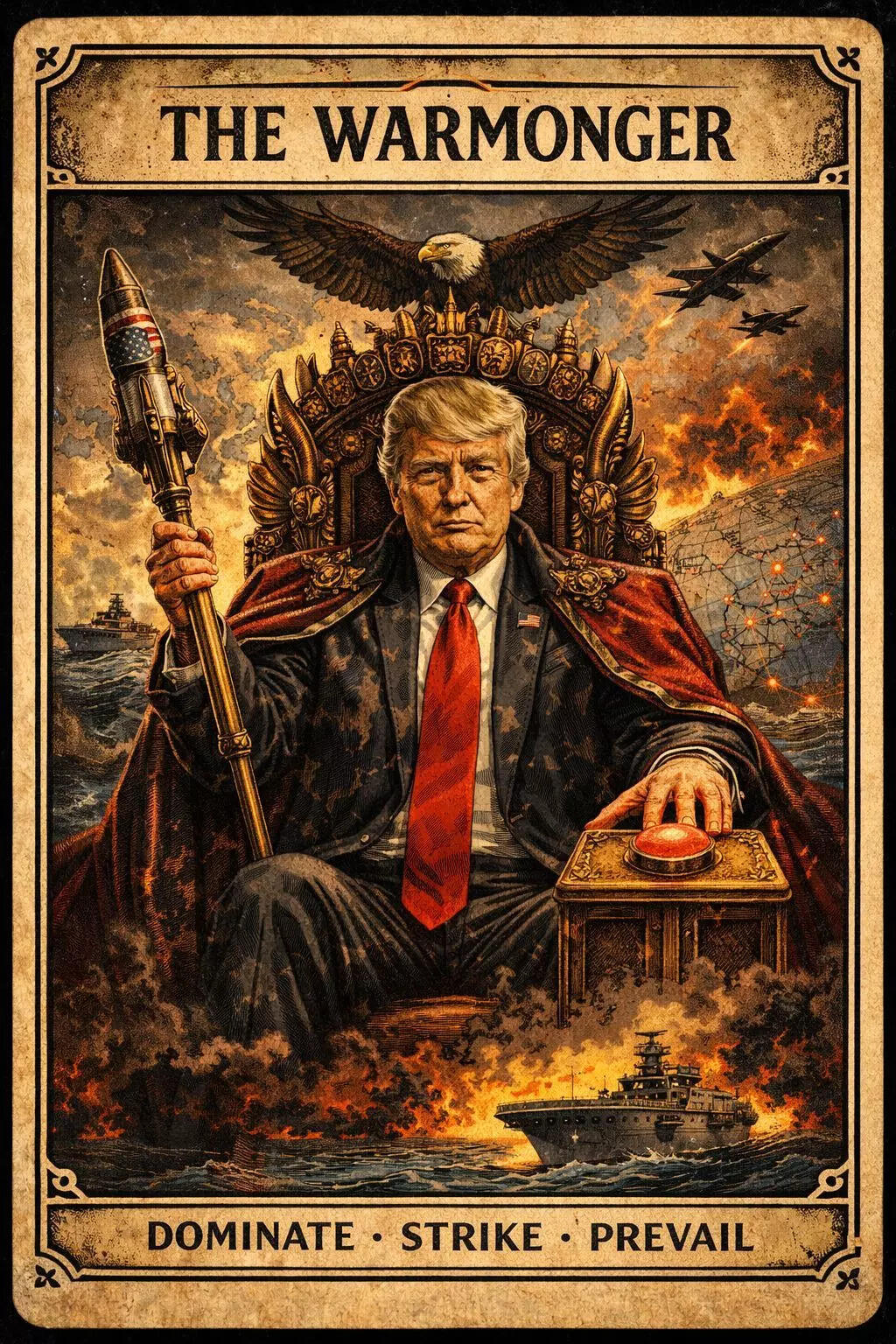
This thirst for violence is also reflected in the innate bloodlust that is a hallmark of every American regime in this war-obsessed nation. The warmonger is America’s oldest political archetype, and the president of the United States, with an almost divine power of retribution, is the most powerful man in the free world.Over time, due to vague language in the U.S. Constitution (“Executive power shall belong to the President of the United States of America”), the president has had unprecedented power to wage war without formal declaration, bomb sovereign nations, assassinate foreign leaders, conduct secret wars, maintain permanent military bases around the world, and so on, with almost no checks and balances. This is the war machine Trump inherited.To think that Trump’s actions in picking one head of state (Nicolas Maduro) or killing another (Ayatollah Khamenei) were isolated is to ignore history. The United States remains the only country to drop atomic bombs. Harry Truman entered the Korean War without a formal announcement. Bill Clinton ordered NATO bombings in Bosnia and Iraq, and scandal engulfed the White House. Lyndon Johnson escalated the Vietnam War by engaging U.S. forces in some of the most destructive bombing campaigns in history. Nixon expanded the war into Cambodia and Laos, and the United States dropped more bombs than were used in World War II.
After the terrorist attacks, Ronald Reagan ordered retaliatory strikes in Libya. George W. Bush furthered this pattern, preemptively invading Iraq and falsely claiming to possess weapons of mass destruction. Barack Obama perfected America’s war with drone strikes in Yemen, Pakistan and Somalia.Trump — though his pre-election rant was different — followed in the footsteps of his predecessors with Operation Midnight Hammer, which was designed to destroy Iran’s nuclear program, and then with Operation Roaring Lion.Most former US presidents have used some form of doctrine to justify their bloodthirsty actions, such as defending the Americas from European colonialism or trying to find non-existent weapons of mass destruction, but this regime in particular doesn’t try. Was the attack on Iran an attempt to rid Iran of its nuclear program? Is this done to promote regime change? Is it to protect women and children? Is this the final stage of the Crusades? Is it for Israel? No one knows for sure, not even Trump.read: What is Trumpism? All he knows is that he’s the best, America is the best, and the way to celebrate any form of aggression is to share elaborate clips of “Destroy Him” themed to Iron Man, John Wick, Transformers, and Mortal Kombat. This feels like the logical endpoint of meme culture: war edited like a Marvel trailer, death soundtracks becoming video game soundtracks.
freedom crusher
Finally, deprivation of liberty. Americans have long projected themselves as champions of freedom around the world, proudly pointing to the First Amendment—”Congress shall make no law respecting an religious belief, or prohibiting the freedom of religion; or abridging the freedom of speech, or the freedom of the press…”—as the sacred text of their political beliefs. Americans like to believe they are the embodiment of the Statue of Liberty, but liberty is often the first victim of power.

For too long, this country that prides itself on equality did not allow women or Black Americans to vote.Abraham Lincoln suspended habeas corpus during the Civil War, allowing citizens to be detained without trial. Woodrow Wilson criminalized dissent during World War I. Franklin D Roosevelt ordered the internment of more than 120,000 Japanese Americans during World War II.The Cold War produced McCarthyism, blacklists and loyalty oaths that destroyed careers and reputations. After 9/11, George W. Bush constructed the architecture of the modern security state: the Patriot Act, warrantless surveillance, Guantanamo Bay, and extraordinary rendition.read: How Obama gave birth to TrumpBarack Obama preserved the system and expanded it. So when Trump uses executive power without restraint—threatening agencies, testing the limits of federal power, and treating constitutional norms as obstacles rather than guardrails—he is not inventing something new. He draws on a long institutional memory of American democracy, in which freedoms expanded in theory but contracted whenever power felt threatened.
Tyler Durden
But perhaps the key to understanding why Trump behaves as he does lies in his stance. Former real estate developer Trump sees the world as property. Gaza? Prime properties are waiting to escape the war. Greenland is rich in resources and can help the United States. Venezuela? Oil available to the United States. Shakespeare said that the world is a stage. For Trump, this is prime real estate.
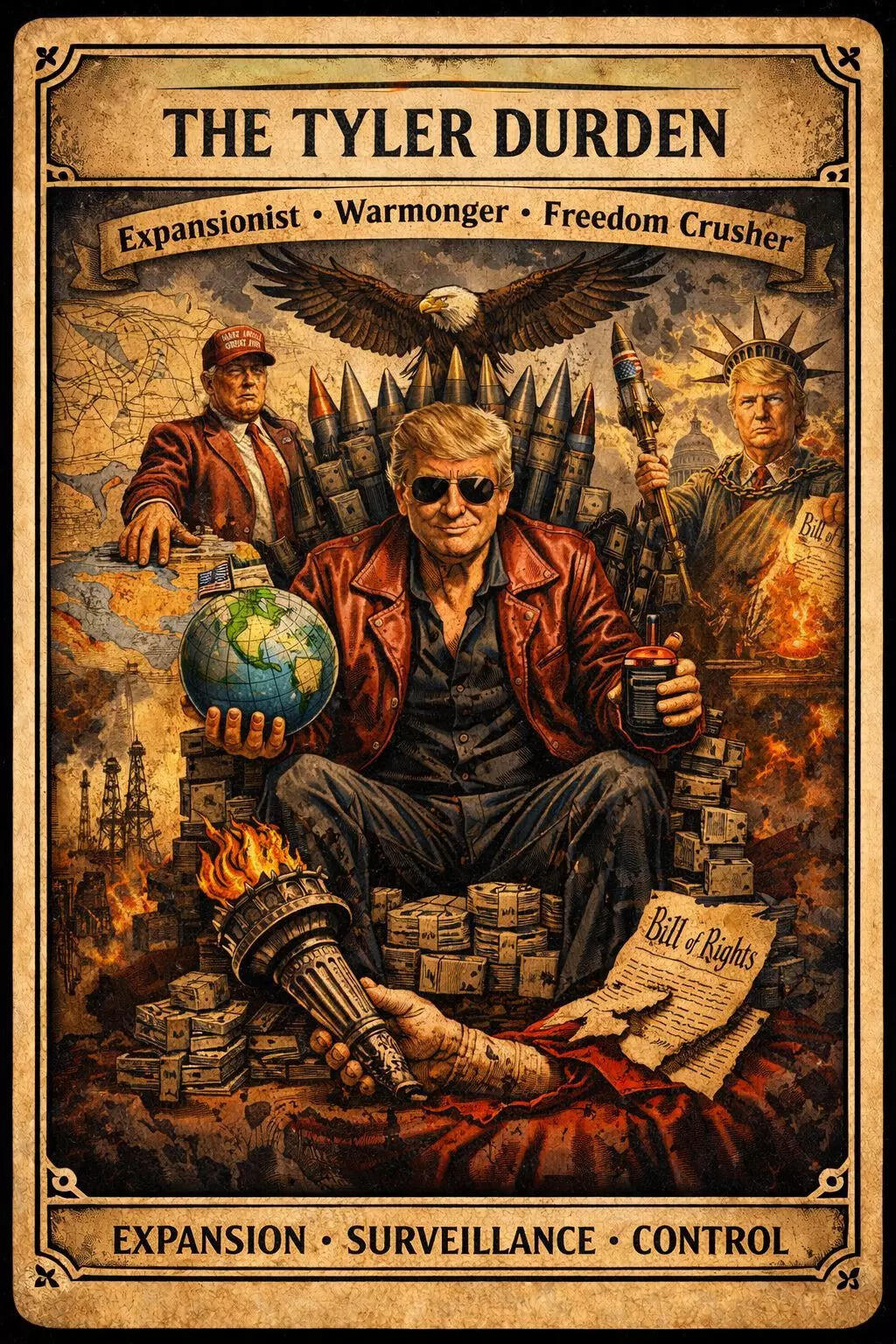
All in all, Trump is, in Latin terms, “all else equal.” The only thing he does differently is refuse to apologize for it, much like the fictional character Tyler Durden in David Fincher’s Fight Club . The film was meant to be a critique of toxic masculinity and patriarchal capitalism, but it ended up becoming a totem for those who celebrated it.Earlier presidents expressed power in the language of democracy, freedom and humanitarian duty, but he abandoned this ritual entirely. The expansionist, the warmonger, and the liberal plunderer are all fleshed out archetypes that existed before him. Trump simply plays them without wearing the moral garb.But the most disturbing thing is that anyone who has watched “Fight Club” knows that Tyler Durden does not exist. This all happens inside the narrator’s mind.What if everything Trump says and does exists first in his head? This would certainly explain garrulousness, stream-of-consciousness speeches, vague justifications, and the like. The executive’s powers have been disputed in the past, but there is an illusion that there are institutions that can stop him. In Harry Potter and the Deathly Hallows, Harry and Dumbledore discuss what is going on. He then asked: “Is this real? Or did it just happen in my head?” Dumbledore replied: “Of course it happened in your head, but why does that mean it’s not real?”And that’s the problem, because anything that goes on in Trump’s head is a painful reality for the rest of us, with disastrous consequences.


