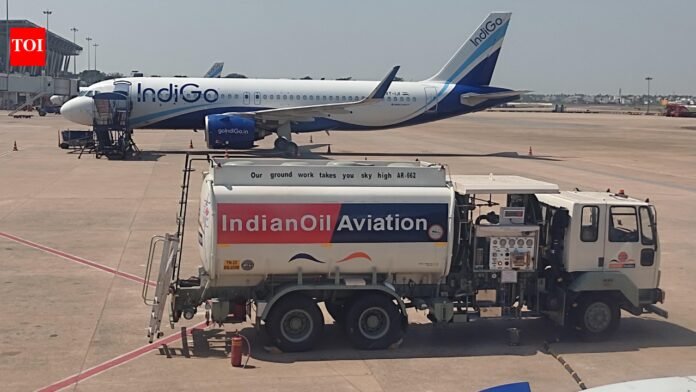
NEW DELHI: Air travelers should brace themselves for a sharp increase in ticket prices. Jet fuel prices more than doubled in April in the wake of the Iran war, dealing a fatal blow to Indian airlines. Early on Wednesday morning, the oil producing unit announced aviation turbine fuel (ATF) prices for April, with domestic flights rising by about 115% and international flights by about 107%. The rupee is hitting new lows every day, adding to the burden on airlines as most of the costs are denominated in US dollars.Domestic ATF pricing: At IGAA in Delhi, India’s busiest aviation hub, the price of ATF per kilogram liter (KL or 1,000 liters) for domestic flights is now Rs 2,07,341.22, up 114.5% from Rs 96,638.14 last month. This is the first time that the price of refined kerosene, used to ensure aircraft are immune to the effects of gravity, has crossed the Rs 2 lakh mark in Delhi, Kolkata and Chennai. Prices at CSMIA in Mumbai, India’s second busiest hub, will rise 115% to Rs 194,968.67 in April from Rs 90,451.87 last month.International flight ATF pricing: The ATF pricing of these Air India flights in India has crossed the $1,000 mark for the first time. Currently, the price per kilogram of ATF for international flights in Delhi is USD 1,690.81, a 107% increase from USD 816.91 last month. Pricing and markups are almost the same in Mumbai. The highest price in Kolkata was $1,727.3, up 102% from $855.25 last month. With the rupee at all-time lows, prices will be further squeezed.In April and May 2024, ATF prices for international flights exceed $900. But the dollar-rupee exchange rate was at 83-84 levels at that time. It has reached a record low, exceeding 95.What this means for airlines’ cost structures: Even before the expected rise in India due to the Iran war, India’s ATF for domestic flights was one of the most expensive in the world, similar to the situation in most other countries. Aviation fuel accounts for 40%-45% of the total operating costs of airlines. This percentage will now change significantly and disable weak players.What the airline will do: Airlines will raise fares to reflect increased operating costs. This will have an impact on demand and lead to fewer flights. Airlines are watching each route closely to see if it makes economic sense to operate. indigo, air india Akasa Group is among the airlines that imposed or increased fuel surcharges last month, which currently range from Rs 150 to $200. The same may now be modified. The fare cap of Rs 18,000 for domestic flights will be removed from March 21, 2026. Since airlines do not get any financial relief from ATF excise duty (from the Centre) or VAT (from places like Delhi and Mumbai), they have explicitly requested the government to cap air ticket prices only if their costs can also be similarly capped.Air India CEO Campbell Wilson said in an email to employees last month that “the financial impact of the (Iran war) crisis is yet to be fully felt, and although spot prices for jet fuel have more than doubled, much of the impact will only affect us from next month.” He warned that rising operating costs could force more airlines to cut flights “depending on changes in fuel costs, ticket prices and customer demand”. The rupee is hitting new life lows every day, increasing airlines’ dollar-denominated costs, including fuel costs for Air India’s international flights. In addition to this, routes to and from the West have become longer.Although airlines have introduced or increased fuel surcharges, Wilson said, “Not every customer is willing to pay higher airfares, so there are limits to how much we can price before demand drops. Furthermore, given the economic uncertainty, it is uncertain whether customers or companies will be as willing to travel as they were before the conflict and may choose to stay put for some time. “Wilson said: “There will be some new demand, as we have seen and deployed additional flights to some European and North American cities, but airlines in some parts of the world have already reduced some flights due to high fuel prices. Depending on changes in fuel costs, ticket prices and customer demand, we may have to make adjustments as well.”
Domestic and foreign aviation fuel prices cross Rs 2 lakh mark; India’s first international flight fare crosses $1,000
- Tags:
- air india
- Air ticket prices rise in India
- airline operating costs
- aviation fuel price in india
- Aviation turbine fuel prices rise
- breaking news
- Domestic ATF price
- Google News
- Impact of rupee depreciation
- Impact of the Iran War on Aviation
- India
- India news today
- indian news
- International ATF price
- Statement from Air India CEO
- Today's news

WEB DESK TEAMhttps://articles.thelocalreport.in
Our team of more than 15 experienced writers brings diverse perspectives, deep research, and on-the-ground insights to deliver accurate, timely, and engaging stories. From breaking news to in-depth analysis, they are committed to credibility, clarity, and responsible journalism across every category we cover.
Related articles
Recent articles