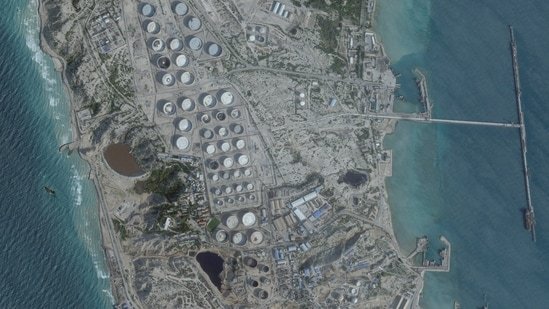
President Donald Trump said on Friday that the United States had struck “every military target in Iran” kharg island Export hub. The 79-year-old further added that the US Central Command (CENTCOM)-led attack was intended to send a warning rather than cripple Iran’s energy exports.

“Not long ago, under my direction, U.S. Central Command conducted one of the most powerful bombing raids in the history of the Middle East, completely destroying all military targets on Iran’s crown jewel, Kharg Island,” Trump wrote on The Truth Society.
follow: US-Iran war live updates: Iran fires new missiles at Israel, Israeli shells hit UN troops in Lebanon
The president further stated that Iran lacks the ability to withstand U.S. military action. “Throughout my first term and now, I have rebuilt our military into the deadliest, most capable and most effective force anywhere in the world by far.”
“Iran has no ability to defend against anything we want to attack – there is nothing they can do about it!” he wrote.
Read more: Why Trump attacked Iran’s Kharg Island. US president explains ‘banned island’ strike
Did Trump attack Kharg Island’s oil infrastructure?
Trump mentioned that the island’s oil infrastructure had not been hit. “I chose not to destroy the island’s oil infrastructure out of decency,” he noted.
However, he warned about Iran’s actions in the Strait of Hormuz.
“However, if Iran or anyone else takes any action to interfere with the free and safe passage of ships through the Strait of Hormuz, I will immediately reconsider this decision.”
Oil prices soar
Brent crude ended above $100 a barrel for a second straight session on Friday, closing at its highest level in more than three years, while U.S. crude futures settled near their highest level since July 2022. Millions of barrels of oil remain trapped in the Persian Gulf, with traffic through the crucial Strait of Hormuz effectively at a standstill.
The blockade has disrupted the flow of millions of barrels of oil per day, leading the International Energy Agency to say global supplies have suffered the worst hit on record. Saudi Arabia, Iraq, Kuwait and the United Arab Emirates have all had to limit crude oil production.
The price spike is also being felt at U.S. gas stations, where the average cost of a gallon of gasoline has risen to $3.63, the highest level since May 2024, according to AAA.
(With input from Bloomberg)