Confucius’ quote of the day: “If I walk with two people, they will be my teachers…” and lessons in finding wisdom in everyone around you

Imagine three people walking down a dusty road in fifth-century BC China. One should maintain good posture when walking and take calm, respectful steps. The second kept stumbling, complaining loudly, and pushing others away in frustration. The third person, watching the two companions quietly, was philosopher Confucius. Confucius did not think that the second person was just annoying, nor did he praise the first person as naturally better, but regarded both as valuable teachers. He chooses to copy the first man’s dignity and use the second man’s rude behavior as an opportunity to examine his own hidden weaknesses.This idea is at the heart of one of the most famous passages in The Analects: “If I’m walking with two other people, each of them will act as my teacher. I will find the good qualities of one person and imitate them, and the shortcomings of another person I will correct in myself. “In essence, this kind of teaching eliminates traditional and rigid ideas about who can be called a teacher. This shows that wisdom is not something only available in prestigious schools, nor is it something only possessed by respected masters. Instead, learning becomes an ongoing and active choice. This quote explains that if one has the right mindset, every human interaction, no matter how mundane or frustrating, can become an opportunity for personal growth. It remains relevant because it reflects a common human habit: judging others instead of using their actions to improve yourself.
The historic road to self-cultivation
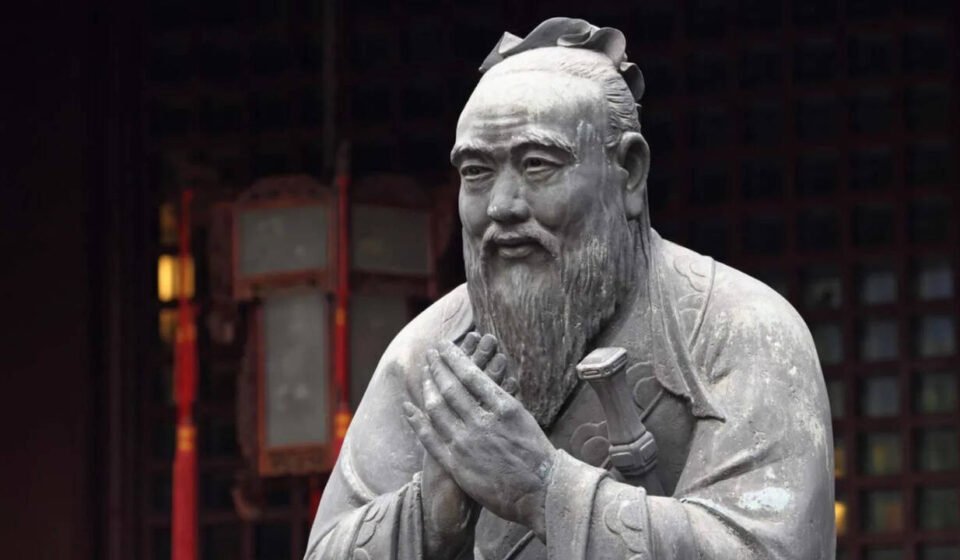
This idea comes directly fromKong FuziBetter known around the world as Confucius, he lived during China’s Spring and Autumn Period from 770 BC to 476 BC. It was an era of gradual decline of the Zhou Dynasty, political corruption, constant wars, and social unrest. In a divided society where rulers relied on force to control their people, Confucius traveled from country to country trying to persuade leaders to return to ethical government, proper etiquette, and moral responsibility.These words were collected after his death by his devoted students in the seventh volume of the Analects, a collection of sayings and conversations that became the foundation of Confucian philosophy. The classical Chinese phrase “When three people are walking together, there must be one who speaks of me”, which literally means: “When three people walk together, one of them must be my teacher.” Confucius was speaking to his students, who were preparing to become future government officials and advisors to kings.Confucius taught an important lesson about intellectual humility by showing himself to be a continuous learner. Although he was considered the most educated thinker of his time, he rejected the idea of becoming an all-knowing saint. Instead, he described himself as a common traveler who was willing to learn from everyone he met, setting an example for his students to emulate throughout public life.
The double mirror of human nature
From a philosophical perspective, this teaching supports the central Confucian idea of self-cultivation, which is to carefully improve one’s character. Within the broader tradition of virtue ethics, being a good person is not about memorizing fixed rules but about practicing good behavior every day. The image of two different companions walking side by side creates two mirrors for understanding human nature. The first mirror encourages imitation, seeing the good in others inspires us to develop the same qualities. The second mirror reflects bad behavior and may be more important. Rather than generating pride or encouraging criticism, the mistakes of others become an early warning that help us recognize similar weaknesses within ourselves.This idea is also relevant to modern psychology, specifically the concept of psychological projection. People are often very good at noticing the mistakes of others, but fail to see the same mistakes in themselves. Confucius reversed this habit. By using the irritating behavior of others as reason to look at himself, he turns everyday conflicts into opportunities for personal understanding.This principle also quietly challenged the strict social and intellectual hierarchy in ancient China. It shows that farmers, merchants, and even aggressive soldiers could teach good character just as well as experienced court scholars. The responsibility for learning rests solely with the student, not the teacher, making wisdom available to anyone willing to humbly observe others.
Radical humility for the modern era
Applying this ancient teaching in 2026 provides a powerful answer to today’s echo chambers and defensive attitudes. In modern workplaces, public life, and online discussions, it’s easy to dismiss people who behave badly or who disagree with us. True leadership means being able to rise above setbacks and find useful lessons even in difficult situations.In today’s workplace psychology, this idea emerges through proactive feedback and self-reflection. When a team leader works with someone who is unreliable or has poor communication skills, a normal reaction is frustration. In contrast, someone who follows a Confucian approach will see that person’s poor communication as a clear example that should be avoided, making sure to provide better, clearer updates to their team. Likewise, seeing a colleague remain calm during a major crisis provides a practical example worth emulating.The same philosophy can even be seen in the development of artificial intelligence (AI) and machine learning systems. Engineers train models using data sets that contain errors, biases, and other issues. Rather than discarding all flawed data, they study these failures in order to build stronger protections for future systems, allowing the software to improve by learning from early mistakes.
Find teachers in everyday life
The great thing about this philosophy is that anyone can practice it. It does not require a university degree, professional qualifications or expensive training courses. It simply requires people to make a conscious choice to see the world around them as a living classroom.Every workplace, bus, train, family gathering is filled with potential teachers. A rude passenger on the morning commute becomes a lesson in patience and self-control, while a colleague who listens carefully during a tense meeting becomes a model of professional respect. By viewing everyday interactions as opportunities to build character, personal growth ceases to be an abstract idea and becomes part of everyday life.Historical records show that in his later years, Confucius edited ancient texts and taught approximately 3,000 students, 72 of whom later became respected philosophers. His influence lasted through centuries of political change, as his advice remains relevant to ordinary human experience. The true measure of wisdom lies not in living alone, but in how well one learns from those who walk around him.