
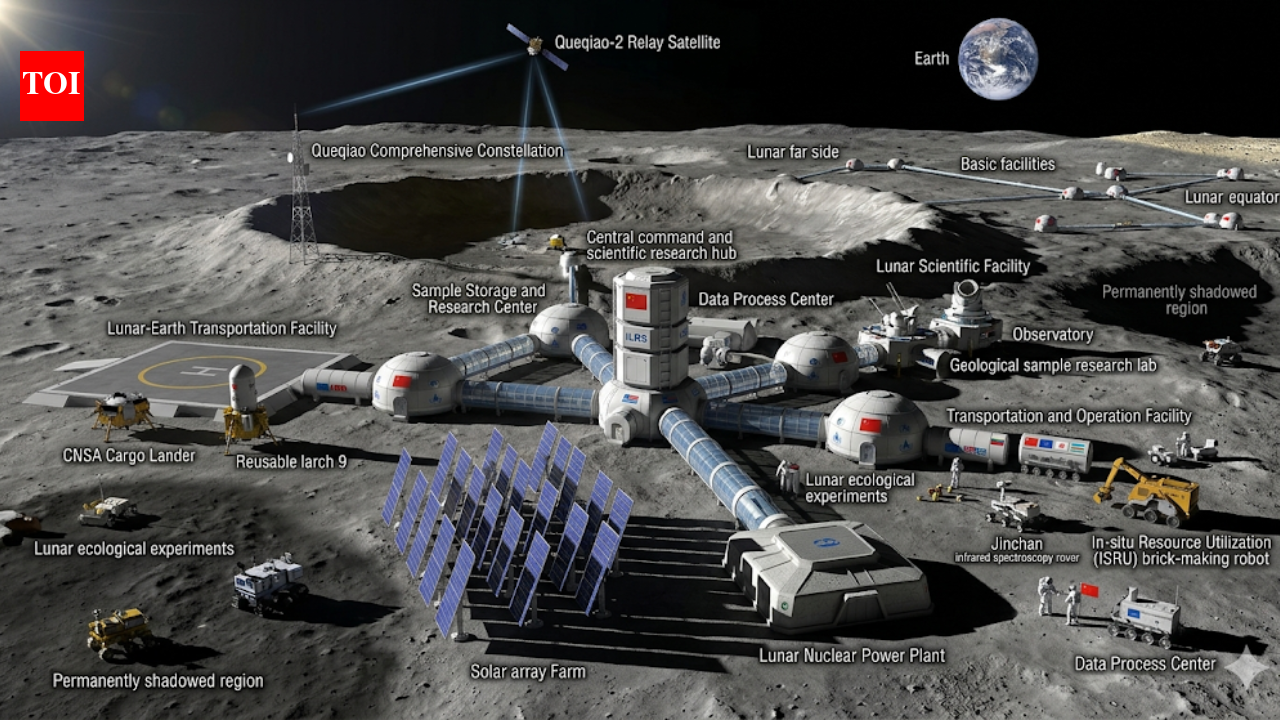
China’s race to establish a permanent base on the moon is accelerating, putting additional pressure on the United States and affecting the direction of future lunar exploration. with its International Lunar Research Station (ILRS) In the program, China, in partnership with Russia, aims to build an operational research facility at the lunar south pole and use existing missions to test technologies to achieve this goal. NASA’s Artemis program is not immune to delays and redesign difficulties. It can be seen that this competition is not only a competition for the flag, but also a competition for a sustainable base on the moon.
Chinese international lunar research station moving fast
It is also important to acknowledge that China’s approach has become more methodical and systematic in recent times. Therefore, the International Lunar Research Station co-founded by the country and Russia strives to establish a manned scientific station near the lunar south pole region by 2035.As can be seen from the long-term plan developed by the China National Space Administration, this process will be carried out in several steps. Chang’e-7 is therefore expected to explore the icy water resources surrounding Shackleton Crater, while Chang’e-8 will use lunar soil to test different construction techniques. Ultimately, “in situ resource utilization” will allow astronauts to build structures, produce oxygen, and even generate fuel directly from lunar resources.The ILRS program also has a growing number of international partners. Orbit Codex said in its article that more than 17 countries and numerous research organizations have joined the project.Speaking of the speech by Wu Weiren, the chief designer of China’s lunar exploration project, the Global Times reported that experts discussed various topics related to ILRS. One of them is a nuclear reactor designed to ensure permanent operation of the moon.
NASA’s Artemis moon program faces growing pressure
While China’s space exploration roadmap looks increasingly stable, plans for NASA’s Artemis program are constantly changing. The United States will continue its efforts to land astronauts on the lunar surface, but the deadline is now 2028.A large portion of the Lunar Gateway was supposed to be the center of NASA activity. Still, the organization decided to tweak the project to focus on building a lunar base on the ground rather than above.According to NASA Administrator Jared Isaacman, the future Artemis Base Camp will first look like “a futuristic junkyard” before it becomes operational.The political environment in the United States is also increasingly supportive of the idea. According to a report prepared by the agency senate committee Related to NASA’s 2026 Authorization Act, the bill explicitly requires NASA to create a permanent moon because “space is not only symbolic but also strategic. The NASA authorization act ensures that the United States, not China, will lead the next era of exploration. “Senator Cruz said.This is no longer just a competition for exploration, but also for strategically important territory, including the water-ice deposits at the moon’s south pole.
Why the moon’s south pole is so important
Due to its possible resource availability, the Moon’s South Pole has become the centerpiece of today’s space race. Scientists at Cornell University believe that frozen water exists in the permanently shadowed areas of Antarctica that could provide drinking water, generate oxygen and make rocket fuel.In addition to being of scientific importance, research on the future habitation of the moon suggests that the polar regions may actually be safer for astronauts to stay for long periods of time. The poles of the moon experienced fewer micrometeoroids than other regions, according to a study of Artemis-era micrometeoroids and their effects. From a purely economic perspective, Antarctica could be very advantageous.
The new space race is about longevity, not prestige
Unlike the Cold War-era race to the moon in the 1960s, the current race is to build something more durable. China and the United States don’t just want to put their astronauts on the lunar surface. Instead, they hope to establish operating stations off Earth.this Artemis Accords Collaboration with ILRS has successfully established two competing approaches to lunar exploration. The U.S.-led alliance approach competes with another approach surrounding China’s rapidly evolving lunar mission plans.There is a lot of speculation about whether China can really be “two steps” ahead of the United States. After all, NASA has a lot of accumulated technical expertise and has many commercial partners, such as SpaceX. At the same time, there is no denying that China’s well-planned moves on the moon have succeeded in attracting global attention. For decades, the moon has represented past achievements. For the first time, it represented the future.