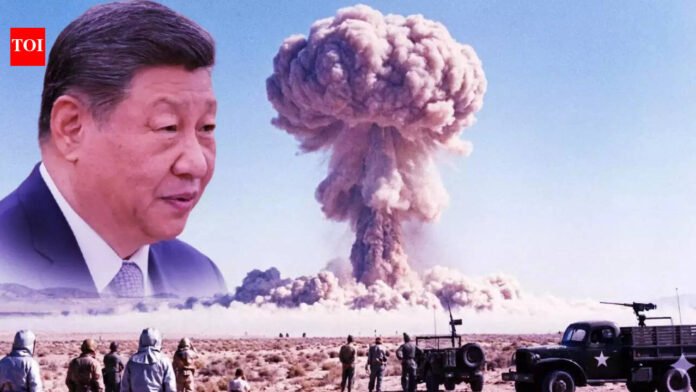
New Delhi: The United States has accused China of carrying out a secret nuclear explosion test on June 22, 2020, just days after a clash in the Galwan Valley that killed 20 Indian soldiers, an allegation it said underscores the need for a new global arms control framework after the expiry of New START.On June 15, 2020, a week before the alleged nuclear test, Indian and Chinese troops clashed in Ladakh. Twenty Indian soldiers were killed, while reports at the time estimated Chinese casualties at more than 35.U.S. Deputy Secretary of State Thomas G DiNanno said China used technology designed to evade international monitoring systems when conducting nuclear tests. “China has conducted nuclear explosion tests, including preparations for tests with a specified yield of hundreds of kilotons…China has used decoupling – a method that reduces the effectiveness of seismic monitoring – to hide its activities from the world. China conducted one such nuclear test on June 22, 2020,” DiNanno said in X.The date cited by US officials comes a week after the June 15, 2020, standoff between Indian and Chinese troops in the Galwan Valley in eastern Ladakh. Twenty Indian soldiers were killed in the clashes, while intelligence reports at the time estimated Chinese casualties at more than 30.
Allegations surface after New START expires
DiNanno’s comments came as New START, the last nuclear arms control agreement between the United States and Russia, officially expired this week, leaving the strategic arsenals of the world’s two largest nuclear powers unfettered for the first time in more than five decades.Di Nanno said: “The restrictions on warheads and launchers in the New START Treaty, signed in 2010, will no longer apply by 2026. By then, one nuclear state is expanding its nuclear arsenal at a scale and speed not seen in more than half a century, while the other nuclear state will continue to maintain and develop a large number of nuclear systems without being restricted by the terms of the New START Treaty.”He said the treaty imposed uneven restrictions on nuclear powers.“…Almost all U.S. deployed nuclear forces are subject to New START, while only a small portion of Russia’s much larger stockpile…China has exactly zero nuclear weapons,” he said.
US urges new nuclear architecture
Di Nanno said China’s so-called secret tests, Russia’s violations and the growth of global nuclear stockpiles made it necessary to seek a new arms control framework suitable for today’s threats.“The combination of Russia’s series of violations, the build-up of global stockpiles, and flaws in the design and implementation of New START has created an urgent need for the United States to call for a new architecture to deal with the threats of today, not those of bygone eras,” he said.He added that Washington was now able to strengthen deterrence while remaining open to meaningful negotiations.“The United States is no longer constrained by the political and military environment of 2010 and the treaties they entered into, and in response to the destabilizing behavior of these other countries, the United States can now finally take steps… to strengthen deterrence on behalf of the American people and our allies,” DiNanno said.
Promote trilateral talks with China
After the expiration of the New Strategic Arms Reduction Treaty, the United States once again called on China and Russia to conduct trilateral nuclear arms control negotiations. Washington has said any future deal must include Beijing, but China has firmly rejected the demand.China has denied U.S. accusations of secret nuclear tests and said it will not participate in disarmament talks at this stage, saying its nuclear arsenal is still far smaller than that of the United States and Russia.
Trump had earlier hinted at testing
U.S. President Donald Trump has previously hinted at similar accusations but gave no details. On October 31 last year, Trump said Washington would begin nuclear tests “on an equal basis” with Moscow and Beijing, but did not elaborate on the nature of such tests.Analysts warn that the end of New START marks a turning point for global nuclear stability, with the lack of formal restrictions raising the risk of a new arms race amid rising geopolitical tensions and mistrust.