

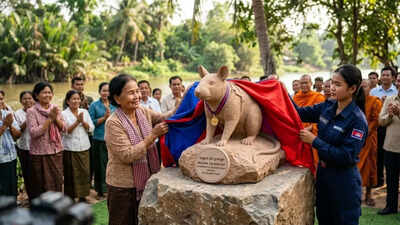
Cambodia has erected a statue in memory of Magawa, the giant African kangaroo known for his extraordinary smelling abilities and life-saving work. The monument was unveiled in Siem Reap on April 3, 2026. In more than five years as HeroRAT, Makawa discovered more than 100 mines and unexploded ordnance and cleared more than 141,000 square meters of land. His training allows him to ignore scrap metal and focus only on the faint smell of explosives, clearing mines more safely and quickly than traditional methods.Cambodia has erected a Magawa sandstone statue in Siem Reap to honor the animal’s intelligence and humanitarian efforts to clear landmines. This little rodent’s story is a testament to the innovative ways non-technical demining methods can help communities hit by conflict and war restore safe living conditions.
The record-breaking career of Cambodian mine-sniffing rat Magawa
A permanent sandstone monument was erected in Siem Reap to commemorate Magawa, whose unrivaled contribution to humanitarian demining made him a true hero in the eyes of his community. Makawa received HeroRAT training from APOPO, a lifelong organization, and is the most accomplished HeroRAT in APOPO’s history, successfully identifying 71 landmines and 38 unexploded ordnance (UXO) during his tenure, while releasing the equivalent of 20 football fields of land to the community.
Why Machuan can ignore scrap metal
Over time, Machuan’s operational efficiency was astonishing. He can clear an area the size of a tennis court in just 20 minutes (a human using a metal detector would typically take four days to complete the same task). Cricetomys ansorgei (African giant kangaroo) was chosen to detect landmines due to specific physiological and behavioral characteristics found in veterinary studies. Scientific research has confirmed that these mice possess a highly sensitive olfactory system capable of detecting trace concentrations of explosive vapors, allowing them to ignore scrap metal and only signal the presence of TNT. Their low body weight allows them to safely traverse pressure-activated mines without triggering pressure-sensitive detonators, allowing them to travel directly across land that could kill human deminers or large detection animals such as dogs.
Why biometric testing is a faster path to security
Magawa’s work is a humanitarian effort that complies with extensive regulations within the International Mine Action Standards (IMAS) global security protocol. IMAS integrates animal detection systems into technical surveys so authorities can confidently return land to communities for agriculture and housing.Because the mice are trained to sniff out explosives, they produce fewer false alarms than traditional sensors. This in turn has accelerated the entire process of reclaiming land for families displaced by the conflict.
The first mouse to receive PDSA honors
In 2020, Ma Chuan’s contributions were recognized around the world, a critical moment for animal detection systems in the field of international security. He made history by becoming the first rat in the People’s Dispensary for Disease Animals (PDSA) in 77 years to receive a gold medal, an honor similar to the animal world’s George Cross.