
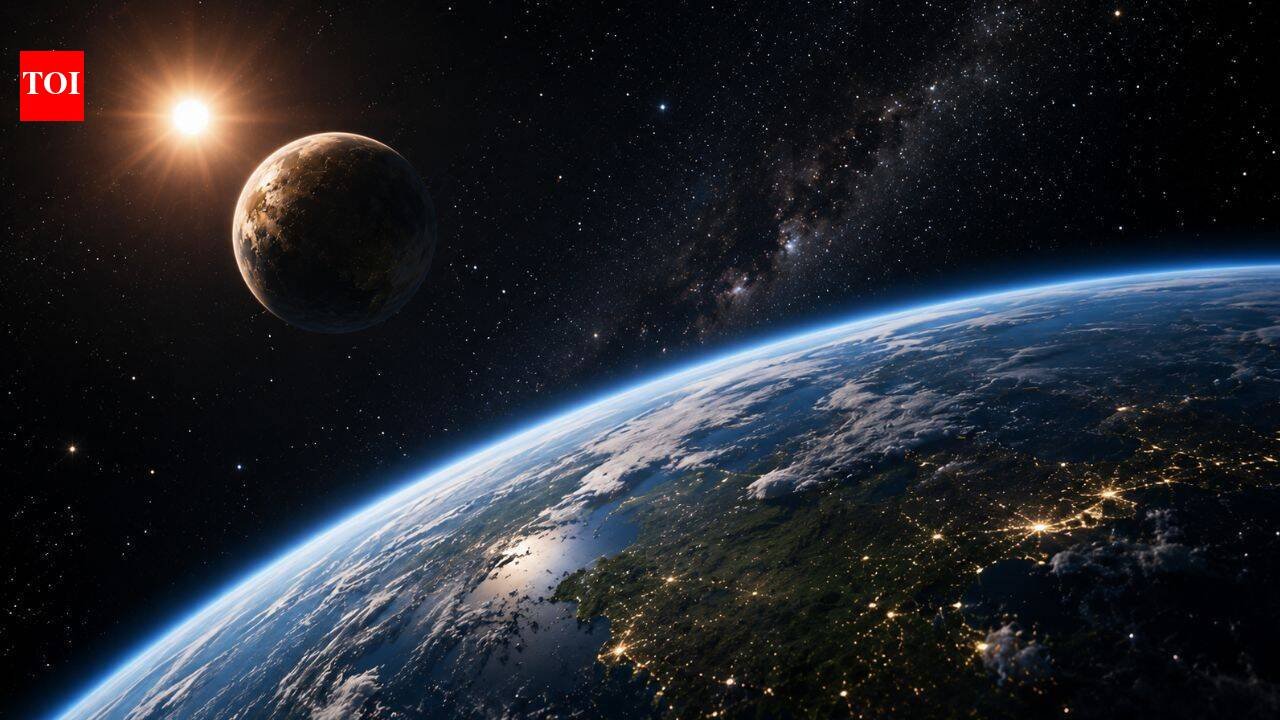

Scientists have discovered a planet that may have good conditions to support life, and it is one of the closest known planets to Earth. This planet, called GJ 3378b, is about 25 light-years away from us and very close to the Milky Way. About twice the size of Earth, it orbits its star in the sun’s habitable zone, where temperatures allow liquid water to exist. The Earth also receives approximately 90% of sunlight from the Sun. Because of this, astronomers say it is one of the most promising nearby planets in the search for life outside our solar system.
What scientists discovered about GJ 3378b and its importance
The research was published in The Astrophysical Journal and is titled “Revised mass and period of the habitable zone super-Earth GJ 3378 b: a planet straddling the cosmic coastline” Led by Paul Robertson, associate professor of astronomy at UC Irvine. The researchers updated their previous measurements and found that the planet has a mass about 2.3 times that of Earth. They also confirmed that its orbit lies within its star’s habitable zone, also known as the “golden zone,” where conditions could be suitable for liquid water.According to the New York Post, “It is one of our closest cosmic neighbors. 25 light-years sounds like a long time, but the diameter of the Milky Way is about 100,000 light-years, so in that respect, it is our neighbor.”The team made the discovery using two ground-based instruments: the Habitable Zone Planet Explorer on the Hobby-Eberly Telescope in Texas and the NEID Spectrograph on the WIYN telescope in Arizona. The research was funded by the National Science Foundation and NASA.
Why GJ 3378b’s atmosphere is so important for the search for life
Although GJ 3378b looks promising, scientists still don’t know one very important thing: whether it has an atmosphere. Without an atmosphere, the possibility of liquid water existing on Earth’s surface would be much less likely, making life as we know it much less likely.The planet is close to what scientists call the cosmic coastline. At this point, radiation from the star slowly strips away the planet’s atmosphere. Mars is an example in our solar system. Scientists believe it once had a thicker atmosphere, but over billions of years, much of that atmosphere was lost to radiation.Robertson explained how thin the atmosphere really is by comparing the Earth to an apple. If the Earth were the size of an apple, he said, its atmosphere would be only as thick as the skin of an apple. Although it is thin, it is enough to create the pressure necessary for the existence of liquid water.
When will scientists know if GJ 3378b can sustain life?
Scientists say the answer will take time. There are currently no space telescopes that can confirm whether GJ 3378b has an atmosphere.The work is expected to be completed by NASA’s planned Habitable World Observatory, which is currently expected to launch in the 2040s. The telescope will be able to directly image planets such as GJ 3378b and study their atmospheres in detail.If scientists confirm that the planet has an atmosphere, they will look for biological signatures. These are chemicals in a planet’s atmosphere that may be produced by living organisms.“I think it’s so interesting,” Robertson said of the possibility of searching for signs of life.The discovery also adds GJ 3378b to a growing list of nearby planets that will be studied by future space telescopes. Robertson said scientists are still exploring our nearby cosmic neighbors, looking for planets around the nearest stars, because they are the easiest places to look for signs of life.For now, GJ 3378b remains one of the most exciting nearby planets ever discovered. It’s the right size, in the right place in the star system, and receives almost the same amount of energy that Earth receives from the sun. Whether it can actually support life is a question scientists hope to answer in the future.