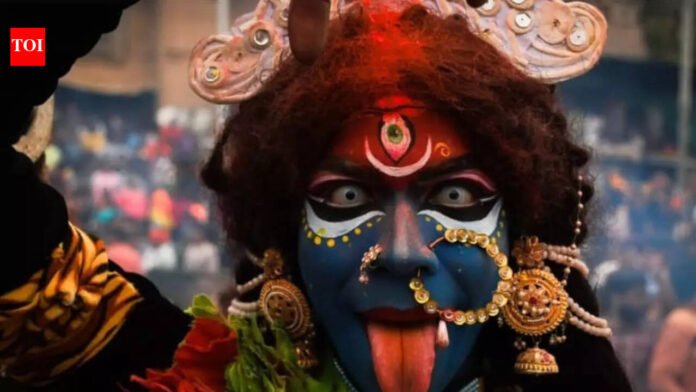
Kashgar open in me,Open in Ghat,Holi opens in the spring.This is not just a song that echoes across India, it is an emotion that Benaras lives and breathes every year. In much of the country, Holi arrives with a blaze of colour, sea breezes in the air, water cannons at the ready and laughter echoing through the narrow lanes. But on the ancient ghats of Kashgar, Holi doesn’t come in pinks and yellows. Instead, it unfolds in muted gray, where devotees gather not for picaris and gurals, but for the sacred ashes rising from the funeral pyre, symbolizing the ultimate truth of life.Here the color changes to cinder. Laughter melted into the loud chants of Hara Mahadev. The celebrations shed their carnival trappings and became contemplative, less revelry and more calculation.This is Masaan Holi, also known as Bhasma Holi or Smashan Holi, the Holi of the crematorium, where faith dances in the shadow of fire and death.
The place where fire never sleeps
Masan Holi is celebrated mainly at Manikarnika Ghat and Harishchandra Ghat, two holy places where funeral pyres are kept burning almost constantly.The word “Masaan” is derived from the Sanskrit “shmashaan” which means crematorium. In this liberated city, life and death coexist without apology, funeral pyres burn forever and the ashes of the departed become the medium of celebration.Masaan ki Holi involves the use of ashes from a funeral pyre. Rooted in Shaivite tradition, Masaan Holi attracts Aghori sadhus, sadhus and devoted followers of Shiva who choose to face death rather than escape from it. Devotees lightly apply bhasm, or Vibhuti (Holy ash) overlap each other, symbolizing the uninterrupted cycle of life and death.
but Why Holi is celebrated ?
To understand Masaan Holi, one must first step into the mythology.The celebrations begin a day after the Rangbhari Ekadashi at the Kashi Vishwanath Temple. This day is considered to honor Goddess Parvati.get” After her wedding with Shiva on Mahashivratri. Although this sacred wedding was celebrated with great pomp, legend has it that certain devas, yakshas, gandharvas, and kinnas were not among the elite guest list.
So what did Shiva do?
According to legend, this ascetic god, dancer, mystic and original rule-breaker chose to celebrate with his leopard skin, decorated with live snakes. gangster friendshis fellow crematorium. exist mahashmashanahe played Holi using the ashes of a burning pyre, dancing in the flames and smoke, chanting “Har Har Mahadev”.And so the tradition began.
Entering the gray area
As a twenty-something who grew up on stories of India’s layered spiritual traditions, I’ve long been curious about this practice, this raw, unpurified ritual. Social media made Masaan Holi a viral sensation. The ash-covered faces, the slow-motion chants, the cinematic spirals of smoke, it’s all about beauty. But what lies beyond the filtered frames?To find out, I arrived in Benares on the second day of Rangbhari Ekadashi. With only two days left of my lavish journalist week, I got fully dressed and prepared for what most would call “the color game,” but here, color itself doesn’t exist!The mood changed as we walked towards the ghats. The closer you get to Manikarnika, the denser the crowds become. The sea of people surged like a tidal wave, devotees, children sitting on their shoulders, sadhus in saffron, Agri sadhus with ashes on their foreheads. The air was filled with shouts and anticipation.Then the strange confusion began.
The whirlpool of human nature
What looks like spiritual enthusiasm from a distance turns into traffic jams up close. I can’t see the hurricane of numbers, but oh my god it exists!A large team, side by side, heading towards the same holy place. I can neither go out nor move!The crowd became unruly. Elbows bump, slippers slip, and personal space evaporates into the smoky air. I found myself caught in a whirling vortex of bodies, a buzzing mass that seemed unable to move backward or forward.Are they all devotees? A seeker of the divine? Of course there are some. But others seem to be thrill-seekers, more obsessed with the spectacle than the sacred. The pushing turned into pushing. The singing grew louder and louder. For a moment, I felt less like a pilgrim and more like driftwood in a crashing wave.One day I had two choices: hold my breath or let go of the slippers.The slippers are lost.To this day, they still inhabit somewhere in Manikarnika Ghat, an unintentional tribute to Kashi Ghat.In the midst of that frenzy, I thought about news reports of stampedes, families separated, chaos turning into disaster. The fine line between dedication and chaos feels very real.However, when the chaos reaches its peak, a sudden calm returns.Breaking free from the crowd, I finally reached the ghat. The Ganges flows as usual, indifferent to human fanaticism. I dipped my feet into the icy water, letting its quiet rhythm steady my racing thoughts.The ceremony began at the nearby Mahashmashan Nath temple, with aarti flames flickering against a smoky backdrop. Devotees smear ashes on their foreheads and “Har Har Mahadev” rises in unison, not as noise but as a prayer.The ashes collected from the fire are handled with quiet respect. The air is filled with the steady rhythm of drums and bhajans echo through the ghats. The procession through the narrow passages of the crematorium is more of a pilgrimage than a procession.The symbolism is clear and profound, everything is reduced to ashes. Self, beauty, status, ambition!While playing Holi holy objectdevotees symbolically renounce vanity and embrace impermanence. It is purified not through color but through confrontation.Death is not denied here. It is acknowledged and even celebrated as a transformation.
A festival, has it transformed?
Locals talk candidly about change.“The nature has changed since social media made it famous,” one elderly resident told me. “There are fewer and fewer ascetics now, and more and more artists or performers are dressing up to attend events.”He wasn’t entirely dismissive, just reflective.The artists now dance around the flame, their movements framed by the flashes of camera flashes. What was once an intimate, interior ritual now unfolds before an eager audience, its silence occasionally interrupted by the click of a camera and the buzz of a dictaphone.Is he right? Maybe yes. Maybe not. After all, traditions evolve. But the tension between the sacred and the spectacle is palpable.This year, for the first time, the celebrations are limited to the Mahashmashan Nath temple. The authorities do not allow the public to play with the ashes of the fire directly on the ghats. Overcrowding, opposition from members of the Kashi Vidwat Parishad and some members of the Dom Raja family, and ongoing development work have made the situation unmanageable.People are concerned about following biblical norms and staying safe. With funeral processions running concurrently with celebrations, managing the space becomes challenging. As I stood there, ash floating in the air like ghostly confetti, I realized something. Social media captures moments, but there’s a big difference between viewing them online and actually experiencing them.Masaan Holi demands an immersive experience” meaning this festival cannot be understood through a quick video. It must be Felt !A one-minute reel might beautify the smoke. But it fails to convey the heaviness of death that hangs in the air. It cannot replicate the discomfort of being squeezed in a crowd or the serenity of being caressed by the Ganges later.Mashan Holi is not entertainment. It was an existential encounter.You arrive curious. You left deep in thought.
why should i go back
Despite the chaos, despite the missing slippers and the crowds, if someone asked me if I would come back? The answer is yes!Because beyond the huge crowds and enthusiasm for the show, there’s beauty. Raw, disturbing beauty.If the myths are to be believed, Shiva himself dances here every year, carefree and covered in ash, unencumbered by worldly etiquette. In fleeting moments, in the chants and smoke, you can almost feel that presence.Banaras has a way of eliminating certainties. It reminds you that life is fragile, self is temporary, and death is not an end but a journey.Masaan Holi is the paradox of Kashi! Chaos yet calm, terrifying yet majestic. Here, colorless ashes become the brightest metaphor.Somewhere between the sleepless fire and the never-ending river, you will understand why the city performs Holi differently.Without color. But it’s impermanent.