Archaeologists have discovered the world’s oldest nearly complete piece of Roman armor, which may reveal the fate of a missing Roman legionnaire | World News

For generations, much of what historians knew about the Roman legions came from carved monuments, scattered metal fragments and later military equipment. Complete examples from the first decades of the Roman Empire are almost impossible to study. That changed after archaeologists carefully preserved a remarkably complete set of Roman armor discovered from the battlefield of Kalklis in northwestern Germany. This discovery not only fills a gap in military history. It gives us a closer look at how Augustus’ soldiers were equipped, how armor was assembled and repaired, and perhaps even what happened to a legionnaire in one of Rome’s worst military disasters. The find is now considered the oldest and most complete example of Roman segmented armor in existence.
Excavations at Chalcrisis reveal earliest known segmented Roman armor
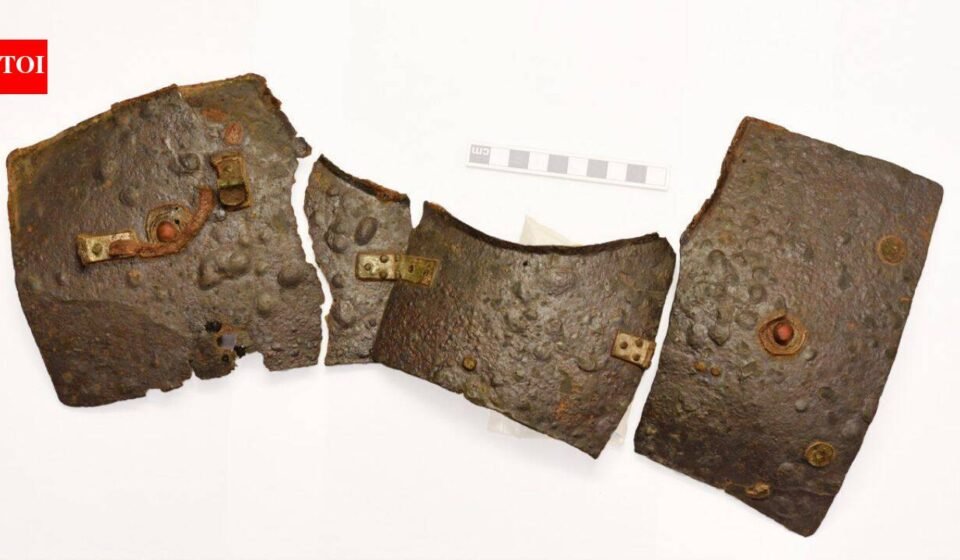
The armor emerged during excavations at Chalcrisis, a site widely associated with the Battle of the Teutoburg Forest in AD 9, when three Roman legions led by Publius Quinctilius Varus were destroyed in an ambush organized by Germanic forces led by Arminius.According to Arkeonews, the suit is among the earliest known forms of loricaegata and is made of overlapping iron plates connected by straps, hinges and buckles. Early discoveries of this type are incomplete and quite young, leaving many questions about how the first versions were actually built.What survived from Kalkris surprised experts. About thirty iron plates remain in place and only a few are believed to have been lost. Despite centuries spent in acidic soil, the bronze fittings, buckles and even traces of leather remain untouched. Archaeologists can study how the armor functioned as a complete system rather than as isolated fragments, revealing details that artistic depictions alone cannot provide.
The oldest Roman armor showed advanced engineering from the beginning
The discovery challenges the long-held assumption that first-generation segmented armor represented a simple prototype before later improvements by the Roman army.The Kalkriese example reportedly demonstrated sophisticated engineering from the outset. Its iron plates form a flexible shell around the torso while allowing movement, and its accessories display careful workmanship rather than experimental construction. Interestingly, this early design lacked the upper arm guards common on later Roman armor. Instead, the shoulders are arranged like a sleeveless garment, supporting the chest and back panel sections.Armor does not show a direct path to better equipment, but suggests that Roman military production developed in a different direction. Later versions appear to have simplified certain elements, perhaps making mass manufacturing easier as the empire expanded and needed to equip large numbers of soldiers.
CT scan reveals hidden Roman armor, but doesn’t damage it
When excavators first encountered the object in 2018, almost nothing could be identified from the surface. A dense block containing soil, corrosion and compressed metal measures approximately 1.25m x 1m and weighs close to 500kg. Immediately removing a single piece could ruin what’s left inside.Administrators lifted the entire block and transported it to the Fraunhofer X-ray Technology Development Center in Germany for industrial computed tomography. Approximately 1,500 scan images were collected over several days as the block rotated within the XXL CT scanner.The images show an almost complete protective suit hidden within the compacted mass long before any soil was removed. For nearly two thousand years, underground pressure has forced the overlapping plates closer together. The restorers then gradually exposed each section, working from the shoulder and chest plates outward while preserving as much of the original arrangement as possible.
Roman bindings found in armor raise new questions about captured soldiers
One of the most interesting features of the armor is an object near the neck and shoulder area. Archaeologists believe it was a Roman restraint device sometimes described as a neck fiddle, a device designed to immobilize a prisoner’s neck and hands.Its existence raises difficult questions rather than providing clear answers. One possibility is that the armor belonged to a soldier who survived the initial battle and was later captured by the victorious Germanic army, possibly restrained using equipment carried by the Roman army itself. Another explanation is that the two objects were later linked through battlefield looting or ritual deposition after the conflict.There is no evidence which interpretation is correct. Even so, the discovery adds a rare personal dimension to a battlefield typically represented by coins, broken weapons and scattered military equipment. More than just a demonstration of Rome’s military organization, the armor may also preserve the last traces of individual legionnaires from the collapse of Varus’ army, providing an unusually direct look at the realities of service in one of Rome’s most disastrous battles.