Archaeologists discover 1,500-year-old church near Zoroastrian worship site in Iraq | World News

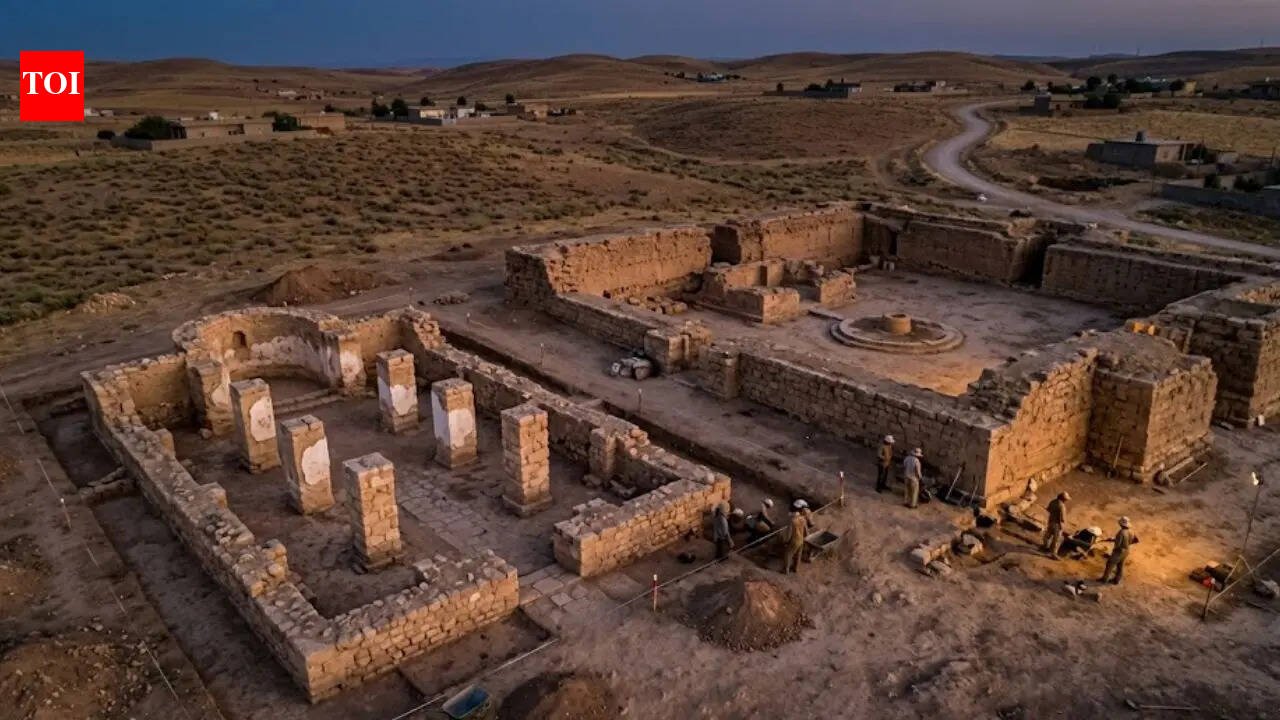
Archaeologists have discovered a 5th- or 6th-century church next to a Sasanian fortification in the Geld Qazaf region of Iraqi Kurdistan. The study was conducted by researchers from Goethe-University Frankfurt and the University of Erlangen-Nuremberg; as a study from Goethe-University Frankfurt points out, their findings provide strong evidence for the existence of religious pluralism in the fifth and sixth centuries AD.Due to the close proximity of Christian places of worship to Zoroastrian buildings, previous historians believe that Christians and Zoroastrians were at odds throughout the period. The excavations revealed three gondola pillars from a church and several pottery fragments with Maltese crosses, which provide insight into how different communities coexisted in rural Mesopotamia during the Sasanian period.
A church found next to a Zoroastrian place of worship
In 2015, the archaeological site of Gird-î Kazhaw was discovered; it includes a large complex of buildings that had been previously identified. Researchers found that the stone columns and brick floors corresponded to architectural styles used in early Christian worship services. The location of the site (adjacent to the Sassanid fortress) represents an area where early Christians coexisted with other faiths, including followers of Zoroastrianism in Persia.As a study from Goethe University Frankfurt points out, this archaeological find provides another example of the recent scholarly focus on rural settlements that provided the social and cultural basis for economic prosperity, rather than solely on imperial centers.
Evidence of Christian Worship Buildings
The research team concluded that the remains of the structure would be identified as a church based on identifiable archaeological features. Excavations revealed five square columns made of quarried stone that were only partially covered with white plaster; combined with an architectural plan showing a three-nave pattern, these features show strong evidence of early Christian church design in northern Syria and Mesopotamia. Another piece of evidence that religious worship took place at this site is the discovery of a piece of pottery decorated with a Maltese cross. This provides clear evidence for Christian worship at the site during the period when the five pillars were discovered. The combination of identified material culture may indicate that the site was an active site of Christian worship.
Tracing the religious and social evolution of Gird-î Kazhaw
This study is part of a larger project in the rural community of Shahrizor Plain. The researchers’ goal was to map the daily lives of workers, farmers, and followers outside the royal capital’s cities. Both the church and the Sassanid fortress later housed an Islamic cemetery, illustrating the cultural and religious evolution throughout northern Iraq over thousands of years. Future research will combine archaeology (archaeobotany and forensic anthropology) to understand the health, nutrition and infrastructure of the people who lived there.