
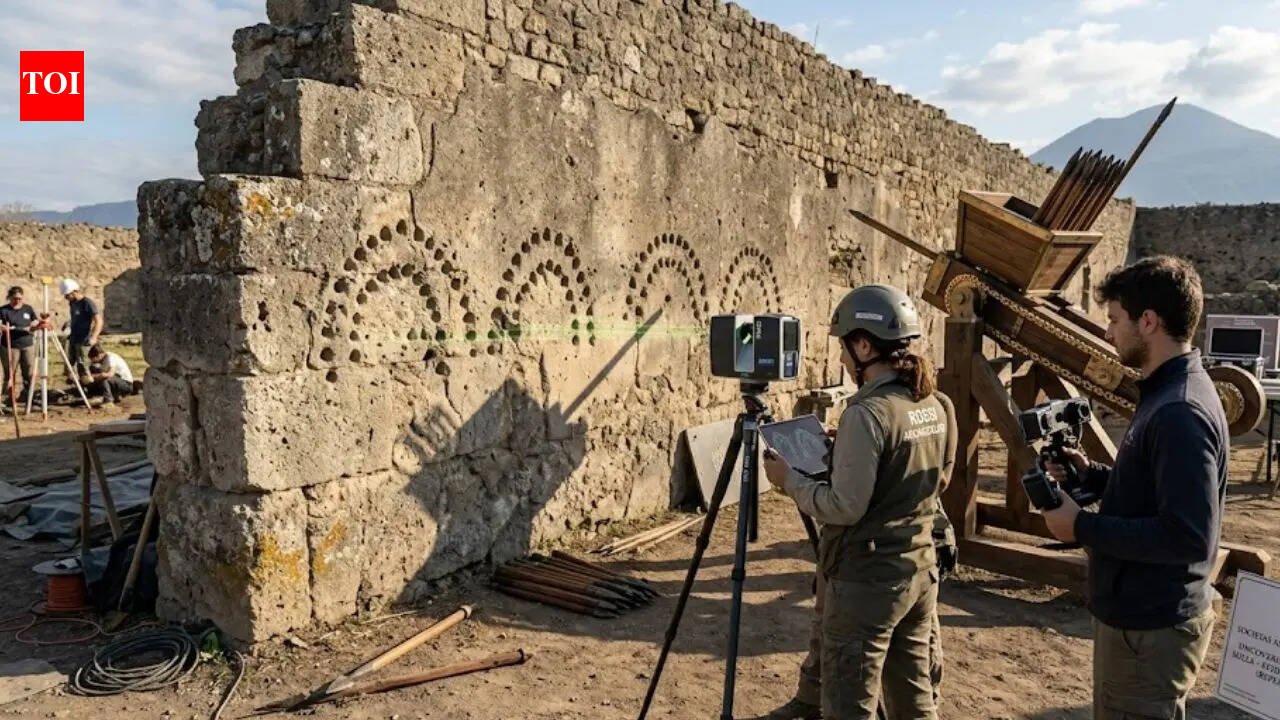
Archaeological excavations at Pompeii have focused on the violent eruption of Mount Vesuvius in AD 79; however, new investigations have turned the focus to the violence nearly 170 years ago. Lead researcher and team member Adriana Rossi used advanced laser scanning and 3D digital imaging to discover a variety of unique and identifiable ballistic signatures on the defensive walls to the north of the town. According to research published in MDPI, the presence of these specific patterns points to the use of polybolos (multi-shot or repeating catapults) during the siege of Pompeii, which have been described as the equivalent of ancient machine guns. Multiple projectiles embodied the revolution in chain-driven projectile firing in Hellenistic engineering and greatly advanced siege warfare in the Roman world.
An ancient weapon ‘machine gun’ discovered in Pompeii
Evidence of this ancient weapon, the “machine gun,” does not come from any physical component, but from “ballistic scars” on Pompeii’s limestone walls. The researchers found that the curved, tightly clustered craters were significantly different from the large, individual craters created by standard heavy catapults. These impact marks are located in the same arc-shaped cluster, indicating that the object was fired from a resting position, and that corresponding recoil or manual firing corrections may have resulted in a straight shot. It also shows the damage done when the Roman general Lucius Cornelius Sulla besieged Pompeii during the Social Wars (89 BC), as noted in the study “From Pompeii to Rhodes, From Survey to Source: The Use of Polybolus.” General Sulla likely acquired this technology through his campaigns in the Eastern Mediterranean and was therefore able to defeat Pompeii’s defenders.
Dobolo’s revolutionary mechanism
Polybolos was a masterpiece of engineering created by Philo of Byzantium in the third century BC. This device differs from traditional ballistae in that it does not require manual tensioning for each shot, but can be continuously reloaded and fired until the magazine is depleted. It used a flat chain (thought to be the earliest known use of such a mechanism in the world) attached to a winch.The Polybolos operator uses a handle to turn the winch while pulling the bowstring, dropping another bolt from the gravity-fed feed tray into firing position and releasing the firing mechanism, all in a single motion. Due to the multi-projectile design, a group of multi-projectiles can effectively suppress defenders on the wall and clear defensive positions on the parapets with rapid projectiles.
How high-tech scans identify Doppolo
The research team used high-resolution lidar (light detection and ranging) and digital photogrammetry to differentiate between types of shelling damage and natural erosion. The researchers were able to measure the depth, diameter and trajectory of each hole by creating an extremely dense three-dimensional lidar point cloud of the wall’s surface. The striking uniformity of Dobolos suggests they were fired by the same (and therefore mechanically consistent) machine rather than different (and therefore mechanically inconsistent) humans. The pattern of artillery marks suggested to the team that the multiple projectiles were likely fired from elevated wooden towers designed to fire on Pompeii’s defenders. This may explain why artillery fire was concentrated at high altitude points along the northern fortifications.