this congress The Left and Left parties will contest the upcoming West Bengal Assembly elections independently after the Congress party ended its partnership earlier this month. The move has sparked fresh speculation in the state, where politics is dominated by Chief Minister Mamata Banerjee’s Trinamool Congress party and its main challenger, the Bharatiya Janata Party.ALSO READ | Congress’s Bengal dilemma: Who should the old party target in 2026 polls – BJP or Mamata Banerjee?The decision marks another turning point for the two once-dominant forces, which now find themselves struggling for influence in Bangladesh’s increasingly bipolar political landscape. What prompted the Congress to go it alone? What does this split mean for the party and its now former allies?
Congress’ calculations
The Congress’s decision to go it alone has raised eyebrows given the party’s shrinking influence in West Bengal. Explaining his rationale, the West Bengal unit leader said the central leadership believes the party has nothing to lose by contesting as an independent.
The Central Committee believes that the party has nothing to lose, so we should fight this battle ourselves
Senior Congress leader in West Bengal
At the same time, the leader admitted that the contest will now be dominated by the TMC and the BJP.“The breakdown in our understanding with the Left has effectively left no room for the third pole in Bengali politics,” the leader told the Press Trust of India news agency on condition of anonymity.
This election is now almost entirely about the TMC-BJP axis
leader of west bengal congress party
With the alliance no longer in existence, Congress plans to focus on consolidating its own vote share rather than relying on alliance arithmetic.
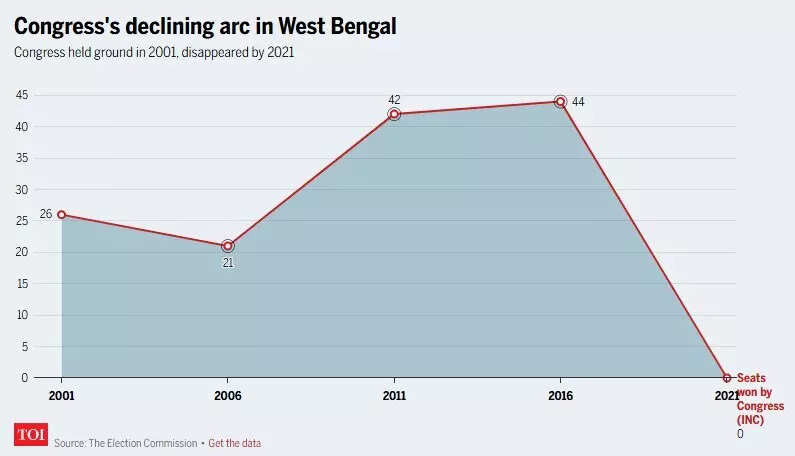
The arc of Congress party’s decline in Bengal
Political observers also noted the contrast between the party’s current national leadership and its previous leadership. They say the relatively conciliatory approach of current leader Subhankar Sarkar has made it easier for the central leadership to end the Left alliance. Former chairperson Adhir Ranjan Chowdhury, a former Lok Sabha MP and a prominent critic of Mamata Banerjee, put aside her differences with the Left to try to oust their common opponent.
The Left’s Response—and its Options
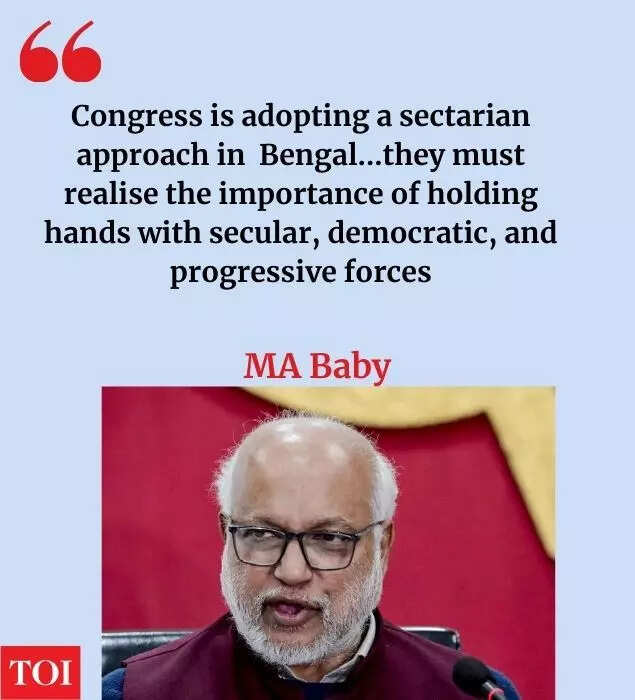
After days of silence, the Left responded to the Congress through senior CPI(M) leader Mabebi.ALSO READ | ‘Congress will suffer’: CPM’s Ma Baby on old party’s decision to contest Bengal polls alone“The Congress party is adopting a sectarian approach in West Bengal. We can work with them only if they realize the importance of joining hands with secular, democratic and progressive forces,” Babi said in Kolkata on February 13.
MA baby in Congress
He added that in the fight against “communal forces”, especially the BJP, the Left preferred to ally with like-minded parties, including the Congress, where feasible.Some left-wing leaders say the EU now intends to formalize all political arrangements – whether official or tacit. They added that this would give the group time to review candidate selections with allies before finalizing the list.Can Congress also have this understanding?
Will Congress’ exit affect the Left Bloc?
The absence of any future left-led alliance in Congress is likely to limit, if not significantly weaken, the group’s electoral influence. Political analysts say this is because a split could lead to vote dispersion, which would mainly benefit the TMC. Therefore, some form of underlying understanding between them cannot be ruled out.Meanwhile, the Left and Congress are direct rivals in Kerala, which is scheduled to go to polls around the same time as West Bengal. In 2021, the Left won a second consecutive term in Kerala, breaking the long-term pattern of alternation of power between the Left and the Congress every five years. There may be anti-incumbents in Congress after a decade of left-wing rule, so they think they have a realistic chance of taking back power.In this case, campaigning separately in West Bengal would allow both parties to avoid uncomfortable questions about Kerala. However, Bangladesh’s tacit understanding also shows that despite sharp political attacks on each other, there are no irreparable tensions in the two countries’ broader political relationship.
Congress and the Left: How archrivals became political allies
There is an old adage that politics makes strange bedfellows, often uniting opposing forces against a common enemy that is too difficult to deal with alone. For the Congress and the Left in West Bengal, that opponent is Mamata Banerjee.The rise of Banerjee and the TMC has pushed these two once dominant political forces to the fringes of Bengali politics. Since ousting the Left in 2011, the Trinamool has not only retained power but also expanded its dominance, crossing the 200-seat mark in successive parliamentary elections.
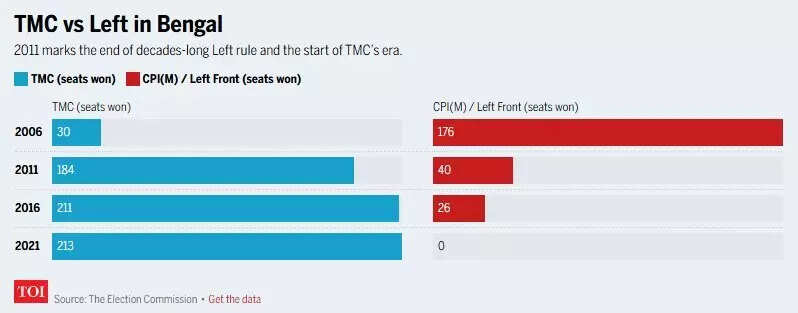
TMC vs Bengal left wing
That means the Congress and the Left have no choice but to join forces but will soon face a relatively new but rapidly expanding challenger in the Bharatiya Janata Party.In 2019, as the Modi wave swept the country for the second consecutive general election, the BJP’s seats increased from two seats in 2014 to 18 of the 42 Lok Sabha seats in West Bengal, while the TMC’s seats decreased from 34 to 22. The BJP won 77 seats in the 294-member state in the 2021 assembly polls, cementing its position as Banerjee’s main rival. The number of members on the committee increased significantly in 2016 from just three, although several of the lawmakers later defected to the ruling camp.
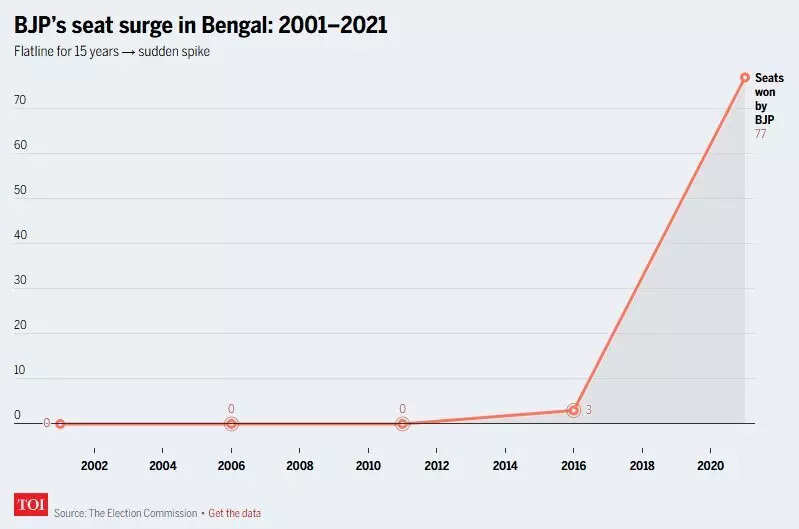
BJP surges in seats in Bengal
With the two major players entrenched, the Congress and the Left have been reduced to marginal players in a once-dominant contest.
Congress-Left Alliance: What the numbers say
The current breakdown in the Congress-Left alliance in West Bengal is not the first time. They parted ways in March 2019, on the eve of the Lok Sabha elections. They had come together again in December 2020, just months before the state went to assembly polls in March-April 2021, and now parted ways again.The Congress party last contested the West Bengal Assembly elections independently in 2006, winning 21 seats. In 2011, when it fought in alliance with the TMC, its numbers doubled to 42.The 2016 Assembly polls marked the first time that the Congress and the Left came together as official alliance partners. The Congress Party once again performed well, winning 44 seats, while its Left allies accounted for the remaining 33 seats won by the group.In 2021, the Indian Secular Front (ISF) secured the lone seat from the Left Front. The Congress party subsequently won the by-election, increasing the alliance seats to two.Taken together, these numbers suggest that the Congress-Left alliance has struggled to translate cooperation into meaningful electoral gains, except in 2016.
A double-edged sword?
The Congress party’s decision to contest in West Bengal alone is a bold but risky strategy. While even a second-place finish seems highly unlikely, the party is likely to aim to establish itself as the third-largest political force in the state. This may not translate into many seats, but it can be reflected in its overall vote share. On the other hand, there is a real risk of being pushed further to the edge.Polls are coming to decide the future of Congress and Left Front in West Bengal. These formerly dominant parties face a crucial test of their relevance, their voter base and their ability to reclaim a fraction of their past influence. The coming weeks will tell whether they can revive or continue to slide toward the fringes of state politics.