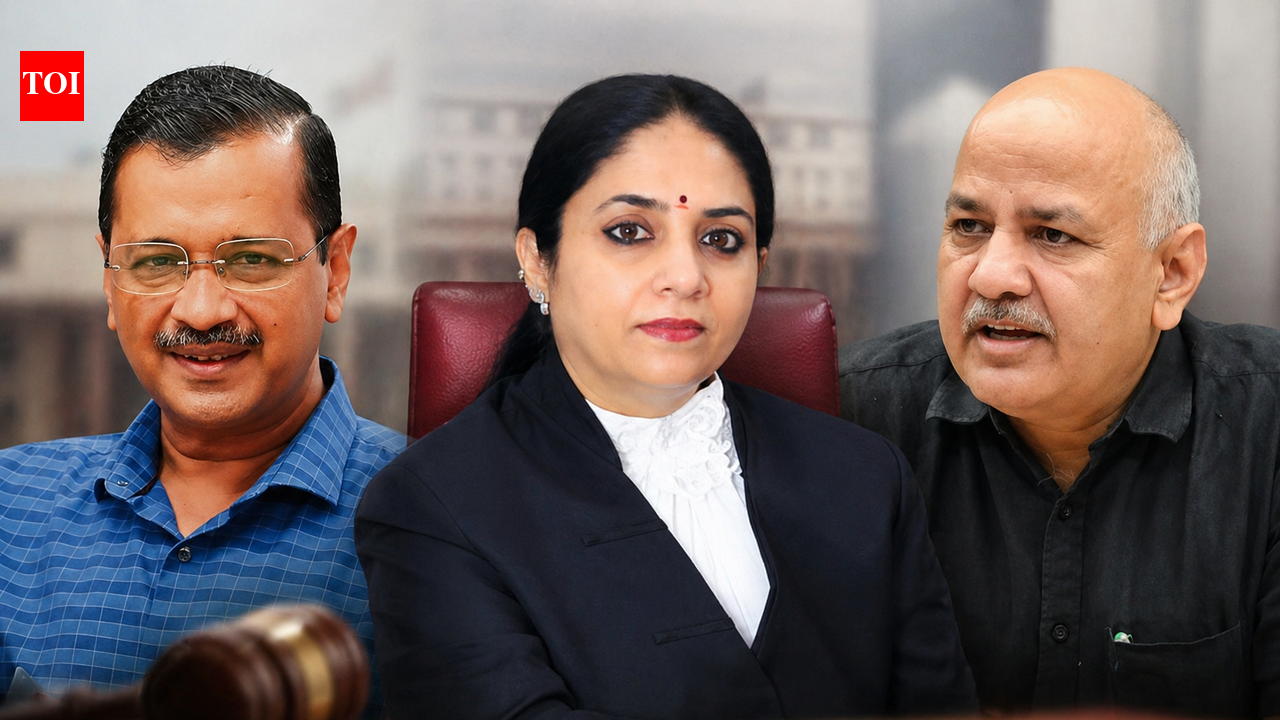

New Delhi: The legal battle over Delhi’s excise policy case has taken an unusual turn, Aam Aadmi Party leader Arvind Kejriwal Manish Sisodia refused to appear before Delhi High Court Justice Swarana Kanta Sharma. Controversy arose after court rejected KejriwalA request for the judge to recuse himself from hearing the matter.In a detailed order, the Delhi High Court strongly defended the independence of the judiciary and held that the allegations against the judges were not supported by evidence. The court said a recusal cannot be granted based solely on opinion, concern or suspicion, warning that such requests could undermine public confidence in the justice system.Also Read – ‘Hope for justice dashed’: Arvind Kejriwal refuses to appear in court, writes to Justice Swarana Kanta
Delhi High Court rejects recusal plea
Justice Swarana Kanta Sharma dismissed Arvind Kejriwal’s application asking her to recuse herself from the Delhi Excise Policy case. The court held that the defense failed to meet the legal threshold required for a reasonable understanding of prejudice. The statement said the accusations were “based on speculation and innuendo” rather than specific material.The ruling states that a party cannot seek to recuse itself simply because it believes a judge may not rule in its favour. The court noted that such defenses must be supported by objective facts. It also warned that allowing unsupported recusal requests would damage the court’s institutional credibility.Also Read – After Arvind Kejriwal, Manish Sisodia now ‘recuses’ liquor case hearing before Delhi High Court judge Swarna Kanta Sharma
Court says no evidence of bias
The High Court examined the allegations made by Kejriwal and found no evidence of bias. It emphasizes that a judge is deemed to be impartial unless the contrary is proved by clear and convincing material. The order says personal concerns or subjective fears are no substitute for legal evidence.“The application is unsubstantiated; it is defamatory, insinuations and casts doubt on my integrity, fairness and impartiality,” Justice Sharma noted. Accepting such claims without evidence would create a dangerous precedent, the court said. It also makes it clear that criticism of previous judicial orders or dissatisfaction with the proceedings cannot be considered evidence of bias.
American AP Association Opposition to judge’s family ties claim
Kejriwal and later Sisodia claimed a conflict of interest, claiming that Justice Sharma’s children were selected as lawyers for the central government. They argued that the situation raised concerns about fairness as the federal government was involved through the CBI and represented by Solicitor General Tushar Mehta.The High Court rejected that argument and said there was no direct link or “connection” between the judge’s family and the case. The court held that family members of a judge cannot be barred from practicing law simply because of their relationship to the judge.
The role of pub events has also been questioned
Another objection raised by Kejriwal related to Justice Sharma’s participation in an event organized by the Akhil Bharatiya Adhivakta Parishad. The AAP leader saw this as part of his concern over ideological neutrality in the matter.The court rejected this charge and clarified that judges regularly attend legal, academic and professional courses organized by several associations. Participation in such activities does not automatically equate to political affiliation or bias, the report said. Justice Sharma noted that no political statements, conduct or adjudicative actions were cited to support the claim of ideological bias.
Kejriwal refuses to appear in court
After his recusal plea failed, Arvind Kejriwal announced that he will not appear before Justice Sharma in the GST policy litigation either personally or through legal counsel. He said in a public statement that his “hopes for justice … have been dashed.”Kejriwal said he had come to a “clear conclusion” that justice must not only be done but also be done visibly, a principle that had not been met in this case. “My hope of justice… has been dashed. Following my conscience and following the principles of Mahatma Gandhi, I have decided not to appear before her again in this case,” he added. He also said he remained confident in the judiciary as an institution and could approach the Supreme Court over the recusal order.
Sisodia later launched a similar boycott
A day after Kejriwal’s announcement, former deputy chief minister Manish Sisodia wrote to the court saying that neither he nor any lawyer would appear on his behalf. This intensified the confrontation between AAP leaders and the high court.In his letter, Sisodia reiterated concerns over the judge’s family’s links to the central government’s legal team. “The future of your children lies in the hands of Tushar Mehta,” he said, adding that he had “no hope for justice.” Sisodia further said that he would follow the path of non-violent resistance.
Court warns against shopping on forums
The High Court order is a strong warning to litigants against trying to seek a preferred judge by making unsubstantiated accusations against him. Such practices could lead to delays and distort the judicial process, the report said.Justice Sharma noted that accepting a plea based on unsubstantiated suspicion would open the “floodgates” for forum shopping. The court also said that “parties shall not be allowed to refer judicial authorities to trial.” It stressed that the judicial process would be susceptible to manipulation if parties were allowed to avoid it by making accusations.Also Read – ‘You put the judiciary on trial’: Delhi High Court judge Swarana Kanta Sharma had sharp remarks as she dismissed Arvind Kejriwal’s recusal plea
Previous orders cannot be grounds for recusal
Kejriwal also cited the earlier orders passed by Justice Sharma on related issues of GST policy and argued that these decisions showed a pattern against the defendants. The court rejected this opinion.The High Court said that an adverse judicial decision could not constitute a basis for recusal. It states that if a party believes that an order is legally wrong, the remedy lies in appealing to a higher court rather than seeking to have the case transferred to another judge. The judgment emphasizes that judges often rule on contentious matters and that a party’s dissatisfaction with an early outcome cannot be seen as evidence of favoritism.
Political reaction fuels dispute
The legal confrontation soon spread into the political realm. Kejriwal, who is campaigning in Tamil Nadu with Chief Minister Stalin, initially said he had not read the detailed high court order and declined to comment broadly.However, the BJP launched a sharp attack on the AAP chief. Party leaders accused Kejriwal of trying to pressure the judiciary and turning the court proceedings into a political spectacle. The incident intensified partisan exchanges, with the AAP seeing it as a fairness issue and the BJP seeing it as an attack on institutions. As the case progresses, the dispute is likely to remain politically charged.
What is a consumption tax policy case?
The controversy stems from the now-scrapped Delhi Excise Policy 2021-22, which has been investigated by the Central Bureau of Investigation and the Enforcement Directorate. The case resulted in the arrests, resignations and protracted litigation of top AAP leaders.The trial court had earlier released Kejriwal, Sisodia and others in connection with the corruption case. The CBI challenged the decision in the Delhi High Court and referred the matter to Justice Sharma. With the recusal plea dismissed and AAP leaders announcing a boycott, the high court is expected to decide how the proceedings proceed.