

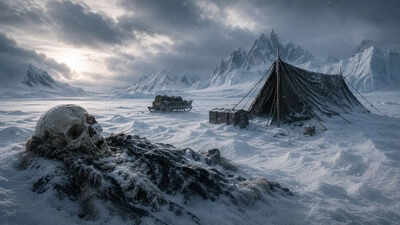
Antarctica is often described first in terms of numbers. Temperatures are well below what most instruments are designed for, wind can reduce visibility to zero, and distance can cloud judgment. People are still working here, measuring ice, running stations, delivering supplies in a blank white field that looks unchanged in weeks. Over the decades, some of those journeys didn’t end the way they planned. Some deaths are carefully documented, others are only partially understood, and still others remain inconclusive. The records left behind are spotty and often fragmentary, affected by weather, isolation and the difficulty of getting anything out once circumstances changed.
The unexplained remains of a young Chilean woman on Livingston Island and a gap in Antarctic history
The oldest human remains associated with the Antarctic region are not Can be found at any science camp or adventure base. They were discovered much later near the beach on Livingston Island in the South Shetland Islands because they had been exposed over time by moving ice and weather.It’s not just the age of the bones that puzzles archaeologists, but the identities behind them. This person was a young woman from southern Chile, far removed from any documented route that early seals took to reach this far south. There may be some gaps in the way she traveled, and even the most careful reconstructions can only circle the possibilities. Blockade ships, informal exchanges along the South American coast, the rough and often undocumented movement of crews in the early nineteenth century. Nothing is squeaky clean.There are no journal entries and no confirmed journal references. There were only ruins and a coastline that looked completely different than it does now.
The final march of the Scott Expedition: a journey where survival slowly became elusive
A British polar expedition led by Robert Falcon Scott reaches the South Pole, only to discover that another team has already arrived there. On the return trip, surviving accounts grew heavier, written in brief entries that became sparse with exhaustion.People walked across the ice one after another. An officer walks out of his tent and does not return, moments later becoming one of the most quoted moments in polar history. Others followed as the distance to the last warehouse shortened but remained out of reach for days.When search teams arrived months later, the last camp was still there, half-buried with bodies inside. They were left there, covered in snow, because there wasn’t much else to do in those conditions. The notes found in Scott’s diary read like they were written by a man approaching the edge of existence.
Dangers of traveling through Antarctica
Crossing the interior from the Antarctic station in mid-winter relies on heavy tracked vehicles and sleds, which often move blindly over a surface that looks stable but is not. In October 1965, the group was traveling near the Heimefront Mountains, crossing a patch of ice softened and covered by drifting snow.A crack suddenly appeared beneath their feet. The machine descended almost vertically, carrying three men. The sled behind suddenly stopped, leaving a man on the ground shouting into a gap that led straight into the deep ice.After a brief contact, a voice came from below. Then it disappears. Someone tried climbing down, gave up, and tried again. At some point, the reaction stops altogether.Cracks in the area may be deep enough that restoration, even with heavy equipment, becomes impractical. Later reports focused less on the fall itself and more on visibility, training and how little warning the ground sometimes gave.
Storms, ice collapse and supply chains disappearing in Antarctica
According to the BBC, in the early 1980s, three men were stationed on Peterman Island during winter travel and unstable sea ice. They crossed the river safely and settled near a hut that had been used by previous expeditions.It’s not what’s changed inside the hut, but what’s changed outside. Storm systems move through and reshape sea ice, breaking connections with the mainland. Initially, this was seen as a delay. Supplies were in place, radio contact was still working for a short time, and the situation in the area did not appear to be unusual.The ice then failed to reform as it normally would. As battery power weakens, the communication window narrows. The weather turned again and the islands were separated for longer than expected.From the base, observers could sometimes see movement and shapes near the cabin, but there was never a clear resolution. When the last scheduled radio check was missed, there was little immediate clarification. A search was carried out when conditions allowed, but the island had changed again. By then the sea ice had disappeared.
What did this continent retain and what did it give back?
The same pattern emerged in reports from Antarctic stations over different decades. Vehicles disappear into hidden crevices, teams become stranded due to sudden weather changes, and minor accidents become serious simply because rescue is far away.Even when recovery is possible, it is often delayed. Bodies may become temporarily buried in snow or ice and sometimes never be found again if the surface moves. In other cases, colleagues were given only partial accounts of what happened, pieced together from radio clips or written notes.Grief in that setting has its own limitations. There is usually no immediate return after death, nor is there a familiar ritual setting. Work continues around the issue, as parking is rarely an option in such isolated conditions.