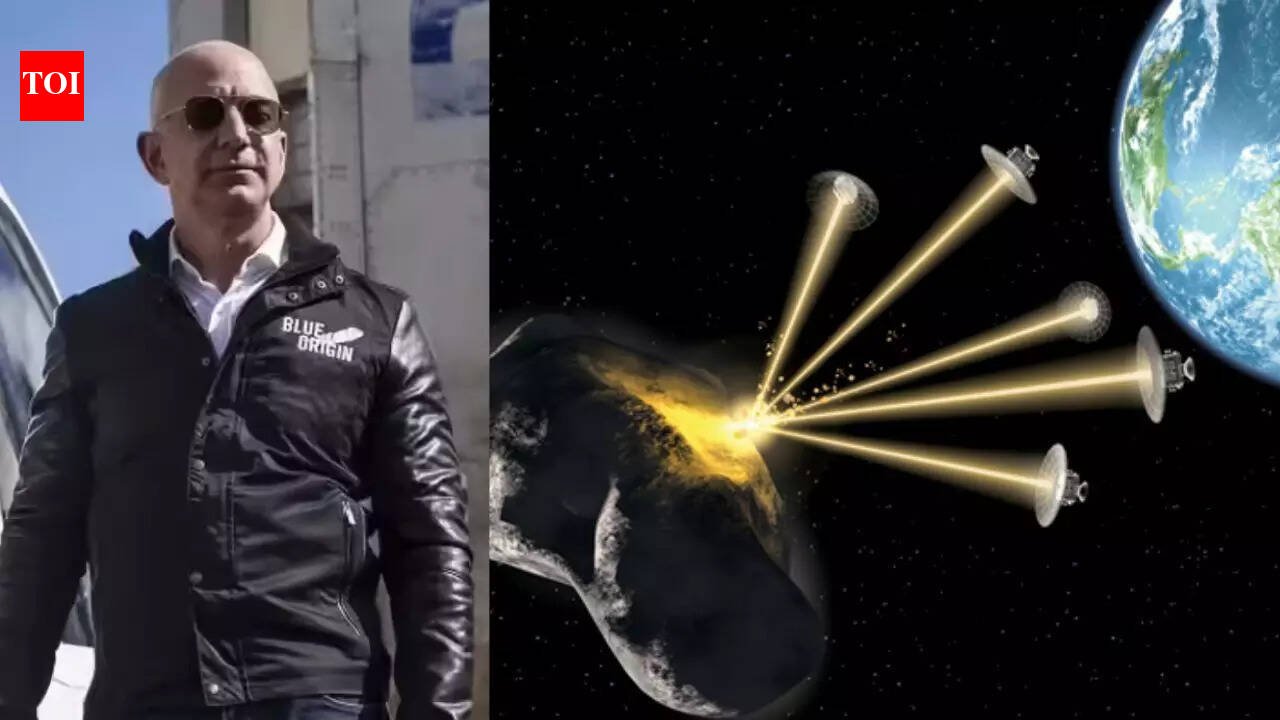
Jeff Bezos’ NEO Hunter mission could protect Earth from deadly asteroids: Inside the high-speed mission that could head off disaster |

Jeff Bezos’ company Blue Origin is working with NASA’s Jet Propulsion Laboratory and the California Institute of Technology to study asteroid deflection strategies. The program, known as the Near-Earth Object (NEO) Hunter mission, aims to incorporate asteroid detection and deflection capabilities into Blue Origin’s “Blue Ring” spacecraft platform. According to Blue Origin’s official press release, Blue Ring is a modular satellite bus capable of supporting payloads of up to 4,000 kilograms through 13 connection ports. The platform is designed to operate in low Earth orbit, geostationary orbit, cislunar space, Mars and other deep space destinations.
Jeff Bezos’ NEO Hunter asteroid deflection and detection mission
The primary goal of the NEO Hunter mission is to detect potentially hazardous asteroids. The mission will be conducted in two phases, depending on the size, speed and composition of the asteroid.In the first phase, NEO Hunter will deploy a CubeSat to rendezvous with a target asteroid. The satellites will collect detailed information about the asteroid, including its composition, mass, density and structural characteristics. These data will guide the selection of appropriate deflection strategies.One technology under consideration involves ion beam emitters, which would project streams of charged particles onto an asteroid to change its orbit over time.
Blue Ring: A flexible satellite platform for government and commercial missions
Blue Ring is a modular satellite platform designed for a variety of missions. It supports payloads of up to 4,000 kg and has 13 connectivity ports. The platform is already used in an orbital domain awareness sensor to be deployed in 2025 in partnership with Scout Space.The spacecraft is suitable for use in low Earth orbit, geostationary orbit, cislunar space, and missions to Mars or other deep space destinations. Its modularity enables it to support government and commercial missions requiring precision and flexibility.
Planetary Defense and Near-Earth Object Hunters Collaborate
Planetary defense has received attention due to the threat that near-Earth objects may pose. Astronomers have developed a database of known asteroids that are large enough to cause damage on a collision with Earth. These are monitored by NASA and other international agencies.The collaboration between Blue Origin, NASA and Caltech integrates commercial spacecraft into an overall strategy for planetary defense research and planning.