
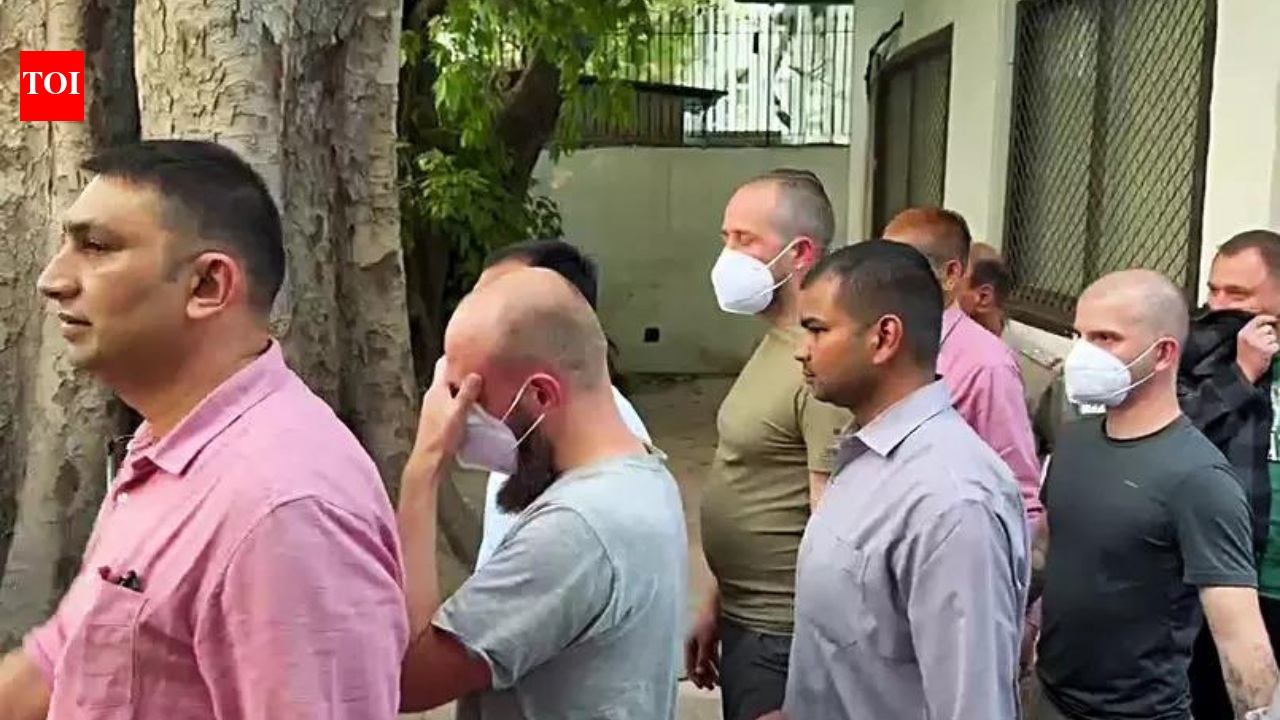
NEW DELHI: A Delhi court on Monday approved the 11-day police detention of six Ukrainians and a US citizen who were arrested for illegally entering Myanmar through India and for having links with ethnic war groups.Earlier, the national investigation agency arrested three Ukrainians from Delhi, three Ukrainians from Lucknow and a US citizen from Kolkata.According to the investigative agency, the defendants – Matthew Aaron Van Dyke, Hurba Petro, Slyviak Taras, Ivan Sukmanovskyi, Stefankiv Marian, Honcharuk Maksim and Kaminskyi Viktor – had direct contact with and were instigated by terrorists armed with AK-47 rifles.
polling
Do you think foreigners who enter conflict zones illegally should be punished more severely?
The agency also said the defendants had ties to ethnic armed groups and supported certain banned Indian insurgent groups by providing weapons, terror hardware and training.How did they get to Myanmar?According to AFP, the gang first entered Mizoram illegally without official permission. The seven men then allegedly entered neighboring Myanmar from Mizoram.They are also said to have shipped a large number of drones from Europe via India. However, the type of drone or its country of origin is unclear.Myanmar has descended into civil war after a military junta seized power in a 2021 coup, with pro-democracy guerrillas and ethnic armed groups fighting for control of much of the country.New Delhi has been suspicious of certain Myanmar factions who share the same ethnic group as the population on the Indian side of the border, fearing the spread of violence and unrest.Who is Matthew Aaron Van Dyke?Matthew Aaron Van Dyke is no stranger to controversy. The American adventurer-turned-filmmaker has gained attention for his work deep in conflict zones and working closely with rebel movements.Van Dijk first came into the spotlight during the 2011 Libyan uprising, when he fought alongside anti-Gaddafi rebels, The Guardian reported.Van Dijk was captured during the Libyan conflict and held for six months in Tripoli’s Abu Salim prison before escaping after the regime fell.Van Dyke describes himself as a “freedom fighter” and documentary filmmaker. He later appeared in Syria during the Aleppo uprising, where he said he was filming a documentary about the rebel movement.However, he also acknowledged that advising militants on weapons based on his own experience in Libya blurred the lines between observer and participant.His activities and self-presentation have drawn criticism from some observers, who accuse him of being a reckless thrill-seeker rather than a neutral storyteller.Critics argued that his involvement in combat situations compromised journalistic integrity and put others at risk.Van Dijk actively uses social media and crowdfunding platforms to promote his projects, aiming to create viral content that attracts global attention to conflicts such as Syria and provides support to rebel groups. Despite setbacks — such as the suspension of his Kickstarter campaign — he continues to work in a high-stakes environment.He insists that his efforts are based on the belief that conflicts like Syria are underreported and that impactful storytelling can influence public opinion and local support, although he acknowledges that there are significant personal risks involved.What did the court say?The court noted that the FIR contained serious allegations against the accused of traveling to restricted areas in Mizoram, illegally crossing the border into Myanmar and establishing links with ethnic armed groups and banned insurgent outfits. It also noted allegations that the defendants were involved in supplying weapons, providing training and assisting in drone-related operations.The court held that these aspects “certainly affect India’s national security and interests” and therefore held that the matter cannot be considered routine in nature.Additional Sessions Judge Prashant Sharma of Patiala House Court passed the order on March 16 in a case being probed by the National Investigation Agency (NIA).After reviewing the case diary, the court found that the investigation was still in its early stages but had shown progress in recent days. While reiterating that detention orders should not be passed mechanically, the court held that there was sufficient material to justify further police detention in this case.The court agreed with the NIA’s plea that the custodial interrogation was necessary to uncover the larger conspiracy, identify co-conspirators, trace the source of funds and analyze digital evidence including mobile phones and social media accounts. It also noted that revelations during preliminary interrogations pointed to a wider conspiracy involving cross-border activities and links to rebel groups.In an important observation, the court noted, “There is no reason to cast doubt on the manner in which the FIR was registered or the manner in which the investigation was conducted.”The court concluded that, given the seriousness of the charges, particularly those involving national security and cross-border links, it was reasonable to continue the custodial interrogation at this stage, while rejecting all objections raised by the defence.