

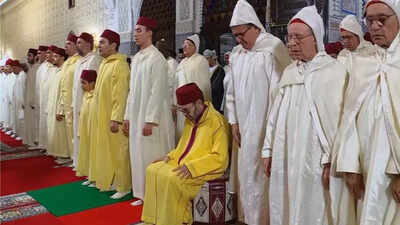
On Holy Night, considered the holiest night of the Islamic calendar, Morocco’s King Mohammed VI presided over a solemn religious vigil at the Royal Palace in Rabat, marking Rabat’s deep spiritual devotion. The ceremony brought together members of the royal family, senior religious scholars, government officials and diplomats to mark the night of power in the final days of Ramadan.The vigil reflects Morocco’s long tradition of celebrating Qadr with royal participation. As the “commander of the faithful,” a title traditionally held by Moroccan monarchs, King Mohammed VI plays a central role in leading religious ceremonies and promoting Islamic scholarship across the country.
Members of the Moroccan royal family attend holy vigil at Laylat ul Qadr
During the ceremony, the king was accompanied by several distinguished members of the Moroccan royal family, including Prince Moulay Hassan, Moulay Rashid and Prince Moulay Ahmed. Their presence underscored the symbolic unity between the Moroccan monarchy and the country’s religious traditions.The vigil began after Isha and Taraweeh prayers and included the recitation of sacred texts and religious readings by prominent Islamic scholars. One of the central moments of the ceremony was the formal completion of the recitation of the classic hadith collection Al-Bukhari, an important tradition in Moroccan religious rituals that marks the climax of Ramadan. The readings were led by respected Moroccan scholars, who also performed prayers seeking divine blessings for the Moroccan state and its leadership.
Approval Quran Scholars and students of Laylat ul Qadr
One of the highlights of the Laylat al Qadr vigil is the presentation of awards to recognize those who have made outstanding contributions to Quranic scholarship and religious education.King Mohammed VI personally honored young Moroccan Quran reciter Zaid El Bakkali, a 10-year-old student from Serre, who has shown extraordinary dedication in reciting the Quran. This recognition highlights Morocco’s efforts to encourage Islamic learning among younger generations and preserve traditional scholarship.Several prestigious national awards were also presented during the ceremony, including the Mohammed VI Award for Quranic Schools and the Mohammed VI Award for Quran and Hadith. Scholars and religious educators from cities across Morocco were recognized for their contributions to Islamic education, mosque leadership and Quran recitation. The awards reflect the Moroccan monarchy’s ongoing initiatives to support religious scholarship and preserve Morocco’s reputation as a center of moderate Islamic thought.
Laylat ul Qadr: The most holy night Islam
Laylat Al-Qadr, often translated as “Night of Power” or “Night of Destiny,” is widely believed by Muslims to commemorate the night when the first verses of the Quran were revealed to the Prophet Muhammad in the Cave of Hira near Mecca. The Quran describes this night as “better than a thousand months,” meaning that worship during Qadr brings great spiritual rewards. Since the exact date of this night is unknown, Muslims usually seek it out on odd-numbered nights during the last ten days of Ramadan.Across the Muslim world, millions of worshipers spend the night praying, reciting the Qur’an and invoking prayers in the hope of forgiveness and blessings. In Morocco, nights also carry deep cultural significance. Families often celebrate children who have completed their first fast during Ramadan, dressing them in traditional clothing and marking the occasion with special meals and family gatherings.
Morocco’s unique Ramadan traditions
The Qadr festival in Morocco combines religious beliefs with cultural celebrations. Children often wear traditional clothing such as jellaba, and girls may receive henna designs on their hands. Some families even organize symbolic ceremonies where the children dress up like the bride or groom as part of the celebrations.These traditions highlight the festive and collective spirit that accompanies the deeply spiritual observance of Ramadan in Moroccan society. The royal vigil in Rabat thus takes on religious and national symbolism, reinforcing Morocco’s identity as a country where the monarchy plays an active role in preserving Islamic traditions. The Qadr vigil at the palace attracted a large gathering of dignitaries, including senior government ministers, parliamentary leaders, royal advisers, senior military officials and members of the diplomatic corps representing a number of Islamic countries. Their participation reflects Morocco’s diplomatic and cultural ties with the Muslim-majority country and underscores the importance of the ceremony as a national religious event. Prayers are also offered for the late Moroccan monarchs Mohammed V and Hassan II, acknowledging the historical role they played in shaping Morocco’s modern state and religious institutions.Morocco’s monarchy holds a unique religious position within the country’s political system. As commander of the faithful, the king is seen as the protector of Islam and the guarantor of religious unity. The Moroccan government actively promotes moderate Islamic teachings aimed at combating extremism and strengthening religious literacy through initiatives such as Quran competitions, religious education programs, and imam training.The Laylat ul Qadr vigil thus represents not only a spiritual gathering but also a demonstration of Morocco’s broader attitudes toward religious leadership and cultural identity. After the ceremony, believers gathered together to pray for Morocco’s prosperity and stability, and to pray for God’s guidance and protection.For Muslims around the world, Qadr remains a deeply spiritual moment during Ramadan, a time of reflection, repentance and renewal of faith. In Morocco, a royal vigil led by King Mohammed VI is one of the most important national celebrations of this holy night. The event also serves as a reminder of the enduring connections between faith, culture and leadership in Moroccan society, with centuries of tradition continuing to shape modern expressions of the Islamic faith.