
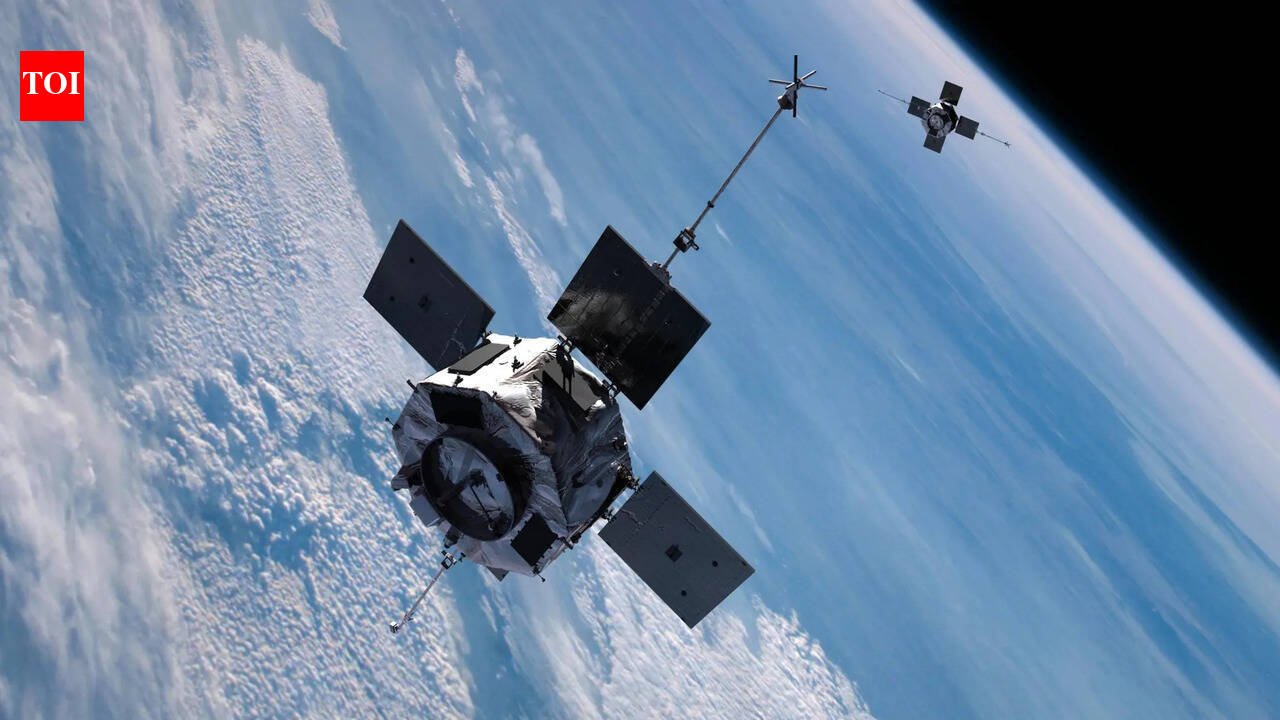
NASAVan Allen Probe A is a 600-kilogram satellite launched in 2012. After 14 years of studying Earth’s dangerous radiation belts, it is about to fall back to Earth. Amid “NASA satellite crash” headlines, fears of destruction grip the public, but experts insist the threat is small. Due to the intense friction, most of the spacecraft will burn up in the atmosphere, leaving little debris. NASA considers the risk to human life to be only 1 in 4,200, making it much safer than everyday hazards such as lightning strikes. Atmospheric drag from solar activity has accelerated this uncontrolled return, which is expected to occur around 7:45 pm EST on March 10, 2026, but there may be a 24-hour delay. The incident highlights the challenge of space debris in an era of booming satellite launches, and what would happen if they crashed to Earth?
NASA’s 600 kg satellite reentry Returns to Earth after 14 years in space
Launched in August 2012 as part of NASA’s Radiation Belt Storm Explorer mission, later renamed the Van Allen Probes, the two satellites detected Earth’s donut-shaped Van Allen radiation belts. These areas are filled with high-energy particles that threaten spacecraft and astronauts. Weighing 600 kilograms (1,323 pounds), Probe A outlasted its two-year design life by more than a decade, providing important data until it ran out of fuel in 2019. As NASA reports, active solar cycles make the atmosphere thicker, accelerating its decline ahead of the 2034 forecast. The U.S. Space Force is tracking reentry on March 10 at approximately 7:45 pm EST, with a 24-hour uncertainty due to orbital changes. NASA says most of them will burn at temperatures in excess of 1,600°C.
NASA satellite crash risk: How likely it is to cause harm
The anxiety over a “600kg NASA satellite crash” is understandable, but according to NASA and Space Force data, the chance of injury is 1 in 4,200 (0.02%). These factors include oceans covering 70% of the earth and low land density.The statement added: “NASA expects most of the spacecraft to burn up as it passes through the atmosphere, but some parts are expected to survive re-entry. The risk of harm to anyone on Earth is low, about 1 in 4,200. “Durable components such as propellant tanks or antennas may survive, but precedents such as Skylab’s 1979 crash or China’s 2020 rocket suggest that debris is scattered harmlessly, often into the ocean, and no injuries to the public have been reported, the BBC reported. Solar activity ensures clean, fuel-free deorbits that avoid space junk.
Why Van Allen Probes A Matters: The Legacy of Beyond Reentry
The legacy of Van Allen Probe A lives on after the dramatic re-entry of its satellite. It decodes the impact of solar storms on the radiation belts, guiding satellite shielding, GPS reliability, and missions such as Artemis. Republic World reports that “their findings could be critical for designing radiation-hardened electronics,” helping to protect power grids and space weather forecasting for communications. Prior to deactivation, the orbit was lowered for burnout to satisfy debris rules. Probe B lasts until at least 2030. NASA’s safety exemption for Probe A due to a slight elevated risk underscores trust in the model. Among the concerns of the Starlink era, it promoted the “Death Design” of disintegrated ships.
Satellite debris threat: wider context and preventive measures
The Van Allen Probes A case reflects a broader problem: more than 30,000 orbiting objects means 100-400 tons of objects are re-entered into orbit every year, but the probabilistic math suggests that damage is still rare. Space Force Squadron 18 and NASA’s Orbital Debris Program conduct real-time tracking. Public Advice: Not required. Speckled debris? Report it if you don’t touch it. This renewed push for giant satellite rules balances Van Allen-style victory with sky safety. The intense finale proves that space risks are subordinated to science, not panic; humanity continues to advance.