

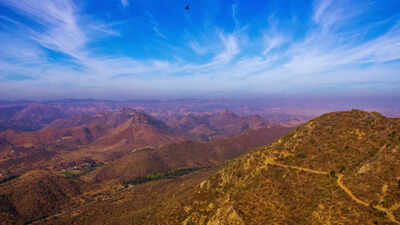
NEW DELHI: A 53% increase in built-up area in India’s Aravallis has led to a 13.8% increase in average annual soil loss between 2017 and 2024, even as forest cover in the country’s oldest mountain range increased during this period, a study has found.When researchers from OP Jindal Global University and Indian Institute of Technology Kharagpur assessed land use and land cover patterns between 2001 and 2021, they found that steep slopes, susceptible soils and mining areas were closely associated with erosion hotspots.Soil erosion is increasing in the Aravalli mountain system despite a significant increase in afforestation, highlighting the inability of local conservation efforts to compensate for large-scale land conversion, according to findings published in the journal Geography.Researchers say the Aravalis are pristine mountains with deep soils and intricate and delicately balanced ecosystems.The mountain range is one of the most mineral-rich mountains in India, containing a variety of metallic and non-metallic minerals. It is the cornerstone of India’s mineral resource base.The team analyzed medium-resolution data recorded between 2001 and 2020 to determine long-term trends, and selected high-resolution data from 2017 and 2024 to accurately measure erosion trends. They said the two years represented different current meteorological conditions.The study revealed “significant increases in overall forest cover over a broad range of spatial scales.”However, fine measurements reveal erosional processes and a dramatic increase in the built environment and subsequent depopulation of pastures and farmland.The researchers say the trend is similar to those seen in ancient mountain systems around the world.“LULC (land use and land cover) has changed rapidly, with the area of built-up areas increasing by 53%, while the area of pasture and cropland has decreased. These drivers have led to a 13.8% increase in average annual soil loss between 2017 and 2024, from 1.59 t/ha/year to 1.81 t/ha/year, while forest cover has increased over time, as shown in this study,” the authors write.Converting semi-natural vegetated surfaces to man-made, impermeable surfaces would have a direct negative impact on the land’s natural defense mechanisms, they said.The team added that the lack of forest would not affect the landscape, but downstream ecosystems would be affected through the disruption and transformation of the larger, stable land matrix.The study found that between 2017 and 2024, human-caused landscape erosion was accompanied by an increase in climate erosiveness.The authors say human activity and climate change are interdependent, with human activity increasing exposure and climate change increasing hazards that characterize the current degradation of fragile ecosystems around the world.“As a result, the average soil erosion rate increased by 13.83%, a direct and foreseeable impact,” they said.“These results highlight the fact that local conservation benefits, such as afforestation, may be overwhelmed by large-scale, unsustainable land conversion processes,” the team wrote.