Historic Apollo 11: What were the first words spoken on the moon? Inside the historic Apollo 11 conversations |

Imagine having a podcast and listening to what their first conversation sounded like during the 1969 Apollo 11 mission (marking a pivotal moment in space exploration). On July 20, Neil Armstrong, Buzz Aldrin and Michael Collins completed the impossible and set foot on the moon for the first time. This victory in the Cold War space race captivated the world and showcased American ingenuity. Perfect weather set the stage for liftoff from Florida’s Kennedy Space Center, and here’s what Neal, Aldrin and Collins had to say.
Kennedy speaks as tensions rise
The conditions were just right that midsummer morning. “The weather was perfect, with a southeasterly wind of 10 knots, temperatures in the mid-80s and cloud levels of 15,000 feet,” noted NASA in their Apollo 11 moon landing recordsCrowds of people gathered along the Florida coast, their hearts racing with anxiety. Yet in the cramped cabin atop the 363-foot-tall Saturn V rocket, the three astronauts remained calm. Their mission echoes the bold challenge President John F. Kennedy launched nearly seven years ago.according to Rice University In a speech delivered in July 1962, he wrote: “We choose to go to the moon and do other things during this decade not because they are easy but because they are difficult, because that goal will serve to organize and measure the best of our energies and skills, because this challenge is one we are willing to accept, one we are unwilling to postpone, and one we intend to win, as well as the others.” The deadline angered NASA, astronauts and the public. As in the August issue space sports magazineMichael Collins later reflected in 2014: “The deadline is the end of the century, and you can motivate people… to say, ‘We have to do this by the end of the century.'” This is a very powerful tool. Collins attributes this success to NASA’s generous budget and talented team.
Staying calm during Saturn V rocket launch
NASA’s flight surgeons reported that the heart rates recorded 36 minutes after launch were 110 for Neil Armstrong, 99 for Mike Collins, and 88 for Buzz Aldrin, which were only slightly higher than an adult’s resting heart rate of 60-100 beats per minute. Calmness under pressure defines these heroes.
First steps and words on the lunar surface
Four days later, Armstrong and Aldrin flew to the moon in the lunar module Eagle while Collins orbited above the moon. The descent captivated audiences around the world, especially as fuel was reduced. Armstrong used manual controls to avoid boulder-strewn terrain and find a safe spot.NASA quoted Armstrong as saying on the radio at 20:17 Coordinated Universal Time (UTC) on July 20, 1969: “Houston, this is Tranquility Base. The eagle has landed. “Houston’s Charlie Duke responded: “We’re copying you on the ground. You’ve got a bunch of guys about to turn blue. We’re breathing again.”Soon, Buzz joined him. “Beautiful view!” he exclaimed as he reached the lander’s broad pads. “Isn’t this something!” Armstrong agreed. “The scenery here is beautiful.”“It was desolate,” Aldrin said.Armstrong’s heart rate reached 150 bpm, the highest of any Apollo commander, but he described the landing as “very mild… It’s hard to tell when we’ll start. “
One small step for the moon, a leap for mankind
Six hours later, Armstrong descended the ladder. He quickly grabbed a lunar soil sample as a backup and stepped onto the lunar surface: “That’s one small step for mankind, one giant leap for mankind.”
“It has a distinct beauty,” he added. “It’s like most of the high deserts in the United States. It’s different, but it’s very beautiful here.” After the mission, Armstrong shared surprises: a close horizon and dust behavior with no atmosphere, no clouds, just sharp trails.Buzz Aldrin followed, carefully closing the hatch following a checklist. “I looked out the window and saw Neil walking down the ladder,” Aldrin recalled. “When it was my turn to exit, I remembered the checklist said to carefully return and close the hatch, being careful not to lock it.”
The Achievements of the Moon Walk: Words from Nixon
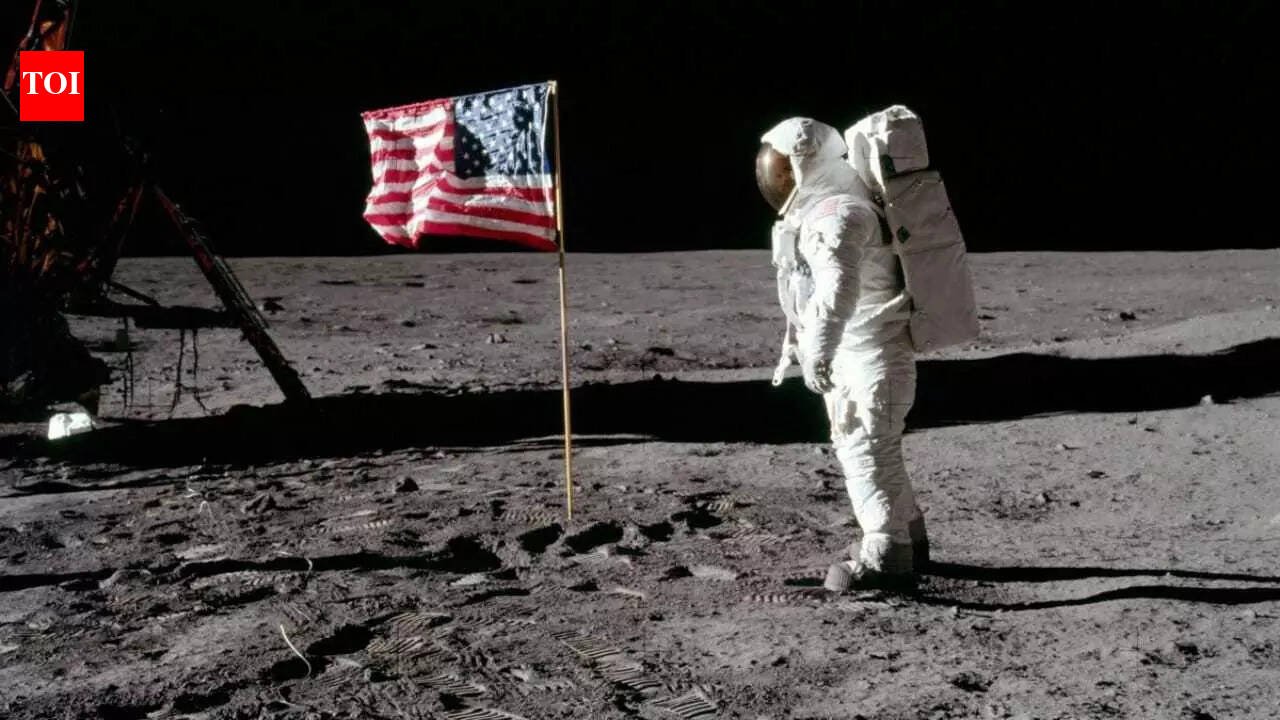
according to American Presidential ProjectThe pair then spent 2.5 hours outdoors, collecting 21.5 kilograms of moon rocks, planting an American flag and chatting over the radio with President Richard Nixon.“This is a priceless moment in human history,” Nixon said, smiling at the White House, “when all of us on Earth are truly one: one proud of what you have done, and one praying for your safe return to Earth.”Astronaut Edwin “Buzz” Aldrin Jr. walks near Eagle’s legs during an Apollo 11 extravehicular activity (EVA), as shown in a clip shared by NASA on the Apollo 11 logbook. It was captured by astronaut Neil A. with a 70mm lunar surface camera. Armstrong, commander of Apollo 11.Meanwhile, Collins orbited alone in the Columbia command module. “I’m the loneliest man in the entire universe, at least according to the newspapers,” he quipped. “I was actually happy to get behind the moon so mission control would shut up. And then I had some peace.”
trip home and splashdown
After staying on the ground for 21 hours and 36 minutes, Armstrong and Aldrin took off and docked with Collins. They splashed down in the Pacific Ocean 13 miles from the USS Hornet on July 24, 1969, 195 hours, 18 minutes and 35 seconds after launch. Bad weather moved the site 250 miles to ensure safety.To check for lunar bugs, the crew was quarantined for 21 days and eventually became icons. Their feat opened the door further for Apollo 12-17.
enduring legacy
Jim Lovell summed it up at the 2014 gathering: “The legacy of Apollo is that if you set your mind to something, get everyone together, everyone agrees we should get it done, and then we move forward, it becomes something we can all be proud of.”Armstrong died in 2012 at the age of 82, and Collins died in 2021 at the age of 90. At 93 years old (as of 2026), Aldrin remains the oldest living moonwalker, along with David Scott (91), Harrison Schmidt (88), and Charles Duke (87).The Apollo 11 moon landing inspired today’s dreamers, demonstrated audacious goals and united us.