
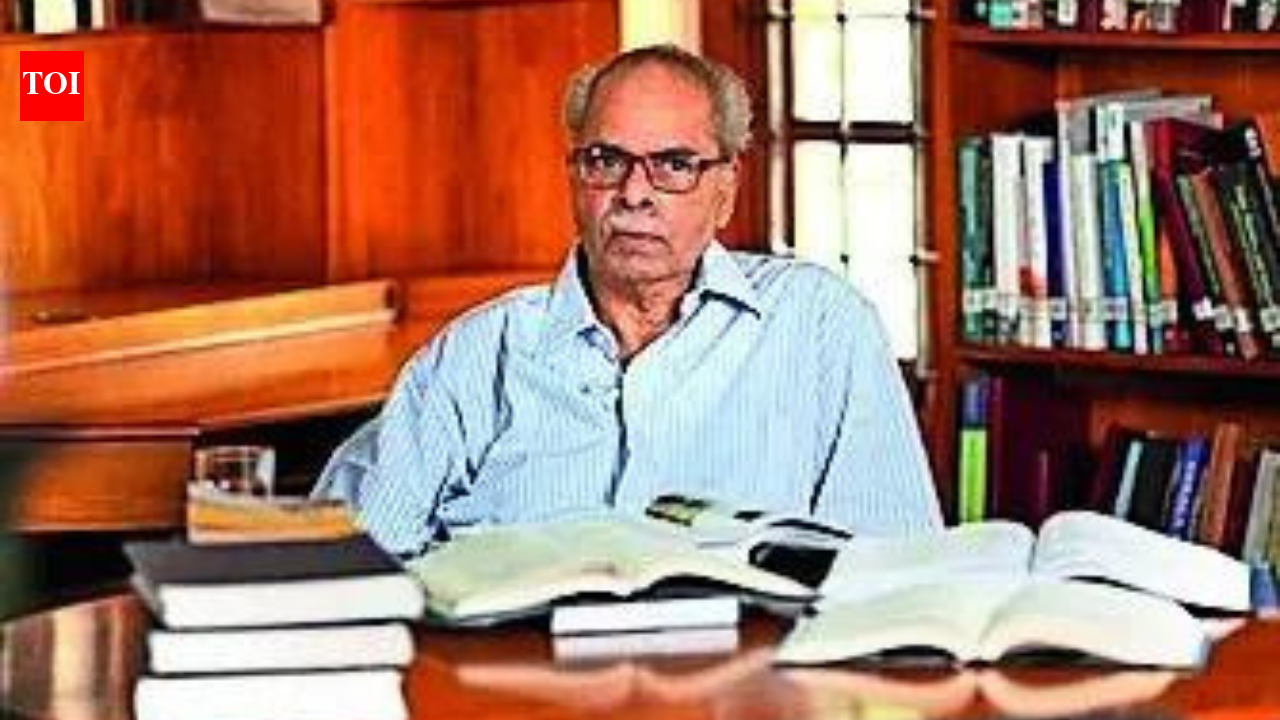
Noted left-wing historian K N Panikkar, who died at a private hospital in Thiruvananthapuram on Monday, criticized colonial historiography for its simplistic view of culture and highlighted how indigenous intellectuals provided an alternative paradigm of modernity. He turns 90 next month.Panikkar, fondly called KN by his colleagues, was one of a group of historians such as Bipan Chandra, Sabyasachi Bhattacharya and S Gopal who created a strong modern Indian history department at the Center for Historical Research at Jinan University.His courses on the intellectual history of nineteenth-century India were groundbreaking. “Panikkar taught it at a time when history writing was dominated by economic and political issues. Salil Misra, a historian of modern India, says that through his research he strives to argue for the centrality of culture as an essential component of human action and large political movements.Historian Rakesh Batabyal adds that Panikkar drew attention to the fact that the ideas of Akshay Kumar Dutt, Lokahitawadi and other 19th-century intellectuals did not need Western validation: they were themselves modern, giving us a sense that a new world was opening up to us. “As he discusses the intellectual tradition of Ayurveda, we begin to understand the complexity of Indian intellectual processes under colonialism,” he said.Modern Indian historian Aditya Mukherjee was both a student and colleague of Panikkar. “He gained a reputation as a great teacher while teaching in a college of Delhi University and was invited to join JNU in 1972. He was an excellent teacher who taught us about the social and religious reforms of the 19th century, making the subject come alive even for an economics graduate like me who had no historical background,” Mukherjee said.Born in Guruvayoor, Panikkar left Kerala after completing his undergraduate studies and went on to obtain his master’s and PhD degrees from the University of Rajasthan, where he later married his college classmate (late) Usha Bhargava. He is also the founding vice-chancellor of Sree Sankaracharya University, Kaladi.The historian’s books include Against Lords and State: Religion and the Peasant Revolt in Malabar. “He was a proud Marxist, but he dealt with issues that were seen as outside the mainstream of Marxist ideology, as seen in his seminal essay ‘Culture and Consciousness in Modern India,'” noted South Indian historian Mahalakshmi Mahalakshmi) said. Historian MG Sashibhooshan agrees. “I remember Panikkar accepting my request to present a paper on Pattanam at a historical conference, even though I knew that my views on Pattanam (Muziris) were different from those of Marxist historians”.Mishra recalled that Panikkar encouraged his students to oppose his views. “It was believed that he was more likely to reward different ideas with higher marks than those that simply matched his ideas. His class became a competitive space and he was not the only voice. Many other students proposed their own ideas and he enthusiastically supported them all”.