
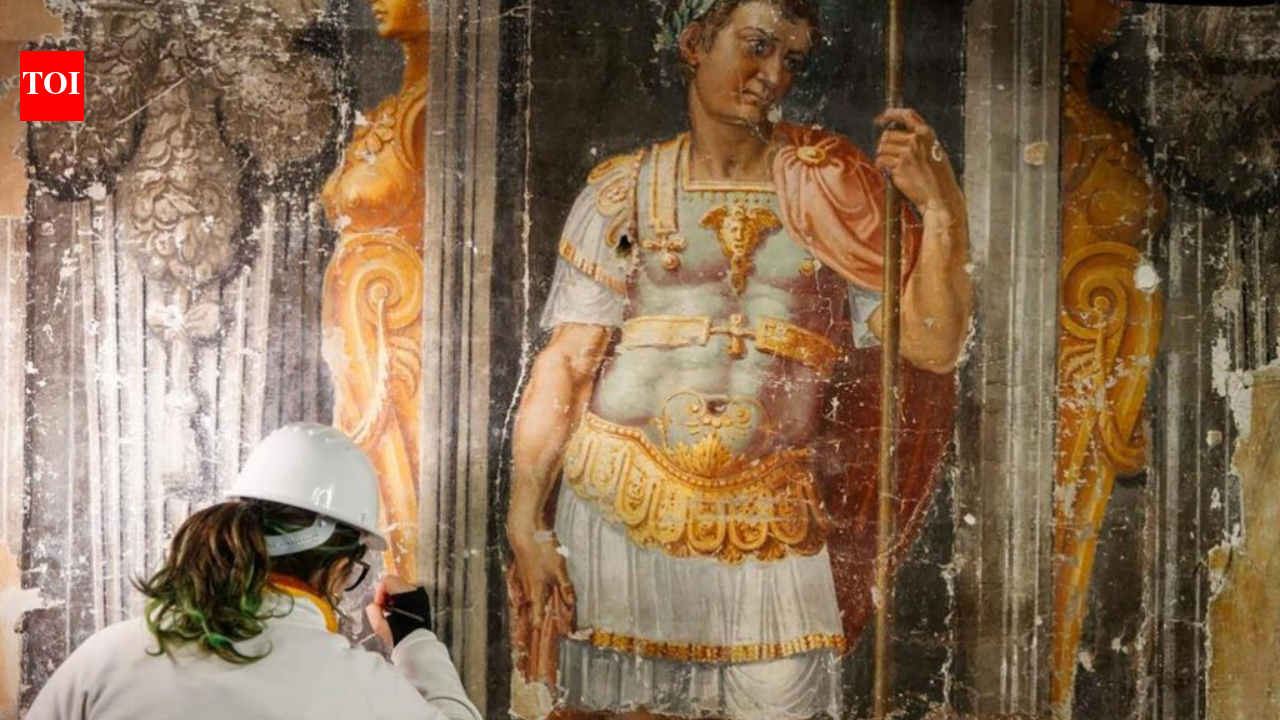
For nearly three centuries, layers of plain paint and plaster hid a remarkable secret inside one of Rome’s long-neglected Renaissance villas. Now, restorers peeling back those layers are bringing colourful scenes of gods, goddesses, soldiers and mythological figures back into view, as per a report by Smithsonian Magazine.The rediscovered artwork is inside Villa Silvestri Rivaldi, a sprawling 16th-century residence just a short distance from Rome’s Colosseum. The villa was acquired by Italy’s Lazio region for €25 million in 2024, and an extensive restoration is now revealing frescoes that had been deliberately covered after the property passed into the hands of a religious institution.The murals include nude and semi-nude figures from non-Christian mythology, which reportedly offended the nuns who occupied the villa from the 17th century. The paintings were subsequently plastered over, leaving the Renaissance artwork hidden for around 300 years. Today, conservators are carefully removing those later layers using techniques including laser cleaning and water-based methods. In some sections, the process has already revealed entire scenes that had disappeared from view for generations.
Frescoes hidden behind plain walls
A hidden Renaissance gallery re-emerges
The first serious attempts to uncover the paintings began more than two decades ago. Between 2002 and 2006, conservators carried out cleaning tests on parts of the walls after suspecting that older murals were hidden underneath.Those tests confirmed that significant artwork remained beneath the overpainting. But restoration could not proceed at the time because the villa was still owned by a religious order that did not have the funds required for the work, according to Paola Mezzadri, a conservator and restorer involved in the project.The situation changed after Lazio acquired the property in 2024.Restoration work has now moved into a more substantial phase, with teams stabilising the deteriorating building while simultaneously investigating and cleaning its historic decoration. The wider restoration project has been described as a roughly $40-million effort, including the property acquisition and work intended to give the complex a new public life.One of the most striking discoveries is in the Hall of Divinities. There, restorers have uncovered monumental figures of goddesses, depicted in vibrant oranges, yellows and greens. Some appear with flowing robes while others hold armour or weapons. The scenes offer a glimpse of the elaborate mythological decoration that once transformed the villa’s interiors.Researchers believe Prospero Fontana may have been responsible for at least some of the paintings. Art historians have also linked the decoration to Perino del Vaga, an important artist of the period and a pupil of Raphael’s circle. Drawings preserved at the British Library have helped researchers investigate the possible connection between Fontana and the frescoes.