Children in China’s Nizhuhe village trekked three hours up and down an 800 metre cliff to go to school; now two elevators and a cable car ride have reduced the journey to half hour

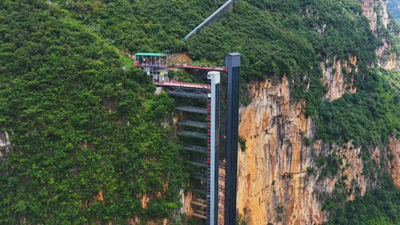
For years, going to school was a daily test of endurance for children living in Nizhuhe village in southwest China. Their route to the classroom involved steep mountain paths, narrow trails and an exhausting climb along the side of an 800-metre cliff. The journey could take nearly three hours, with children leaving home before sunrise and returning tired after a full day at school.Today, the same journey takes about 30 minutes, thanks to a combination of a shuttle bus, two cliffside elevators and a cable car system. The unusual transport network has turned what was once described as the most dangerous school commute into a safer and more predictable trip for students living in the remote mountain village.Nizhuhe village is located in Puli township in Xuanwei city, Yunnan province, near the border with Guizhou province. The village lies at the bottom of the Nizhu River Grand Canyon, while Guanzhai Village Primary School is located more than 500 metres above it. The school serves children from several nearby mountain communities, including Nizhuhe.Before the new transport facilities were introduced, children had to follow a rough trail carved into the rocky slopes. Some sections were extremely narrow, with loose gravel and steep drops. The most difficult stretches required children to climb using their hands, making the route particularly dangerous during bad weather or in the dark.For parents, the concern was not simply that their children had to walk for hours. The bigger fear was that something could happen on the way. Zhao Suzhen, the mother of 12-year-old student Lei Xin, recalled worrying about her son’s safety as he travelled along the cliffside path. Children had to complete the route regularly, regardless of the weather or the season.
Arrival of the ‘sky shuttle’
Safety and access remain central
For the children, the change is more than a reduction in travel time. It has removed the most hazardous part of their daily routine. Instead of climbing narrow paths along the cliff, students can now travel through a series of engineered connections before reaching the school.Lei, who had experienced the earlier route, compared the elevator ride to being carried through the sky. He calculated that the first elevator took around 90 seconds, while the new one completed its journey in approximately 57 seconds. His comments reflected how unfamiliar and extraordinary the experience remains for children who once had to depend on their own feet to cross the mountain.The project has also changed the relationship between the remote villages and the wider region. What was once an isolated canyon area has become more accessible to visitors. The elevators and cable cars have helped attract tourists, while residents have gained easier access to transport, services and economic opportunities. Daily visitor numbers reportedly rose from about 4,000 to 15,000 after Fuyao began operating. The added capacity has eased congestion while creating more opportunities for local employment in transportation, guiding, and hospitality.The development is part of a wider effort across China to improve school access in remote areas where rivers, mountains and difficult terrain can separate children from classrooms. In another part of Yunnan, students travel by ferry to reach school from villages located around reservoir areas. Local authorities have worked with schools, parents and transport officials to create more coordinated and safer transport systems for children.Nizhuhe’s solution is particularly striking because of the landscape involved. The elevators are built directly into the steep canyon environment, allowing children to travel vertically before crossing the gorge by cable car. The system does not remove the mountains or change the location of the village and school. Instead, it creates a new route through the difficult terrain.The project has also prompted discussion about the challenges of providing public services in remote settlements. For communities with small populations, building a separate school may not always be practical. Improving transport to an existing school can offer a way to connect children to education while also supporting residents and tourism.For the students of Nizhuhe, however, the most important change is simple: reaching school no longer requires a dangerous three-hour trek. A journey that once demanded physical strength, time and constant caution can now be completed in roughly 30 minutes.The cliffside elevators and cable car may have been introduced as part of a larger transport and tourism project, but they have become an important part of the children’s daily lives. In a village where geography once dictated how easily children could attend school, the new “sky shuttle” has made the route safer, faster and far less daunting.