Nepal farmers are losing up to 90% of their maize to monkey and wild boars; getting compensation can require 12 documents for a payout capped at Rs 10,000

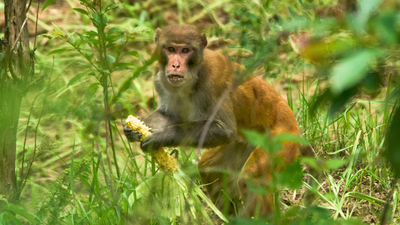
Nepal farmers are reporting substantial crop losses from wildlife, with rhesus macaques, wild boars and porcupines among the animals frequently entering agricultural fields. A 2026 study by the National Trust for Nature Conservation found that households surveyed across 44 local government areas lost an average of 50.3% of their maize production to wildlife, while maize losses reached up to 90% in Gandaki Province and 88% in Karnali. The government has a relief mechanism for wildlife-related crop damage, but farmers seeking assistance can be required to submit multiple documents and recommendations. Recent reporting says the process can involve 12 types of documents, while the maximum relief available for damaged grain or standing crops is Rs 10,000 (NPR), subject to the rules and assessment. Lawmakers have now called for a national plan to address rising wildlife-related crop losses.
Nepal farmers’ maize losses reached 90% in Gandaki
The National Trust for Nature Conservation, with technical support from Tribhuvan University’s Central Department of Zoology, surveyed 1,846 households across 44 local government areas in Nepal’s mid-hill regions for its study of problematic wildlife species. The research examined rhesus macaques, wild boars and porcupines, along with the economic effects of crop damage. It found that maize was the most widely cultivated crop and the most heavily raided among those studied. Households reported an average loss of 312 kg of maize a year, equivalent to 50.3% of their production. The study estimated the economic loss from maize at about Rs 2.5 crore among the surveyed households.The level of damage varied between provinces. The study recorded relative maize losses of up to 90% in Gandaki and 88% in Karnali. Rice losses reached 85% in Sudurpashchim, while wheat losses there reached 90%. The figures represent findings from the surveyed areas and are not a nationwide estimate that 90% of Nepal’s maize crop is being destroyed.
Monkeys are the most widely reported crop raiders
Rhesus macaques were the most frequently reported problematic animal in the NTNC survey. Some 98% of respondents identified monkeys as a problem, followed by porcupines at 67% and wild boars at 31%. Researchers also identified barking deer as secondary crop raiders, while leopards were reported as a major cause of livestock losses.Researchers directly counted 20,395 rhesus macaques in the 44 local government areas included in the study. They estimated that at least 104,137 rhesus macaques live across Nepal’s mid-hill region. Some troops recorded during the research contained as many as 198 animals.The wildlife involved also varies by region. The parliamentary motion filed in August said crop damage from monkeys, wild boars and porcupines was particularly severe in Bagmati, Gandaki and Sudurpashchim. Farmers in Koshi have reported damage mainly from monkeys and elephants, while communities in parts of Lumbini and Madhesh have faced damage from monkeys and nilgai, also known as blue bulls.
Farmers can apply for government relief
Nepal has a government mechanism for providing relief for damage caused by specified wildlife species. The current relief distribution framework has been in effect since July 2023 and covers 16 wildlife species, including monkeys and blue bulls, alongside species already covered under the earlier provisions.For wildlife-damage claims, farmers may have to provide multiple documents and recommendations. Recent reporting says the process can involve 12 types of documents. The documents and recommendations can include:
- Application from the victim or claimant
- Photographs of the damaged site or affected person
- Damage-assessment or site-verification report, known as a Sarjamin Muchulka
- Recommendation from the local ward office
- Recommendation from the relevant agriculture or veterinary office
- Land registration or land-ownership certificate
- Disability or death certificate, where applicable
- Health post or hospital recommendation, where applicable
- Medical bills, where applicable
- Post-mortem report, where applicable
- Police report, where applicable
- Relationship certificate with a deceased victim, where applicable
The documents required depend on the type of wildlife-damage claim. Not all of the documents listed above apply to every case. For crop-damage claims, photographs, damage assessment, local recommendations and land-ownership documents are among the requirements reported by Nepalese outlets.
Crop-damage relief is capped at Rs 10,000
The wildlife-damage relief guidelines provide a maximum of Rs 10,000 for damaged grain, based on an assessment of the loss. For standing crops, the maximum relief is also Rs 10,000, with the payment limited to once per seasonal crop. An individual can receive crop-related relief no more than twice a year.The guidelines provide relief rather than automatic reimbursement of the full value of a crop loss. The amount paid in an individual case depends on the assessment and the conditions specified in the relief framework.
Land ownership is part of the eligibility rules
The relief guidelines state that authorities can provide relief when wildlife damages crops planted on land with proper ownership documents. Farmers cultivating land without the required ownership documentation can therefore face difficulty qualifying for crop-damage relief.The National Human Rights Commission has examined this issue and recommended changes to allow relief for crops grown on traditionally used, unregistered land in certain circumstances. A parliamentary committee study has similarly highlighted land-title requirements as an issue in the relief system.
Sixteen wildlife species are covered
The current relief framework covers 16 specified wildlife species. They include nilgai, monkeys, elephants, rhinos, tigers, bears, leopards, snow leopards, clouded leopards, wolves, wild dogs or dholes, wild boars, wild buffalo, mugger crocodiles, pythons and gaur.Farmers in Madhesh have also reported crop damage from animals and birds that are outside the specified list. Recent reporting cited deer, peacocks and parrots among species for which local residents have sought inclusion in the relief provisions.
Crop damage is part of a wider wildlife conflict
Crop destruction is one part of a broader human-wildlife conflict affecting communities across Nepal. Government figures cited in recent reporting recorded 14,821 cases of human-wildlife conflict in Madhesh between mid-July 2024 and mid-July 2025, during which 134 people and 457 animals died.The NTNC study also found that wildlife affected several other crops, including rice, wheat, millet, potato, mustard, oranges and cardamom. Loss proportions for these crops ranged from 18% to 52% across the study areas, although some province-specific losses were considerably higher.
Lawmakers seek a national action plan
The issue reached Nepal’s House of Representatives in August 2026, when lawmakers filed a motion of urgent public importance calling for a comprehensive national action plan to address increasing crop losses caused by wildlife. The motion was proposed by Nepali Congress lawmaker Narendra Kumar Kerung and backed by lawmakers from several political parties.The motion says damage caused by monkeys and wild boars is affecting agricultural production, farmer incomes, food security and rural livelihoods. It calls for a national plan with clear deadlines, adequate funding and defined responsibilities for federal, provincial and local governments.The motion also asks the government to provide Parliament with a consolidated account of previous decisions, studies, spending, programmes and results related to the issue. It proposes that progress on the national action plan be submitted to the relevant parliamentary committee every three months.
A government task force is studying the problem
Nepal’s Ministry of Agriculture, Forestry and Environment formed a 15-member technical task force on May 18, 2026 to study human-wildlife conflict. The task force includes representatives of government agencies, conservationists and researchers. Its responsibilities include reviewing previous studies, existing policies, institutional arrangements, relief and compensation systems and earlier management efforts.The task force has been asked to recommend short-, medium- and long-term measures for preventing and managing conflict involving monkeys, wild boars, blue bulls and porcupines.
Parliament is examining a national strategy
The Agriculture and Natural Resources Committee of Nepal’s Parliament has also been examining a technical report prepared by the task force. The report is titled “A Brief Technical Report on Addressing Human-Wildlife Conflict in Nepal: A National Strategy for Conflict Management, Mitigation and Coexistence.” The committee scheduled a discussion on the report on August 18, 2026.The discussion places the existing relief system alongside broader measures for conflict management and coexistence. The national strategy is being considered as wildlife-related crop damage continues to be reported across multiple provinces.
Nepal has introduced wildlife-risk insurance
Nepal has also introduced a wildlife-risk insurance policy covering human and property losses caused by wildlife attacks. The Nepal Insurance Authority approved the policy in July 2026, with implementation beginning from July 17.The policy has an annual premium of Rs 1,500 and covers 18 categories of wild animals. According to details reported by the insurance sector, coverage includes up to Rs 1 million for death or permanent disability, Rs 500,000 for temporary total disability, Rs 100,000 for serious-injury treatment and Rs 20,000 for minor-injury treatment.The policy also covers property damage up to Rs 500,000, livestock losses up to Rs 100,000 and agricultural crop damage up to Rs 50,000. The 18 categories covered include elephants, rhinos, tigers, bears, leopards, jackals, deer, wolves, wild dogs, wild boars, crocodiles, Indian bison, pythons, nilgai, monkeys, langurs, blackbuck and orphaned animals.
The conflict is spreading across agricultural landscapes
The latest research and government discussions show that wildlife-related crop damage is occurring across several different agricultural regions rather than being concentrated around a single protected area. The NTNC study identified Bagmati, Gandaki and Sudurpashchim as areas where multiple crop-raiding species frequently occur together, while the parliamentary motion highlighted different combinations of wildlife in Koshi, Lumbini and Madhesh.For farmers, the reported losses include staple crops such as maize, rice and wheat as well as commercial crops. Nepal’s response is now developing along several tracks, including the existing relief system, a technical review of wildlife-conflict management, parliamentary consideration of a national action plan and the introduction of wildlife-risk insurance.