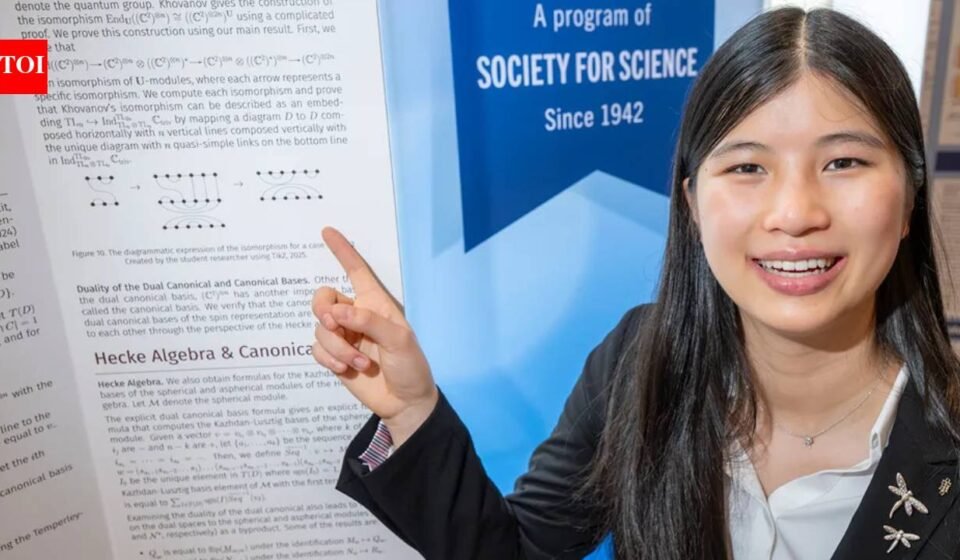
Meet Rachel Chen, the 18-year-old Los Angeles student who expanded a 1997 quantum-math idea to describe entire particle systems with simple diagrams; she won $100,000

At just 18, Rachel Chen has taken a decades-old mathematical idea and expanded it into a visual framework for understanding complex quantum systems, earning her a $100,000 award in the 2026 Regeneron Science Talent Search.Chen, a student at Marlborough School in Los Angeles, California, won fourth place in the prestigious competition for her mathematics project, titled The Dual Canonical Basis in the Spin Representation via the Temperley-Lieb Algebra.Her research builds on a 1997 mathematical finding involving Temperley-Lieb diagrams – simple point-and-curve illustrations that can be used to represent aspects of quantum systems.Chen’s work extends that approach to describe how an entire system of quantum particles behaves under the influence of a magnetic field, potentially giving researchers a more intuitive way to examine relationships between different quantum-mechanical states.
How Rachel Chen turned complex quantum physics into diagrams
Quantum mechanics is notoriously difficult to represent mathematically because particles can interact with one another and their surroundings in complicated ways.Chen’s project focuses on the spin representation, a mathematical framework used to describe the spin states of multiple particles.As she explains in her project presentation, a single electron has two possible spin states – up and down. Quantum superposition means that its state can be represented as a combination of those possibilities rather than simply one or the other.The mathematics becomes considerably more complicated when multiple electrons interact.Chen describes the spin representation of a system of n electrons using repeated tensor products of the complex plane, creating a structure that becomes increasingly difficult to visualise as the number of particles increases.Her research asks a deceptively simple question: Can that complicated mathematical structure be represented in a more visual and accessible way?Her answer involves the Temperley-Lieb algebra.
What are Temperley-Lieb diagrams?
Temperley-Lieb diagrams use points arranged along parallel lines and curves connecting those points.Although the diagrams look relatively simple, they can encode sophisticated mathematical relationships. According to Society for Science, researchers in mathematics and physics use Temperley-Lieb diagrams to study concepts including phase transitions and mathematical knots.Chen demonstrated that these diagrams can form a basis for the spin representation, effectively providing building blocks through which the complicated quantum system can be viewed.She went further by showing how the diagrams relate to a particularly important mathematical structure known as Lusztig’s dual canonical basis.
A new explicit formula
One of the significant aspects of Chen’s project was her work on the dual canonical basis.According to her presentation, there had previously been no explicit non-inductive formula for this basis of the spin representation.Using her diagrammatic approach, Chen developed what she described as the first explicit formula for the dual canonical basis of the spin representation.She also used the visual framework to revisit known classical results, demonstrating that the diagrammatic perspective was consistent with existing work before using it to derive new results.Her research additionally examined the Hecke algebra, a related mathematical object, and provided a new axiomatic description of the canonical basis of the spin representation.
Making complicated quantum systems easier to visualise
The potential importance of Chen’s work lies not simply in creating attractive mathematical diagrams, but in using them to simplify the way researchers can think about highly complicated quantum structures.Society for Science said her approach could provide an intuitive framework for understanding the structure and connections among different quantum-mechanical states.Chen also extended the ideas from her project into additional work involving multiple-electron systems.In her presentation, she explained that her diagrams can be used to show explicitly how a system containing multiple electrons can decompose into multiple single-particle systems.That could provide another way to analyse complicated electron systems by breaking them down into simpler components.
From mathematics competition to $100,000 award
Chen’s achievement came at the 2026 Regeneron Science Talent Search, one of the United States’ most prominent competitions for high school seniors conducting original scientific research.The 2026 competition attracted more than 2,600 entrants, with 40 finalists competing for more than $1.8 million in awards.Chen ultimately secured fourth place and $100,000 for her research. The Society for Science specifically recognised her for developing a concrete, visual way to describe systems of many quantum particles using Temperley-Lieb diagrams and expanding on the 1997 finding.The top prize went to Connor Hill, while Chen ranked fourth among the 2026 finalists.
Rachel Chen is also an internationally ranked chess player
Chen’s interests extend well beyond advanced mathematics and quantum physics.At Marlborough School, she founded the school’s math club, which has grown to more than 100 members, and she plays volleyball.She is also an internationally ranked chess player and won her age group at the Pan-American Chess Festival in 2022. She serves as Contests Director for Athemath, a nonprofit focused on building a community for girls interested in mathematics.And despite working on highly complex mathematics, Chen has a decidedly pop-culture side: she is a devoted Taylor Swift fan and has memorised the words to more than 200 of the singer’s songs.Her unusual combination of interests – from quantum mathematics and chess to volleyball and Taylor Swift – has helped make her one of the more distinctive young researchers recognised by this year’s competition.