

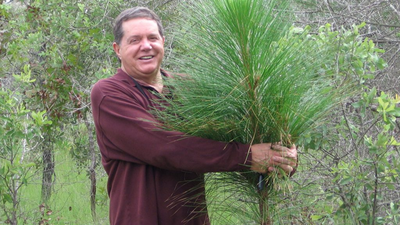
He is 85, known as the father of sociobiology, has been at Harvard for 60 years, and has won a hundred scientific awards, including two Pulitzer Prizes. Yet what E.O. Wilson, an evolutionary biologist, is focused on is a new conservation approach, a new ecological Grail which is a quest to refute conservation sceptics who think there isn’t enough left of the natural world to be worth saving, according to a report by Smithsonian Magazine.Through the 544 million years or so, since hard-shelled animals first appeared, there has been a gradual increase in the number of plants and animals on the planet, despite five mass extinction events. While the high point of biodiversity most likely coincided with the moment modern humans left Africa and spread across the globe, over the years, species faltered and vanished. It was slow at first, but now, the event is taking place at an acceleration where Wilson predicts the oncoming of a “biological holocaust,” a sixth mass extinction event, caused by humans. According to him, the only way humans could prevent a mass extinction crisis would be to set aside half the planet as permanently protected for the ten million other species.While one would believe this to be a fantastical dream inspired by a dreamer, a forest being created by M.C. Davis, a multimillionaire, is already on the pathway. Davis’s idea has been to revive the ‘Piney Woods’, the signature ecosystem of the American Southeast. The longleaf pine forest once covered 90 million acres, or about 60 per cent of the land, in a virtually continuous 1,200-mile stretch across nine states from Virginia to East Texas.That forest has been reduced by 97% and there are about three million acres of it left. The coral reefs have been destroyed by about 10-20% and the Amazon rainforest has been damaged by more than 20%. The longleaf pine forest’s “Big Cut,” as it’s still known, began after the Civil War and left behind what commentators referred to as “a sea of stumps.” Much of the land has since been reforested, but de-longleafed, and is now planted with row after row of faster-growing pines raised for pulpwood.Davis, who is a commodities trader in timber and oil and gas rights, and grew up about 65 miles west of his forest, has spent the past decade spending half a million dollars annually planting longleaf pine trees and another half million on other parts of a longleaf forest.His awakening for the cause came from a ‘Black Bear Seminar’ that he walked in on while being stuck in traffic. “There was an old drunk, and a politician who’d thought there’d be a crowd, and a couple of Canadians looking for day-old doughnuts and coffee—and, up on the stage, two women talking about saving black bears. They were riveting. The next day I gave those ladies enough money to keep going for another two years, which I think scared them, it was so out of the blue. Then I asked them for a 100-book environmental reading list for me, for my education. I spent a year reading Thoreau, John Muir, and Ed Wilson. Then I started buying up land to see what I could do,” he told the outlet.