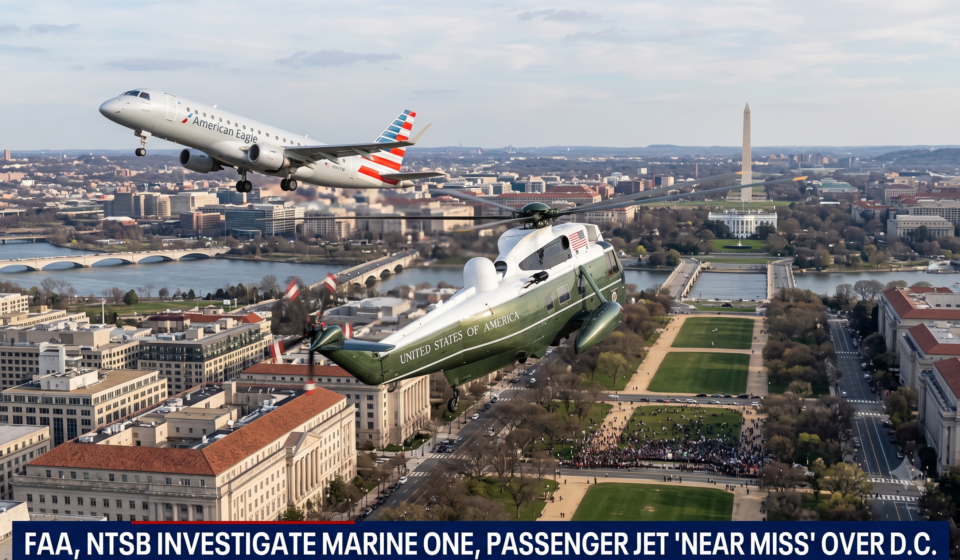

WASHINGTON — Federal aviation officials have launched formal investigations after President Donald Trump’s Marine One helicopter and a commercial passenger jet flew closer to each other than safety regulations allow over the nation’s capital.
Both the Federal Aviation Administration (FAA) and the National Transportation Safety Board (NTSB) confirmed they are reviewing the incident, which occurred Tuesday afternoon as Marine One departed the White House for Joint Base Andrews.
What Happened Over Washington
According to official flight records and air traffic audio:
- The Takeoff:Marine One lifted off from the White House Ellipse around 2:33 p.m. local time, carrying President Trump for the first leg of a trip to Los Angeles.
- The Commercial Jet:At roughly 2:34 p.m., Envoy Air Flight 3742—an Embraer E170 regional jet operated for American Airlines—took off from nearby Ronald Reagan Washington National Airport bound for Pensacola, Florida.
- Loss of Separation:The two aircraft passed within less than a mile of each other, triggering what air traffic regulators define as a “momentary loss of separation”.
Standard security protocols typically require controllers at Reagan National Airport to pause commercial takeoffs and landings whenever Marine One flies through the area.However, commercial departures briefly continued after the helicopter’s lift-off.
Communication Issues
Air traffic control audio recordings revealed that Marine One pilots attempted three times to notify controllers at Reagan National that they were three minutes away from departure.
The tower controller responded that one of the radio messages was “broken and unreadable”.Moments later, as the helicopter announced its departure, the controller warned the crew about the passenger jet already taking off.The Marine One pilots acknowledged seeing the jet, held position briefly, and then proceeded safely to their destination.
Official Responses
“Based on our preliminary safety review, there was momentary loss of separation after which the aircraft continued to move away from one another. The air traffic controller was in contact with both the commercial pilot and Marine One pilot during the loss of separation. The President was never in danger.”
— Federal Aviation Administration (FAA)
White House spokesperson Kush Desai reinforced the statement, noting that Marine One is flown by top-tier aviators and that the president was not in harm’s way at any point.Marine Corps officials also described the flight as routine.
The NTSB and FAA said their investigations are ongoing to determine why commercial flights were not paused and what corrective measures may be necessary to prevent similar airspace close calls.